
Las Mobili
There is a particular quality that the best executive desks share — and it has nothing to do with price. It is the quality of not needing to be noticed. The desk that earns a second look from a client without the occupant ever mentioning it. The one that a visiting partner clocks in the first three seconds and files away as evidence that the person behind it knows what they're doing. This quality is not achieved by choosing the most impressive option available. It is achieved by choosing correctly — the right proportions for the room, the right material register for the person, the right finish that holds its character at year ten as well as year one. Italian executive desks — and their designer, modern and classic readings — made by producers who have been getting these decisions right for decades tend to have it. The ones made by producers optimising for the catalogue photograph tend not to.
Italian executive desks, specified to your requirements and delivered across the UK.
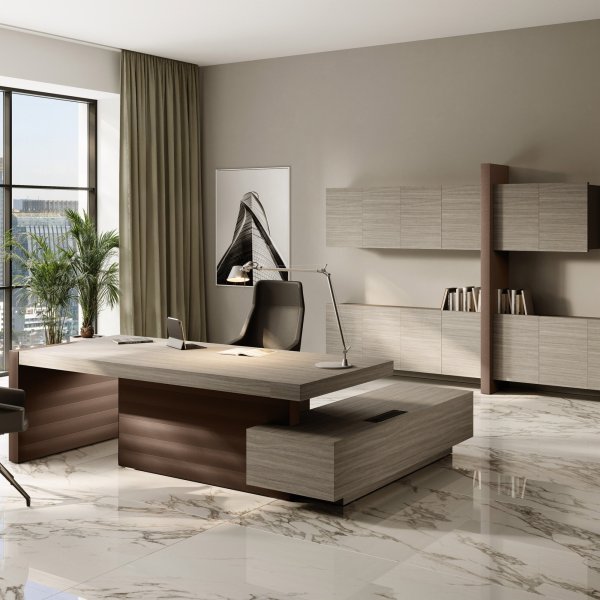
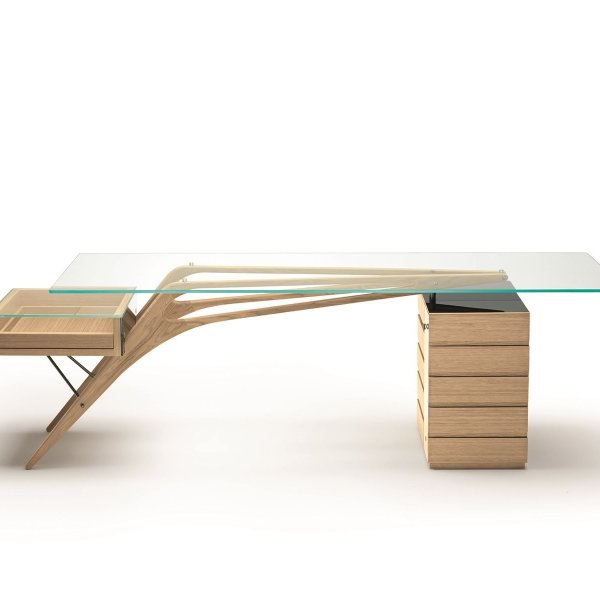
La Mercanti supplies executive desks directly from Italy's principal producers — solid timber tops, walnut first among them, leather writing surfaces, lacquered finishes, signed designer programmes — Jera by Las Mobili is the reference on this site — — configured to your dimensions and coordinated with storage, credenzas and seating from the same design family. A desk from a properly resolved programme doesn't require the surrounding pieces to be explained — the coherence is self-evident, which is rather the point. Samples, technical drawings and lead times on request. Do get in touch if we can help.
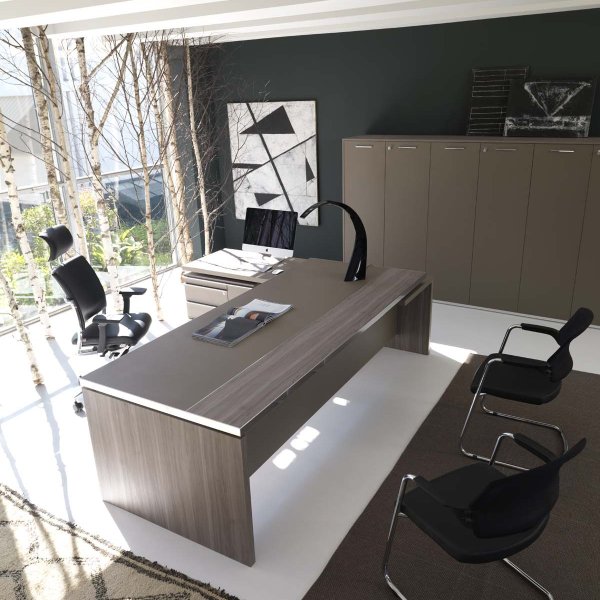
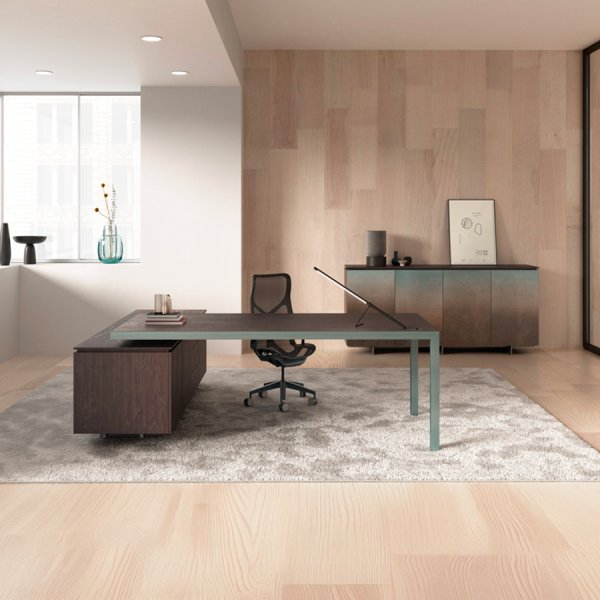
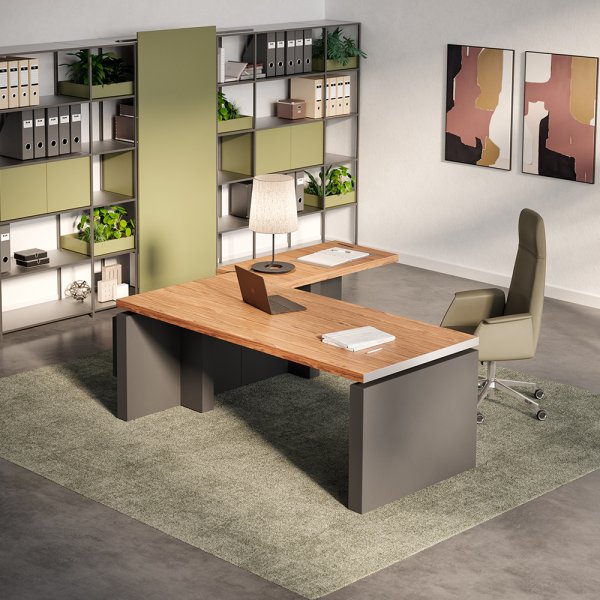
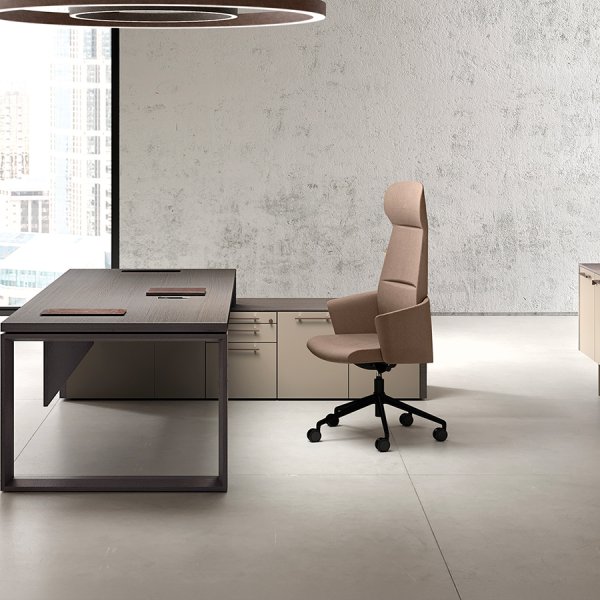
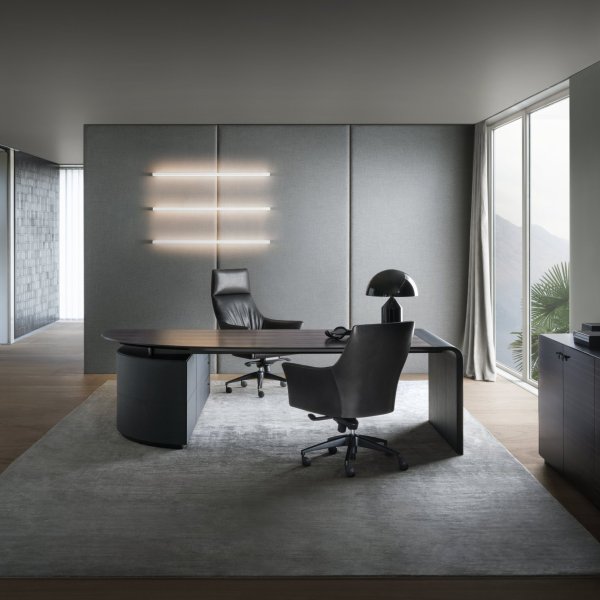
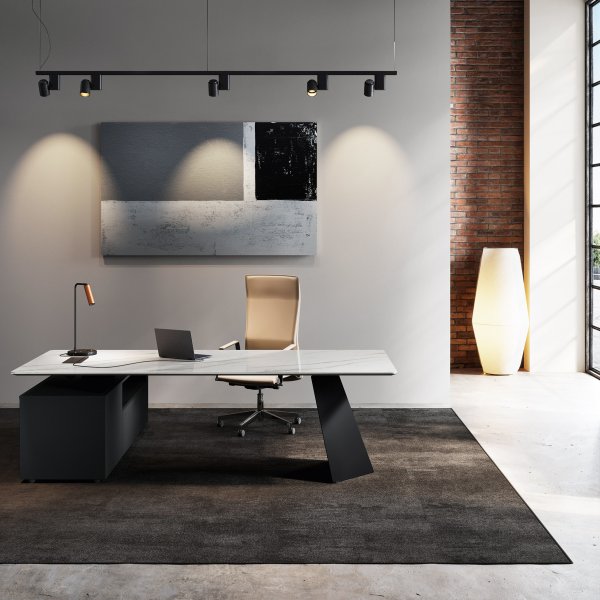
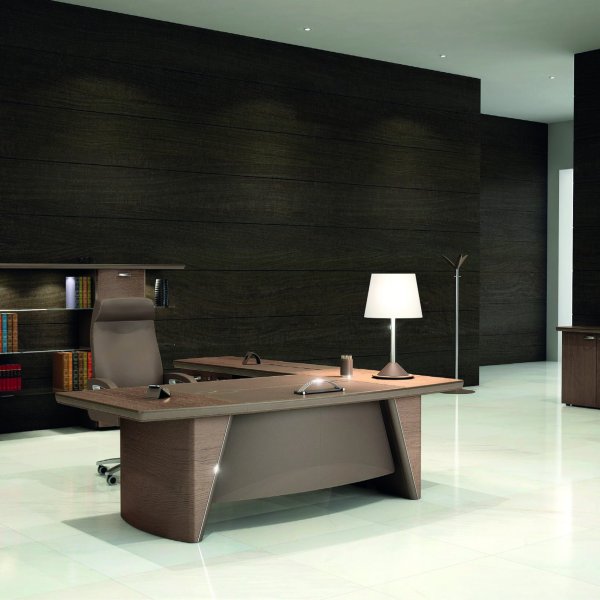
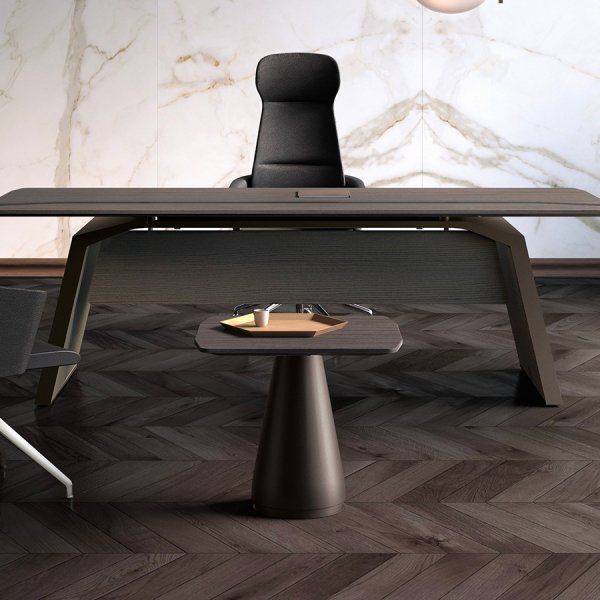
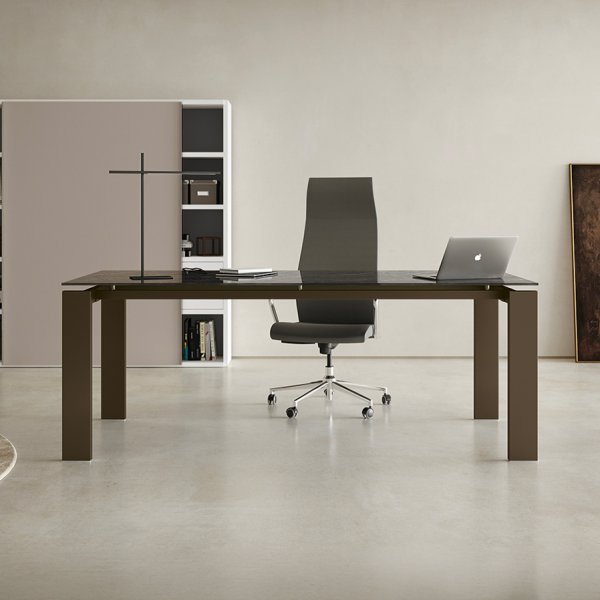
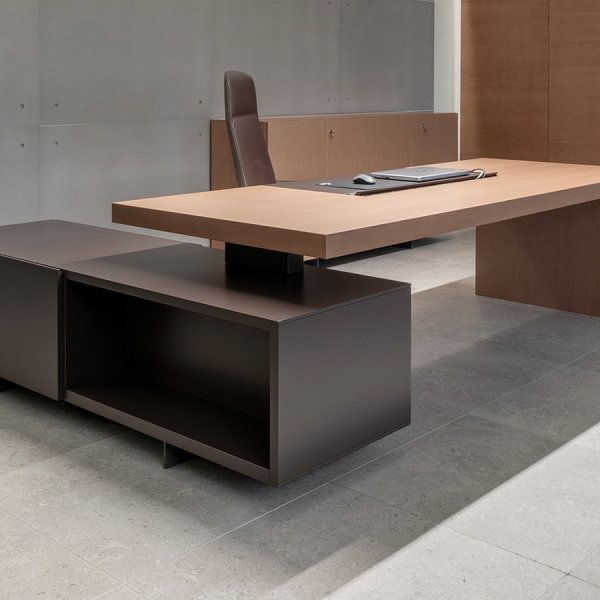
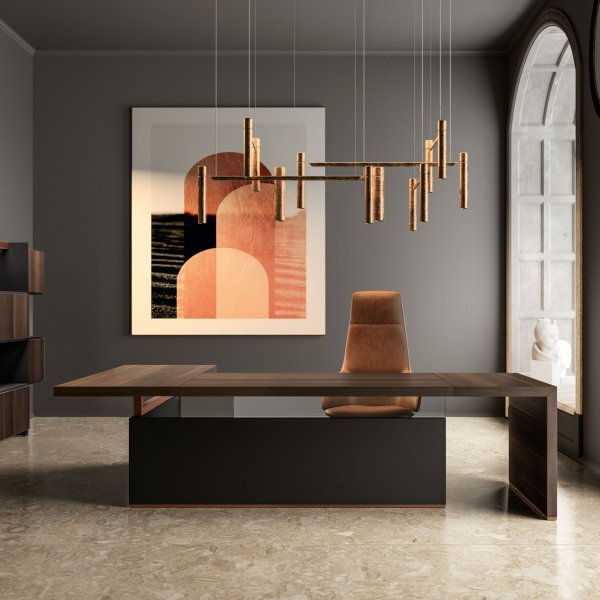
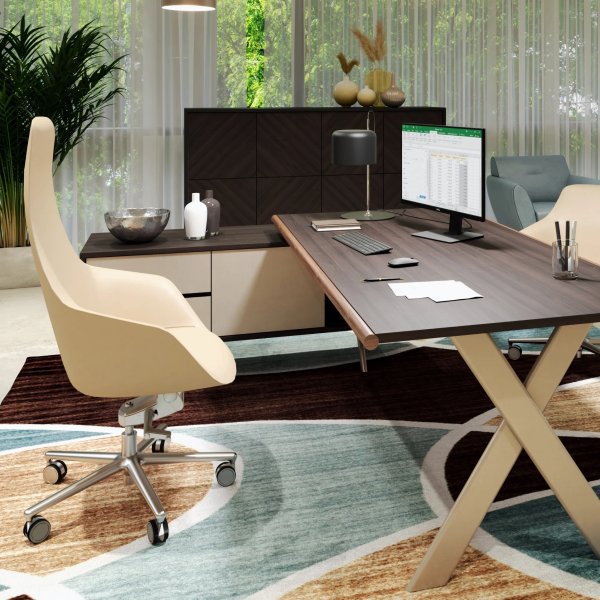
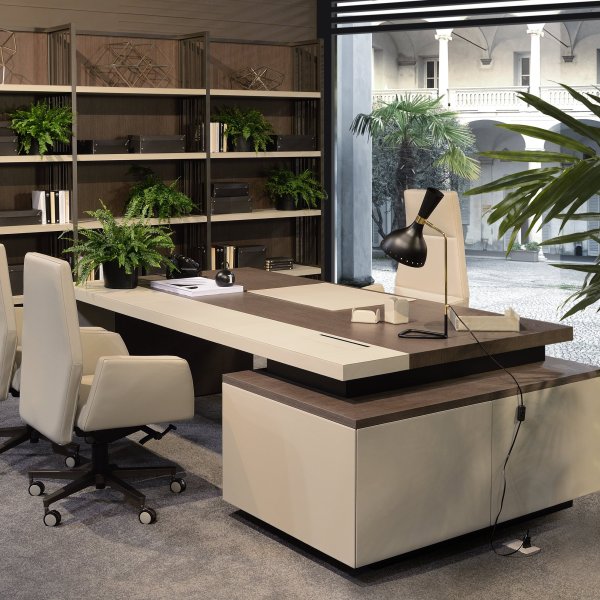
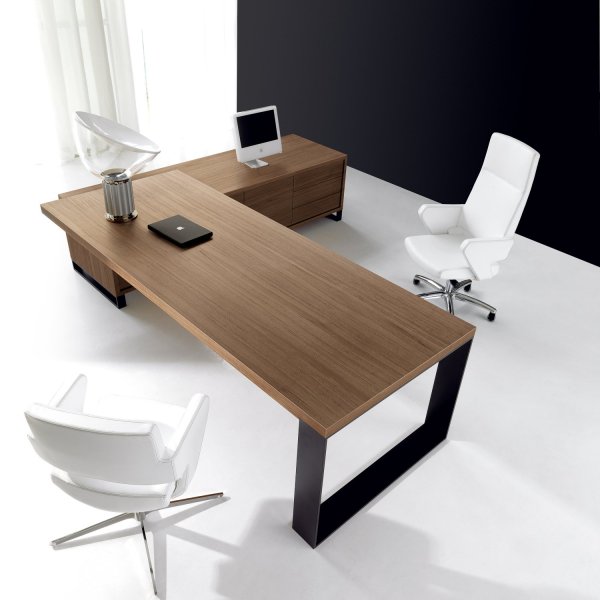
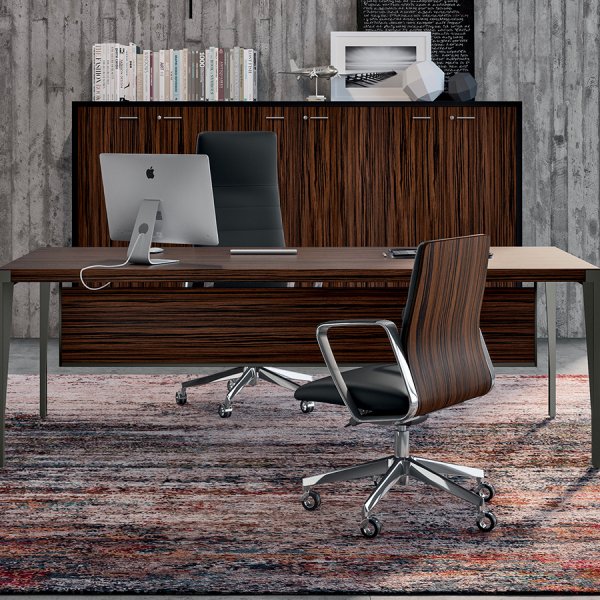
Because the people who occupy those offices stopped making decisions based on what impressed them and started making decisions based on what held up. The City professional who has worked in enough well-furnished offices understands, usually through direct observation over a career, that American contract furniture performs adequately and dates reliably, that Scandinavian design reads as considered but signals a certain modesty that doesn't suit every context, and that Italian executive furniture at the right level simply doesn't ask to be justified. It is there, it is correct, and it communicates something about the occupant's judgment without the occupant ever having to make the case. The mechanism is not aesthetic preference — it is the accumulated reading of rooms by people who read rooms professionally. A senior partner at a Magic Circle firm, a private equity principal in St James's, a managing director in Canary Wharf: these are people whose professional lives have been spent in well-furnished rooms. They know the difference between a desk that was chosen and a desk that was settled for. Italian executive furniture at this level tends to be chosen. That is what the rooms in those buildings are communicating, without saying it.
Because in the British professional context, coherence reads as competence. An executive office where every element — desk, storage, credenza, guest seating — shares a design language communicates that the decisions made in that room are similarly considered and coordinated. An office where individually good pieces from different manufacturers sit alongside each other communicates something subtler and less flattering: that the decisions were made independently, without a governing logic. British clients and colleagues rarely articulate this observation. They register it. The practical implication for specification: the programme decision must precede the desk decision, not follow it. A desk confirmed before its programme counterparts have been verified is a decision that constrains every subsequent choice — because the storage and credenza will be selected to match the desk rather than selected because they are the right pieces. Specifying from within a complete programme — desk, cabinetry, seating from a single design family with coordinated finish families and resolved proportional relationships — is the structural reason why certain offices look designed rather than assembled. The investment is identical. The outcome is not.
The DSE Regulations apply to any worker who habitually uses display screen equipment as a significant part of their normal work — which includes the director or partner who spends substantial time at a screen, not only open-plan employees. In practice, compliance for a private executive office requires three things that affect furniture specification directly. First, desk height: the working surface must permit the forearms to be approximately horizontal and the eyes to be at roughly the same height as the top of the screen — for most adults, this means a desk height between 680mm and 740mm, with adjustability preferred where the occupant is significantly taller or shorter than average. Second, legroom: sufficient clear space beneath the desk to allow postural variation — a minimum 600mm clearance width and 450mm depth at knee height, rising to the underside of the desk. Third, adequate surface area: enough space for the screen, keyboard, documents and any secondary materials in active use without requiring the occupant to adopt awkward postures to reach them. Italian executive desk programmes at the specification level La Mercanti supplies are designed to these dimensions as standard. The practical note for any employer specifying a director's office: a DSE assessment for the specific occupant, conducted before the furniture is ordered rather than after installation, identifies any dimensional requirements that deviate from standard — and is considerably less expensive than a return visit to adjust or replace a piece that doesn't suit the person who will use it for eight hours a day.
A well-made executive desk has three physical qualities that no catalogue image conveys: the surface holds items placed on it without resonance (dense core construction, not hollow-fill); the front edge is chamfered or radiused rather than squared — a detail that matters considerably after four hours of continuous work; and the drawers open and close with consistent, quiet resistance that doesn't change between the first cycle and the ten-thousandth.
None of these qualities appear in a showroom photograph. All of them become apparent within the first week of use. The desks that are worth buying are the ones that feel right before they look right — and continue to look right after they've been used hard for five years. The desks that photograph well but don't feel right are, in practice, expensive mistakes. The British office furniture market is not short of them.
Most executive desk purchases in the UK are made in reaction to something — a feeling of dissatisfaction with the current arrangement, a move to a new office, a sense that the existing piece no longer represents where the practice or the business has arrived. The feeling is accurate. The specification that follows from it is usually not, because it addresses the impression of the problem rather than the problem itself. This guide takes the surveyor's approach: before specifying what you want, understand precisely what the current arrangement is failing to do. The resulting specification is not a wish list. It is a direct translation of observed deficiencies into resolved solutions.
Sit at your current desk and work normally for twenty minutes without adjusting anything. Then stop and answer four questions honestly.
Where are your forearms? If they are angled downward from elbow to wrist, the desk surface is too high for your seated height, and you are applying sustained pressure to the underside of your wrists that accumulates over eight hours into tension through the forearms and shoulders. If they are angled upward, the desk is too low, and you are rounding your shoulders to compensate. The correct position — forearms approximately horizontal, elbows at roughly desk height — is achievable only if the desk height is matched to your seated height, which varies by between 100mm and 150mm across the adult range. A desk specified at the standard 730mm suits a person of roughly 175cm seated in a chair at its midpoint adjustment. It suits nobody else without adjustment.
Where is the monitor? If the top of the screen is above eye level, you are extending your neck to read it. Over eight hours, this produces specific tension at the base of the skull and between the shoulder blades that most users attribute to stress rather than to desk geometry. The monitor height is determined by the desk height plus the monitor stand or mount — which means a desk specified at the wrong height cannot be corrected by adjusting the monitor without introducing a secondary imbalance.
Where are the things you reach for most often? If any item you touch more than ten times per day requires you to lean forward or rotate your torso to reach it, your desk configuration has a circulation problem. The primary working zone — everything reachable without moving the upper body — should contain everything in active daily use. Items outside this zone should be in secondary storage, not on the desk surface.
How much of the desk surface is actually in use? If more than forty percent of the top is covered by items that don't move between sessions — cables, equipment, documents that have found a permanent home on the surface — the desk configuration does not have adequate storage integration. The problem is not the desk surface. It is the absence of organised storage that allows the surface to remain clear.
Record the answers. These are not comfort observations. They are dimensional specifications in waiting.
Stand in the doorway of your office and look at the desk from the position of someone entering the room for the first time. Stay there for thirty seconds without moving and note three things.
What is the dominant material reading? The surface, the edge, the base — taken together, do they communicate considered quality or accumulated compromise? A desk that was good when specified and has aged well reads as intentional. A desk that was good when specified and has not aged well reads as neglected. A desk that was never quite right reads as a placeholder that was never replaced. The distinction is visible from the doorway in thirty seconds to anyone who reads rooms professionally — which, in the British professional context, includes most of the people who enter the room.
Where is the visible wear? Run your eye along the front edge of the top — the surface that receives the most incidental contact from forearms, hands and adjacent chairs. If the edge banding has lifted, chipped or discoloured at any point, that is the desk's primary visible failure. It does not matter how good the surface material is. The edge is what close observers notice, and in a room where close observers form the majority of visitors, it matters disproportionately to its size.
Does the desk coordinate with what surrounds it? Storage, seating, any secondary surfaces — do they share a design language with the primary desk, or were they acquired separately and placed in proximity? Coordination is not matching. It is the shared resolution of proportional decisions, hardware profiles and finish families that makes a collection of pieces read as a designed room rather than a furnished one. If the answer is that each piece was individually acceptable and the aggregate is slightly unconvincing, the problem is not any individual piece. It is the absence of a programme decision that preceded the individual selections.
This assessment addresses the gap between how the desk was specified and how it is actually used — a gap that almost always exists and almost always informs the next specification more usefully than any product catalogue.
Cable management. Describe the current cable situation in one honest sentence. If that sentence contains the words "behind," "underneath," "temporarily," or "I've meant to sort that out," the current desk does not have adequate integrated cable management and the next specification must include it as a non-negotiable requirement rather than an optional feature. Integrated cable management — routing channels within the desk structure, grommets at specified positions, power access at the working surface — is designed into a desk or it is not. It cannot be added satisfactorily as an afterthought.
Storage at point of use. What do you open or reach for within the first thirty minutes of every working day? If any of those items are not within arm's reach of your working position — in a drawer directly below the working surface, in a cabinet within ninety degrees of rotation — the desk configuration does not match the actual workflow it supports. The specification for the next piece should list these items explicitly and confirm that the drawer dimensions, quantities and positions accommodate them before any finish or material decision is made.
The meeting function. Does your desk ever serve as a meeting surface — two or three people gathered around it for a working discussion rather than seated formally across from you? If yes, does the current desk configuration allow this comfortably? The depth required for a working meeting at the desk — documents, screens, and the physical presence of two people on the visitor side — is typically a minimum of 900mm. A desk specified at 800mm depth serves a single-occupant working position correctly and a two-person working meeting inadequately. If the desk functions as both, the specification must account for both.
The three assessments produce a set of observed facts about what the current arrangement fails to do. The specification for the next desk is a direct translation of those facts into dimensional and material requirements.
From Assessment 1: a desk height requirement (specify the exact height in millimetres based on your seated working position, or specify a height-adjustable range if postural variation is a priority), a surface area requirement (minimum dimensions derived from what is in active daily use), and a circulation layout requirement (where secondary storage must be positioned relative to the primary working position).
From Assessment 2: a material register requirement (what finish category holds up to the observed wear patterns of your working day and the ambient light conditions of your specific room), an edge specification requirement (the front edge treatment that will hold its integrity over the desk's intended service life), and a programme requirement (the storage, credenza and seating that must be specified from the same design family before the desk decision is confirmed).
From Assessment 3: a cable management requirement (specify integrated routing as a non-negotiable, with grommet positions confirmed against your technology setup before the desk is ordered), a storage configuration requirement (drawer dimensions and positions confirmed against the specific items they must contain), and a working configuration requirement (surface depth confirmed against whether the desk serves both solo working and small meeting functions).
A specification built from these three assessments is not a product description. It is a precise account of what the next desk must do, expressed in terms that allow a supplier to confirm whether a specific piece satisfies the requirements or does not. It eliminates the conversation about whether the desk looks right — because a piece that satisfies a precise specification looks right by definition — and replaces it with a conversation about which programme resolves all of the requirements most coherently.
La Mercanti is glad to work through this assessment with you. Samples, dimensional drawings and programme specifications are available before any commercial commitment is required.