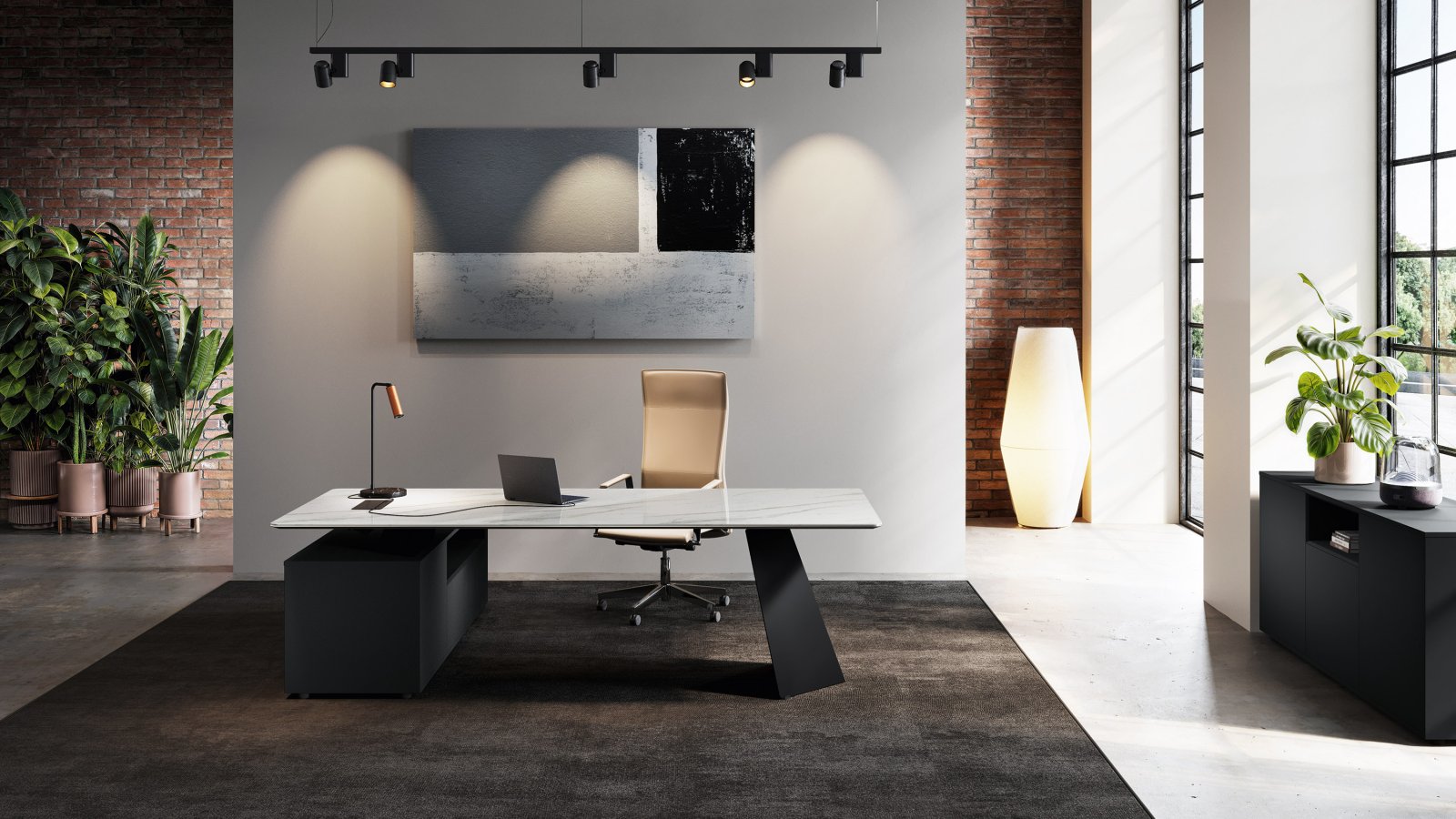
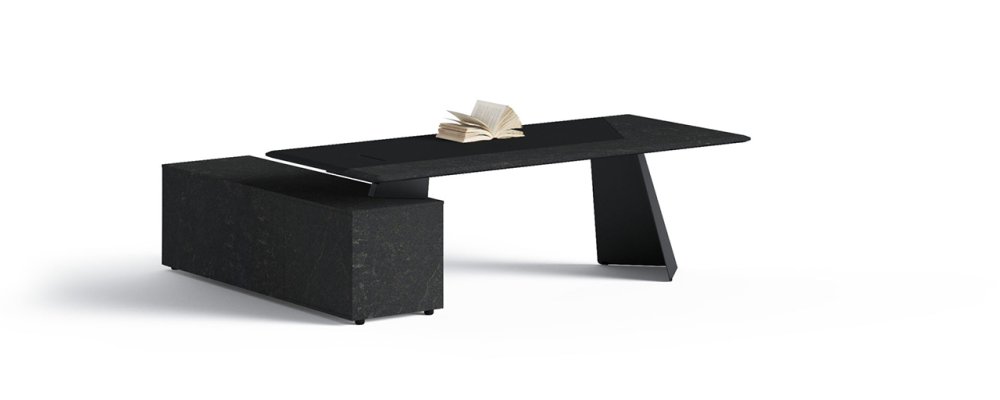
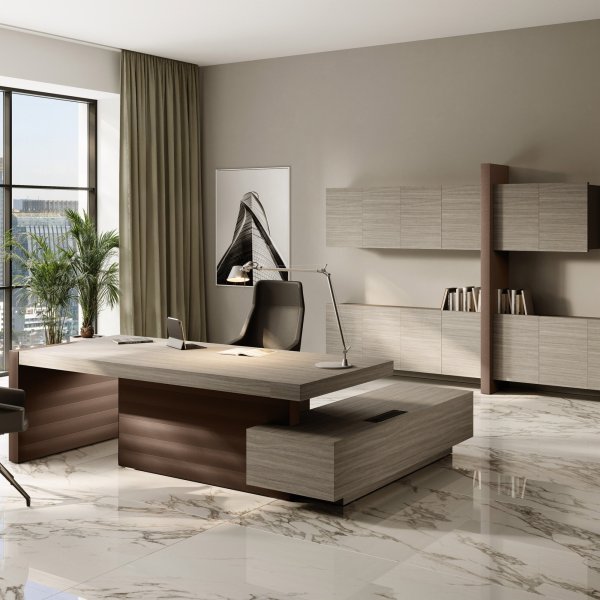
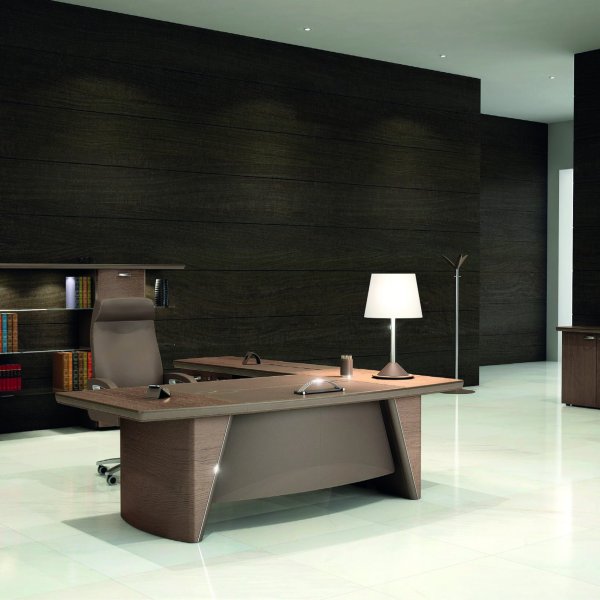
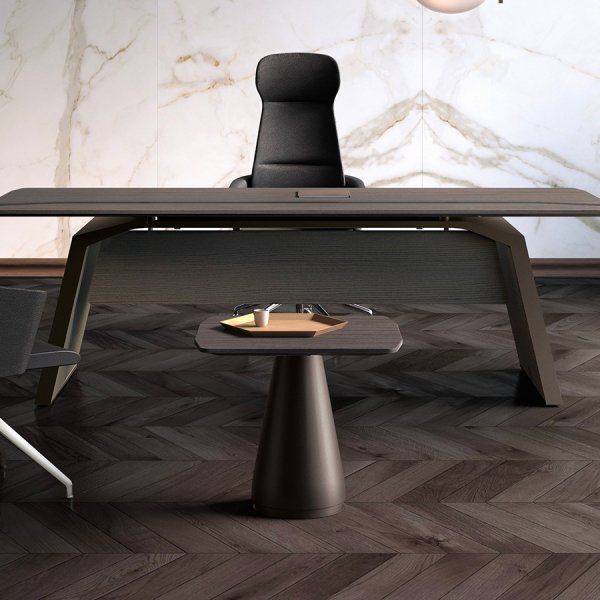
Black Desirè ceramic top detail on Monolith executive desk by Orlandini Design

Monolith executive desk — Las Mobili, ceramic top and sculptural steel base

Las Mobili

Orlandini Design

Executive desk only
Monolith Most chosen configuration Executive desk only
£ 5,856

Prefer a tailored configuration?

Bespoke: size, colour, finish

Monolith by Las Mobili, designed by Orlandini Design, is an executive desk that works by line, not by mass. Where traditional executive furniture builds authority through volume, Monolith draws it: a thin double-MDF top with shaped perimeter edges, carried on V-shaped legs cut from 4 mm sheet steel. The desk reads like a section drawing — which is precisely why architects specify it for offices that must feel current rather than ceremonial.

The four top options set the register of the room. A single 3d-foil surface in six finishes keeps it quiet. The marble-effect ceramic top — White Calacatta or Black Desirè, 6 mm bonded to the wood core — brings the marble conversation into the office without quarry weight or sealing rituals. Tops with an inset writing zone, in 3d-foil or black or mud eco-leather, mark the working area the way a desk pad never convincingly does.

The detail that wins fitouts

Every V-leg carries an integrated cable riser, and a press-folded steel tray runs under the top: power and data climb inside the structure, invisible from the visitor's side, no floor-mounted spine required. The epoxy-coated frame comes in Rust, Terracotta or Black — a palette that lets the desk either anchor a neutral room or converse with brick, timber and stone. Service units work as structural supports or freestanding pieces; columns, low cabinets and modular units extend the same finish language across the whole executive floor.

Tell us which finishes you'd like to assess

£ 170

Fully redeemable against your first order

FAQ

Ceramic or 3d-foil top — how should we advise the client?

Decide by use, then by light. The marble-effect ceramic surface — 6 mm bonded to the wood core — is the choice where the desk doubles as a meeting surface: it shrugs off coffee, keys and daily wear, and White Calacatta lifts rooms that lack natural light. The 3d-foil tops, in six finishes, read warmer and quieter and pair naturally with the eco-leather or 3d-foil writing insert. We send physical samples of both — the sample cost is credited in full against a confirmed order.

How does Monolith handle power and data without a cable spine on the floor?

Three elements work together: a press-folded steel tray under the top collects the slack, the V-legs carry a built-in cable riser so cables climb inside the structure, and an optional top-access with soft-closing flip-top brings connections to the surface. What still needs planning is the feed point: agree the floor box or wall feed position with the electrical contractor before confirming the desk orientation — the riser is in the leg, so the leg should stand near the feed.

Can the service unit replace a pedestal?

It does more than replace it. The Monolith service unit works either as a structural support — it carries the top, becoming part of the desk's architecture — or freestanding beside it. Push-open doors, drawers on metal guides with soft self-closing, and folding open inserts in 3d-foil make it the daily storage point, while columns and low cabinets behind the desk take the archive load.

We already have Las Mobili furniture in the building. Does Monolith coordinate?

Yes, deliberately. Monolith shares its core 3d-foil finishes — Grey Elm, Bali Walnut, Black, Wengé, Grey Beige — with other Las Mobili executive programmes, and adds Slate 55 plus the ceramic surfaces. So a Monolith floor can sit one level above an existing installation without a visible break in material language. Send us what is installed and we will map the matching finish codes before you specify.

What documentation is available for FF&E schedules and tenders?

The technical data sheet, 3D models and high-resolution images are published by Las Mobili, and the product certifications are available among the downloadable documents on this page. For tender-specific requirements — environmental criteria, emissions data, fire classification — we confirm the applicable documentation project by project before you submit, so the specification and the delivered product never diverge.

Rust and Terracotta are bold choices for an office. Will they date?

They are earth colours, not fashion colours — the same register as brick, corten and fired clay, which is why they sit so naturally against timber floors and stone. In practice most specifications use them as the accent: Black frame for the conservative floor, Terracotta or Rust where the office wants to signal that design decisions are made in-house. If the room must outlive three rebrandings, choose Black and let the ceramic top carry the character.

Choosing the right Monolith top: a five-step decision

Five steps for A&D and end clients — from use analysis to finish samples — to lock the top specification before requesting a quotation.

Start from what happens on the desk, not what it looks like

Count the real activities: writing and signing, laptop work, small meetings across the desk, occasional lunches. A desk that hosts meetings and cups earns the ceramic top; a desk that is mostly a workstation with a screen reads better — and warmer — in 3d-foil. If the executive writes by hand daily, shortlist the versions with the inset writing zone in eco-leather or contrasting 3d-foil.

Choose the surface family: ceramic, foil, or foil with insert

Marble-effect ceramic (White Calacatta or Black Desirè, 6 mm on the wood core) gives the stone presence without stone maintenance. Single 3d-foil in six finishes is the quiet, coherent choice. The insert versions — 3d-foil in Grey Elm, Black or Grey Beige, or eco-leather in Black or Mud — frame the working zone and suit executives who keep the desk clear. Decide the family first; the exact finish comes after the metal colour.

Pick the metal colour against the room, not the catalogue

The frame and V-legs come in Rust, Terracotta or Black epoxy. Black recedes and suits glass-and-grey corporate floors. Rust and Terracotta engage with brick, timber and warm plaster — they turn the desk into the room's centre of gravity. One rule that holds: the metal colour should either match the room's temperature or deliberately oppose it; a near-miss reads as an error.

Plan the cable feed before fixing the orientation

Monolith carries cables inside: steel tray under the top, riser inside the V-leg, optional soft-closing flip-top access on the surface. That discipline only works if the leg stands near the power feed. Mark the floor box or wall feed on the plan, orient the desk so a riser leg meets it, and specify the top-access cut-out at order stage — it is prepared with the top, in the frame colour.

Validate finishes physically — the cost comes back with the order

Ceramic, 3d-foil and eco-leather behave differently under warm artificial light and daylight. We send a physical sample set to your studio or the client's office; the sample cost is credited in full against a confirmed order. Check Calacatta under the room's actual lighting before committing — on screen it flattens, in the room it performs.

You May Also Like