
E5000
£ 702
/person
University furniture works harder than almost anything else in the contract market. A lecture theatre seat is occupied by different bodies every hour, tipped and released thousands of times a term, written on, leaned on and occasionally stood on — and it is expected to keep doing this for fifteen or twenty years, because estates budgets do not come round twice. University and lecture room furniture has to be specified for that arithmetic, and it shows when it has not been.
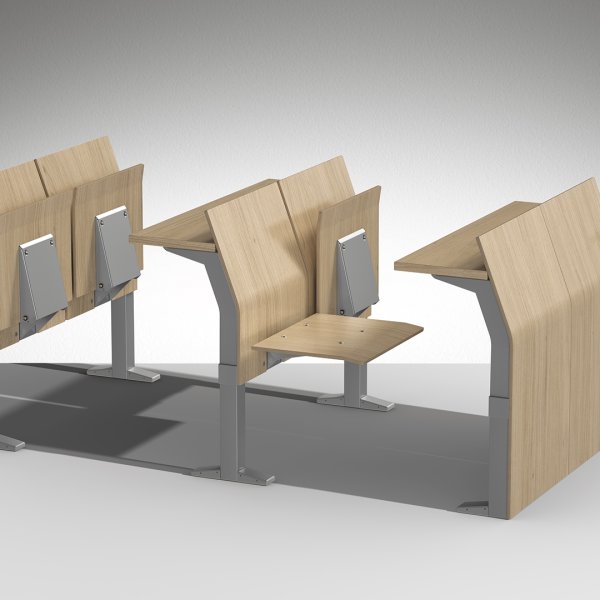
The range here covers the full teaching estate: tiered lecture theatre seating with folding writing tablets, beam-mounted rows, benches with integrated power for laptop-based teaching, and the seminar tables and stacking chairs that let a flat room change format between periods. The Italian producers behind it engineer for intensive public use — metal pivots where the movement happens, individually replaceable components, and FSC-certified timbers where sustainability scoring asks for documents rather than adjectives.
La Mercanti works with universities, estates teams and their contractors across the UK, with drawings, samples and specification support from survey to installed rows.

The moving parts go first, in a reliable order: the writing tablet mechanism, then the seat tip-up, then upholstery edges and armcaps — the structure itself is rarely the problem. That order should drive the inspection. On any candidate seat, work the tablet through its full travel a dozen times and listen for play; ask what the pivot runs on, because metal bushes survive students and unlubricated plastic does not; check whether tablet, seat pad, back and armcaps can each be replaced individually, on site, with ordinary tools. A seat that fails those questions will fail them again in year six, at scale, across four hundred positions.
The commercial translation belongs in the tender: require declared cycle testing for the mechanisms, a parts list with guaranteed availability across the life of the installation, and a warranty that covers the moving parts specifically rather than the frame in general. Replacement seating is bought once a generation; the specification is the only moment of leverage.
An overcorrection, in most estates. Large-cohort teaching has not disappeared — first-year modules still put two hundred people in front of one academic, and for that job the raked theatre remains the best machine anyone has designed, with sightlines, focus and density no flat room matches. What has changed is what happens inside the hour, and the furniture can follow. Current theatre programmes allow wider rows with turn-and-talk spacing, seats that let students form pairs without leaving their places, benches with power for laptop work, and wheelchair positions provided within the rake rather than as an afterthought at its edges.
The pragmatic estate keeps both formats and assigns them honestly: theatres for the large cohort, flat rooms with stacking chairs and linking tables for seminars and group teaching. The expensive mistake is converting a good theatre into a mediocre flat room to follow a trend, then hiring external venues for the large lectures that never stopped happening.
Almost always through competitive tender, under a sector framework or the university’s own procedure, run by procurement with estates and evaluated on more than price: whole-life cost, warranty and parts, delivery into a working campus, installation within term breaks, and sustainability evidence all carry scored weight. The pattern that produces poor outcomes is familiar. The specification is written around a single product seen at an exhibition, the tender inherits its assumptions, and the evaluation becomes an exercise in matching a photograph.
The stronger sequence brings technical dialogue forward. Before the specification freezes, estates teams can take physical samples, mechanism test data and site-specific drawings from candidate suppliers without prejudicing the tender, and this is where the real differences between products emerge. A supplier worth shortlisting will commit in writing to installation windows in vacation periods and to a named point of contact from order to handover; the ones who go quiet at that request are answering a different question.
Honest evidence is a document with a chain behind it. Chain-of-custody certification for timber, such as FSC, verifiable back to the producer; declared recycled content with the calculation available on request; components designed for individual replacement, with the parts list to prove it; upholstery that can be re-covered rather than requiring the seat to be scrapped; and take-back or refurbishment offered as a priced service rather than a sentiment. Each of these can be checked, scored and audited, which is precisely what a university evaluation panel needs it to be.
Padding is the rest: unanchored percentages, eco-prefixed adjectives, and logos that dissolve under a single enquiry — and in a public institution’s tender, the reputational risk of repeating them sits with the bidder as much as the supplier. The working rule for an estates team is to ask for the certificate behind every claim and drop from scoring anything that arrives without one. Producers with real programmes answer in days; the silence of the others is itself useful evaluation data.
Universities keep converting good lecture theatres into mediocre flat rooms, having talked themselves into believing large-cohort teaching has ended, and then quietly hire external venues for the lectures that never stopped. The honest method treats the estate room by room. Classify each space by the teaching it actually holds, assign a tiered or flat format on that evidence, specify within each format for how the hour is now taught, and phase the replacement into vacation windows with the parts written into the contract.
Begin with a full academic year of timetable and booking data rather than a walk round the empty rooms. For each space, record the sizes of the cohorts it really teaches, the hours a week it is actually in use, and the formats those hours take: the straight lecture to two hundred, the problem class that wants students working in pairs, the session taught to a camera as much as to a room. A three-hundred-seat theatre running at forty per cent occupancy is telling you something a headcount never will, and it is often the cheapest comfort upgrade on the estate hiding in plain sight.
Then add what happens when nobody is being taught, because it changes the brief. Open days, conferences and external hire each place their own demands on comfort, finish and access, and a room that earns hire income deserves a specification a notch above the teaching minimum. The output of this step is a single classification line per room, covering cohort, intensity, formats and secondary use, and the whole estate plan hangs from it. Skip the classification and every later choice becomes a guess dressed as a decision.
With the classification in hand, assign each room its format honestly. Where a large cohort recurs on the timetable, keep the rake: for putting two hundred people in front of one academic with sightlines, focus and density intact, the tiered theatre remains the best machine anyone has built, and no flat room comes close to matching it. Where the real use is seminars, group work and problem classes, go flat, with stacking chairs and linking tables that let a technician change the room’s shape between periods. The classification usually makes the call obvious; the pressure to override it comes from fashion rather than from the timetable.
Resist the conversion that looks progressive and lands badly: turning a working theatre into a flexible flat room, only to find the two-hundred-seat lectures never went away and must now be taught in a hired venue across town. Keep both formats on the estate and put them where the evidence points. An estate that matches format to teaching serves more students, at lower cost, than one that chases a single fashionable room type and pays for the mismatch every term.
A format decision settles only half the specification; the other half is fitting the furniture to how teaching has actually changed. In the tiered rooms that means wider rows with the spacing that lets students turn and talk without leaving their seats, power at the bench for laptop work, writing surfaces sized for more than a notepad, and wheelchair positions provided within the rake itself rather than stranded at its edges as an afterthought. The rake can stay; what sits on it should reflect a room where students now do things as well as receive them.
In the flat rooms, specify for reconfiguration: chairs that stack and link cleanly, tables a technician can reset between periods, and edges and finishes that survive being dragged rather than lifted. Across both, hold the mechanisms to a standard the traffic justifies, with metal pivots at the wear points, cycle-tested tip-ups and tablets, and every component individually replaceable on site with ordinary tools. Furniture that follows the teaching gets used as intended; furniture chosen from a brochure gets worked around, and the workaround slowly becomes the room.
A campus cannot close for a refit, so the calendar dictates the programme before the design does. Installation lands in vacation windows, which means sequencing the theatres across successive summers rather than promising the impossible in one, and it means asking every supplier, in writing, for a plan that protects a working building: access routes, lift capacity, floor loadings where a theatre sits above occupied space, and the escape and accessibility provisions the fire officer will hold the project to regardless of the furniture chosen.
Then buy for the fifteen to twenty years the budget has to last, and make the evidence contractual. Require declared cycle ratings on the moving parts, spare-part availability guaranteed in writing for the installation’s whole service life, and chain-of-custody certification such as FSC for the timber, each answerable with a document rather than an adjective. Whole-life cost over that period, not the capital price on tender day, is the figure that should decide the award. Replacement seating comes round once a generation, and the contract is the single moment an estates team holds any real leverage.