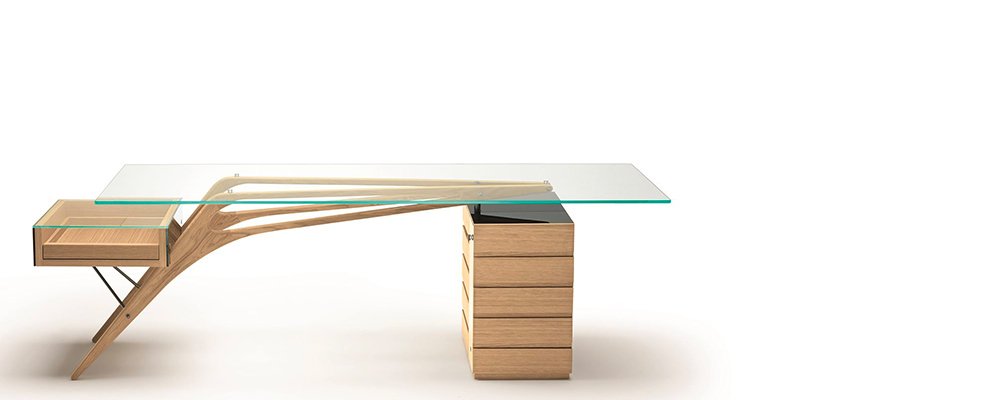
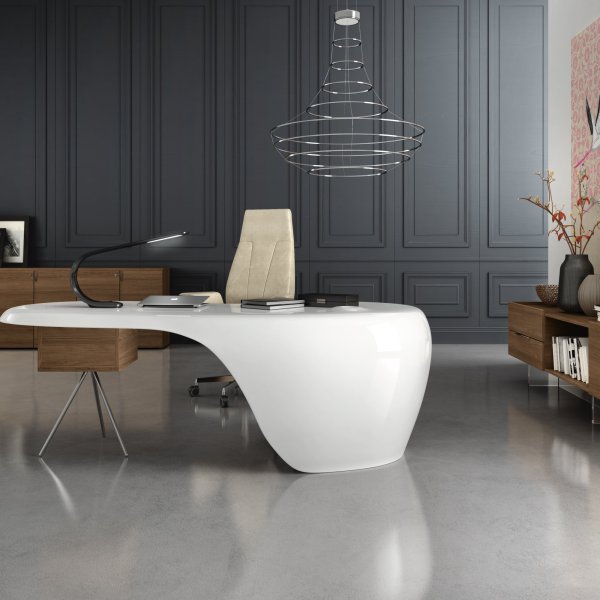
Executive desk Cavour CM by Zanotta seen from three quarters

Maximum strength from the least material: Zanotta's Cavour CM

Zanotta
Desk with integrated pedestal
Cavour CM An icon of Italian design Desk with integrated pedestal
£ 21,739

Tell us your requirements

Trade terms for professionals and design studios

Look at Cavour CM from the side and the question is obvious: how does that hold up a glass top two hundred and twenty centimetres long? The legs are thin, splayed, branching — closer to a structural sketch than to furniture. That was precisely Carlo Mollino's pursuit: the greatest strength from the least material, and elegance as the by-product rather than the aim.

The principle is legible in the parts. Solid timber where load has to travel — this is an executive desk in natural oak, black oak or Canaletto walnut —, veneer where a broad surface is needed, and a glass top that adds no visual mass at all. On one side a drawer unit sits as a closed block; on the other an open tray cantilevers out into the air. The desk is in equilibrium rather than simply symmetrical, which is why it looks as if it were caught mid-movement.

Produced by Zanotta since the original 1949 drawing, one of the luxury executive desks that never needed relaunching. La Mercanti specifies the timber, the glass and the optional kit for offices in the United Kingdom and beyond.

Technical information based on data declared by the manufacturer.

Model: Cavour CM, code 2690, Zanotta — design Carlo Mollino, 1949

Dimensions: top 220 cm (86.6 in) · overall 247 cm (97.2 in) including the projections of the frame · depth 90 cm (35.4 in) · height 75 cm (29.5 in)

Frame: legs in solid natural oak, black varnished oak or Canaletto walnut · wax-finished varnish

Drawer unit and extractable tray: veneered in the same species as the frame, wax-finished, both covered with extra-clear tempered plate glass, back-painted in black

Top: clear plate glass, extra-clear plate glass or smoky grey plate glass, the latter matching the black varnished oak frame

Executive kit (on request): black cowhide covering for the bottom of the extractable tray and the first drawer · black cowhide desk pad 80 × 50 cm (31.5 × 19.7 in) · solid wood penholder 35 × 15 cm (13.8 × 5.9 in) in the same finish as the desk

Intellectual property: all rights to the works of Carlo Mollino are held by the Italian State; the piece is manufactured under exclusive licence from the State Property Agency

La Mercanti Srl — trusted supplier for design and contract projects since 1997.
San Benedetto del Tronto (AP), Italy · +39 0735 753833 · info@lamercanti.com
Supply, quotations, specifications and project support across the UK and worldwide.

Tell us which finishes you'd like to assess

£ 170

Fully redeemable against your first order

FAQ

What are the dimensions?

The glass top measures 220 cm, but the overall footprint is 247 cm because the frame projects beyond the glass at both ends — that is the figure to use when measuring a room. Depth is 90 cm and height 75 cm. Allow additional clearance on the side where the tray pulls out.

Which timbers are available?

Three: natural oak, black varnished oak and Canaletto walnut, all with a wax finish. The legs are solid timber; the drawer unit and the tray are veneered in the matching species. Canaletto walnut is the warmest of the three and the one most often chosen where the desk faces visitors.

What does the Executive kit include?

Black cowhide lining for the bottom of the extractable tray and the first drawer, a desk pad measuring 80 × 50 cm in the same leather, and a penholder in solid wood finished like the desk. It is the only factory option on this model, so it is worth deciding at order stage rather than later.

Why is glass laid over the wood?

The drawer unit and the tray are faced with extra-clear tempered glass, back-painted black: a thin sheet over the veneer, painted on its rear face. It gives a deep reflective surface that takes the daily wear instead of the timber, while the sides of the units remain visible as wood.

Who owns the design rights?

The Italian State. Intellectual property in Carlo Mollino's work belongs to the State, and Zanotta manufactures Cavour CM under exclusive licence from the State Property Agency. For a buyer this is a simple assurance: it is the authorised production of the original design, not an interpretation of it.

How to care for waxed timber and glass on the same piece

Two surfaces, two routines, one desk. Five habits that keep both looking right after ten years.

Treat the wax finish as a skin

A waxed surface breathes and marks more readily than a closed lacquer. A dry cloth and, occasionally, a wax made for the purpose — never a general household spray.

Keep water away from the joints

Damp cloths are the usual cause of pale rings at the edges. Wipe spills immediately and dry the surface rather than letting it air.

Clean the glass without ammonia

Ammonia-based sprays attack the black backing paint at the edges over time. A neutral cleaner and a soft cloth are enough for a surface that has no pores.

Lift objects, do not slide them

Grit under a base is the only thing that scratches tempered glass. Anything with a rough underside deserves a felt pad.

Keep the sunlight even

Timber shifts tone under direct sun, and it shifts unevenly if half the desk is shaded. La Mercanti advises on placement relative to windows when the room is planned.

You May Also Like