Ar.tu
£ 3,896
A classic executive desk makes an argument no other piece of office furniture can make: continuity. In the professions where British clients still expect a room to look like the institution it represents — chambers, private client law, wealth management, the older end of the City — a classic desk in dark walnut says the practice was here before you and intends to remain after. That message has not dated. What has dated is the clumsy version of it: the reproduction piece with ornament doing the work that construction should be doing.
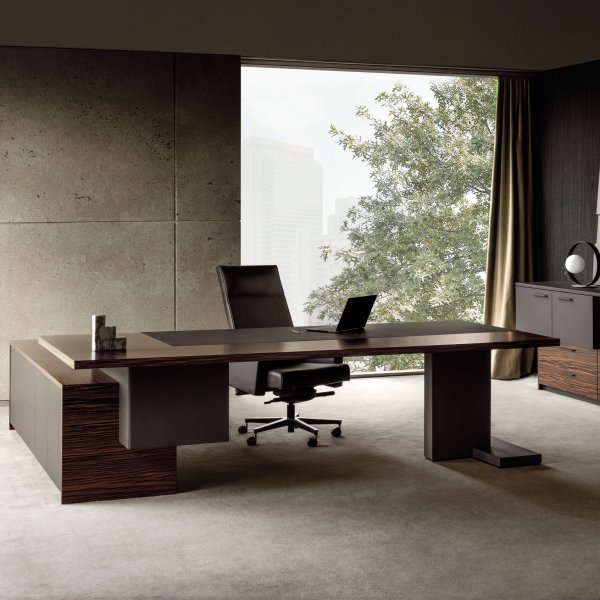
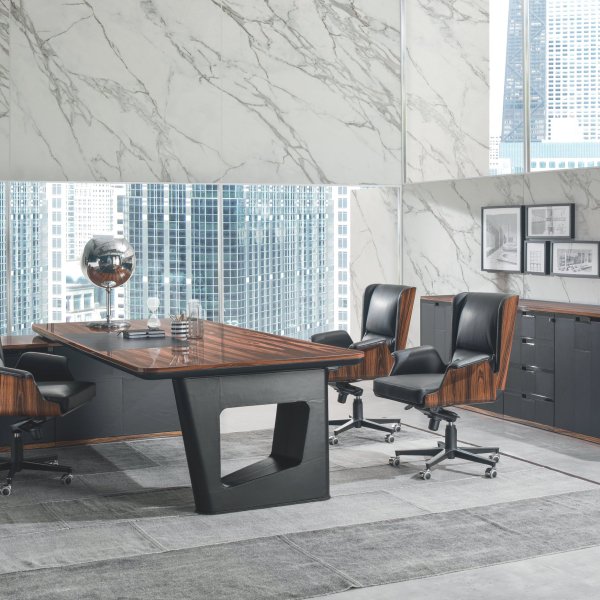
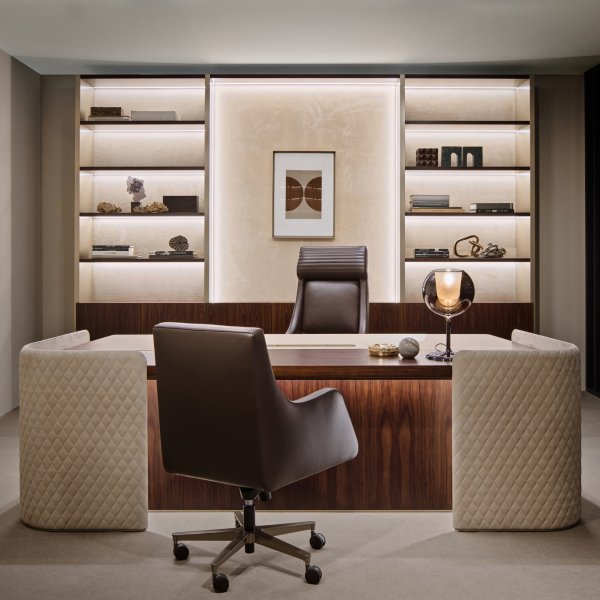
The classic executive desks in this collection are Italian, and that is precisely the point. Italy’s traditional workshops never stopped making this furniture, so the craft never needed reviving — bookmatched veneers, hand-finished edges, leather inlays cut and fitted rather than glued and hoped for. The forms are traditional; the engineering is current, with cable management and screen-age proportions resolved inside the heritage silhouette. Boardroom tradition, without the dust.
La Mercanti supplies classic executive desks from Italy’s traditional producers, configured to your room and delivered across the UK, with matching storage, boardroom tables and seating available from the same workshops. Drawings and finish samples on request.
Sector by sector, no — but the margin for poor execution has gone. In chambers, private client law, wealth management and the older institutions of the City, continuity is still the product: clients bring their affairs to rooms that look capable of outlasting them, and a classic executive desk makes that argument better than anything else in the furniture vocabulary. What has dated is the costume version of it — the reproduction piece with applied ornament, an orange-toned finish and construction that would embarrass the century it imitates. The distinction every visitor now reads, even without the vocabulary for it, is between inheritance and fancy dress.
The rule that holds: choose by construction, never by silhouette alone. A classic desk earns its place through veneer work, edge quality and drawer engineering; the traditional form is simply the language those qualities speak. If the quality is present, the desk reads as establishment. If it is absent, no amount of dark timber will supply it.
Because at the widths an executive desk demands, fine veneer over an engineered core is the technically superior construction, not the economy option. Solid timber moves — a metre-eighty of solid walnut will respond to every heating season the building has, and the flatness a desk depends on is exactly what it surrenders. Veneer on a stable core holds its geometry for decades, and it makes possible the thing that defines the classic register: bookmatched figuring, the mirrored grain across a top that no solid board can offer. The traditional Italian workshops treat veneering as the craft it historically was; solid sections are used where they belong, in legs, edges and frames that take the wear.
What separates good from cheap is therefore less solid-versus-veneer than the quality of the veneer work itself: the thickness of the leaf, the matching across surfaces, and the edge treatment where honesty is visible. Ask about the core and the edge before asking about the species. Makers proud of both will tell you at length.
Because the antique was designed for a working day that no longer exists, and asking it to host one is unkind to both parties. A nineteenth-century partners' desk was drawn around letters, ledgers and ink: its height, its drawer geometry and its unbroken top assume none of the equipment a modern principal actually uses. There is nowhere for cable to go that does not involve violence to the piece, the proportions rarely suit today’s rooms, and a desk of genuine age carries condition risk that only reveals itself in use. It belongs in the room as presence, never as the primary working surface.
A new classic desk from a traditional workshop offers the same language with the function built in: heritage forms with factory-cut cable routes hidden in the construction, dimensions drawn for screens and current seating, finishes that can be serviced by the maker rather than a restorer. The honest division of labour, in the offices that get this right, is an antique where it can be admired and a new classic where the work is done.
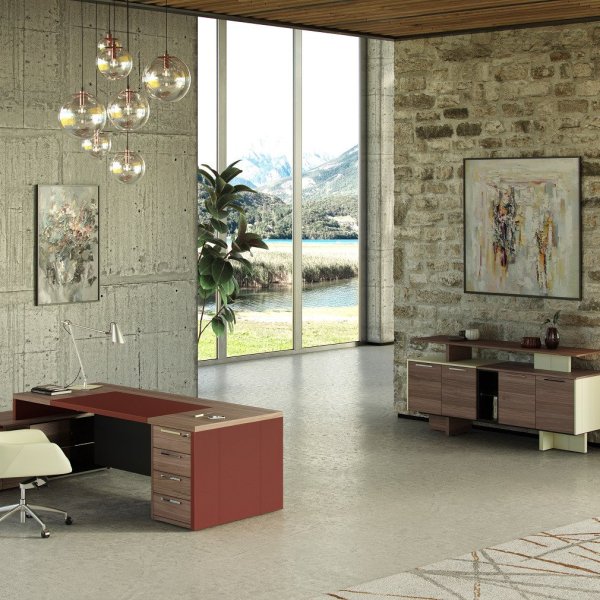
It holds its own remarkably well, provided it is treated as the room’s anchor rather than a transplant from another one. Glass-and-steel floors are starved of exactly what dark timber supplies — material depth, warmth, the sense of weight that makes a decision feel considered — which is why a classic desk in a contemporary shell often lands with more force than the same desk in panelling, where it merely matches. The failure mode is set-dressing: surrounding the desk with a full cast of traditional props until the office becomes a themed room on the wrong floor.
Three disciplines make it work. Keep to a single note of tradition rather than a chord: the desk and perhaps its chair, with everything else belonging to the building. Give it light, because dark surfaces absorb it and a north-facing glass box will need the difference made up deliberately. And let the floor argue with the desk rather than blend with it: contrast between the timber and what it stands on is what reads as intent. Done this way, the desk stops being furniture and starts being the point of the room.
Classic executive furniture rarely fails at delivery. It fails months earlier, at specification, in one of four predictable ways: the silhouette is bought instead of the construction, the room is ignored, the technology is postponed, and the purchase is treated as final when it is actually the start of a twenty-year tenure. Each error is invisible in the catalogue and obvious in the office. This sequence takes them in the order they usually occur, with the check that prevents each one.
Pastiche is the classic desk’s characteristic failure, and it is a construction problem wearing an aesthetic disguise. Applied ornament, routed mouldings and a heavy finish can be added to any carcass; what cannot be faked is the joinery underneath. Before any discussion of style, ask for the section drawing and the construction detail: the core material and its density, the thickness of the veneer leaf, how the drawers are built and what they run on, whether the frame is joined or merely fastened together.
Then inspect where economy hides. Open a drawer fully and look at its sides and base rather than its front. Check the veneer matching across the top and down the visible edges — a workshop that bookmatches its figuring is telling you something about everything else it does. Look at how the base meets the floor and how the frame carries the load, because that is where reproduction furniture saves its money. The desks worth the classic register pass these checks without excuses; the costume versions fail them within a minute, whatever the photograph promised.
A classic desk is the most room-dependent object in office furniture: it works by proportion and light, and both are properties of the room rather than the piece. Measure before shortlisting. The desk should hold the room without crowding it — generous clearance behind the chair, comfortable space for guest seating in front, and a relationship to the floor area that reads as authority rather than congestion. In period rooms, take the scale cues from what the architecture already provides: ceiling height, window rhythm, the line of the cornice.
Light is the harder half. Dark timber absorbs it, and a room that is merely adequate for pale furniture can turn sombre around walnut. Judge the room’s natural light at its worst hour rather than its best, and plan the difference deliberately — task lighting, wall treatment, the tone of what surrounds the desk. In contemporary buildings the calculation inverts: the glass shell supplies light in quantity and warmth not at all, and the dark desk becomes the corrective rather than the risk. Either way, the room decides. Consult it first.
The most common act of vandalism against classic furniture is committed with a hole saw, on site, six weeks after delivery. It is entirely avoidable. A traditional silhouette does not exempt the desk from modern duties — screens, docks, charging, a lamp, telephony — so the routing must be specified at order, while the piece is still in the workshop. Factory-cut grommets pass through the veneer cleanly, positioned in millimetres against where the equipment will actually sit, and finished as part of the top rather than apologised into it afterwards.
Map the equipment first: what runs on the desk daily, what charges there, where the cables must emerge and where they must disappear. Then have the workshop resolve the route through the construction — many traditional programmes now carry channels and outlets inside heritage forms, invisible until needed. The test of success is simple. The desk in full working order should look, from the guest chair, as if it carries nothing at all. That illusion is designed and ordered; it is never improvised afterwards.
A properly made classic desk is a twenty-to-thirty-year asset, and specifying it as a one-off purchase wastes most of that value. Offices move, practices merge, rooms change shape. The desk will be dismantled, transported and reassembled at least once in its life, and whether it survives that with dignity is decided by its construction and its maker rather than by the removal firm. Ask, before ordering: can the piece be taken apart and rebuilt without damage, can the finish be renewed by the workshop, can a leather inlay be replaced, and will the programme still exist when a matching credenza or boardroom table is wanted five years from now?
Producer continuity is the quiet criterion here. Italy’s traditional workshops have often been making the same families of furniture for generations, which means the desk bought today can be repaired, refinished and extended by the people who built it. That is what separates an asset from an expense — and it costs nothing extra to check. A classic desk specified this way outlasts the office it was bought for, which is rather the point of the register.