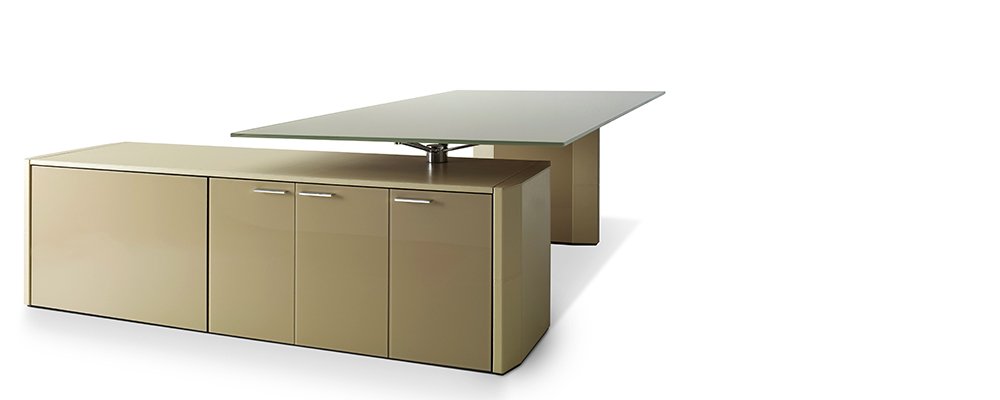
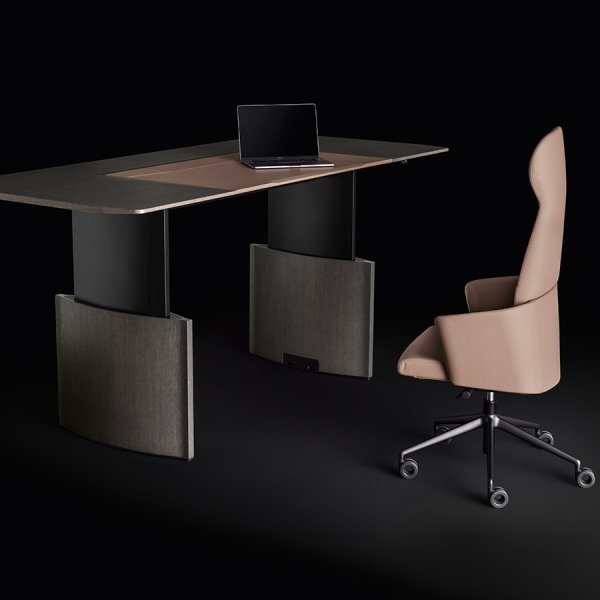
De Symetria executive desk by i4Mariani seen from the side

The chromed cross that carries the top: inside De Symetria

i4Mariani

Luca Scacchetti

Executive desk only
De Symetria Most Requested Executive desk only
£ 17,901

Let's discuss your project

Trade terms for professionals and design studios

Look at a De Symetria desk from the side and you will find a detail most collections hide: on top of each leg sits a cross-shaped element in chromed steel, and that is what the top is fixed to. It is structure made visible on a modern executive desk — the point where the vertical panel becomes a horizontal plane, declared instead of concealed under an apron.

Everything else follows that logic of stated parts: legs are 65 by 10 cm panels, 60 cm high, available with leather edges and a veneered or painted-glass centre, entirely in leather, or entirely veneered; tops are 205 and 225 cm by 100 deep at a finished height of 75, in saddle leather, leather, veneer or 15 mm extra-clear glass. Designed by Luca Scacchetti in 2010, the collection reaches international projects through La Mercanti, drawings and samples first.

Technical information based on data declared by the manufacturer.

Collection: De Symetria
Manufacturer: i4Mariani
Design: Luca Scacchetti, 2010
Top support: cross-shaped chromed steel element fixed on the legs; the top is fixed to it
Type: executive desk, fixed and castored pedestals, sideboard cabinet, low and high cabinets, low tables
Desk sizes: 205 × 100 and 225 × 100 cm (80.7 × 39.4 and 88.6 × 39.4 in); height 75 cm (29.5 in)
Tops, three finishes: melamine panel covered in saddle leather or leather · veneered particleboard · 15 mm (0.59 in) extra-clear glass, transparent or painted white, black or RAL 1019
Thickness: 3,5 cm (1.4 in) for leather and veneered tops; 1,5 cm (0.59 in) for glass
Legs: melamine panel 65 × 10 cm (25.6 × 3.9 in), h 60 cm (23.6 in); edges in saddle leather or leather with veneered or painted-glass centre, fully covered, or fully veneered
Standard veneer: ebony type; other finishes on request
Stitching: available on the saddle leather version only
Fixed pedestals: h 60 cm (23.6 in); 60 × 70 cm (23.6 × 27.6 in)
Castored pedestals: h 62 cm (24.4 in); 43 × 58 cm (16.9 × 22.8 in)
Sideboard cabinets: h 60 cm (23.6 in); 200 × 65 cm (78.7 × 25.6 in)
Doors: 76 × 54 cm (29.9 × 21.3 in) (low cabinets), 182 × 54 cm (71.7 × 21.3 in) (high cabinets)
Modesty panels: h 43 cm (16.9 in), 2 cm (0.79 in) thick; 85 · 105 · 125 · 145 cm (33.5 · 41.3 · 49.2 · 57.1 in)
Low tables: top 100 × 100 cm (39.4 × 39.4 in), legs 25 × 25 cm (9.8 × 9.8 in), h 28 cm (11 in)
Handles: polished aluminium
Frames: black melamine; black lacquered plywood drawers
La Mercanti Srl — trusted supplier for design and contract projects since 1997.
San Benedetto del Tronto (AP), Italy · +39 0735 753833 · info@lamercanti.com
Supply, quotations, specifications and project support across the UK and worldwide.

Tell us which finishes you'd like to assess

£ 170

Fully redeemable against your first order

FAQ

Why is the support visible instead of hidden?
Because the design treats the joint as part of the object. The chromed cross sits on the leg and receives the top, so the transfer of load is legible from the side. Concealing it would have required an apron between the legs, and that is exactly the horizontal mass the collection avoids.
Does the cross work with all three tops?
It is the fixing element for the desk tops, which come in saddle leather or leather at 3,5 cm, veneered at 3,5 cm, or in 15 mm extra-clear glass. The lighter glass version is where the chromed detail reads most clearly, because nothing above it hides the connection.
How thick and how tall are the legs?
The leg is a panel of 65 by 10 cm, 60 cm high; the finished desk height is 75 cm. Ten centimetres of thickness is what allows a panel that narrow to look substantial from the front and slim from the side.
Can the leg be finished differently from the top?
Yes, and it is one of the collection's decisions: leg edges can be in saddle leather or leather with a veneered or painted-glass centre, or the leg can be entirely covered or entirely veneered. Matching or contrasting with the top changes the room considerably.
What is the difference between the two pedestals?
The fixed one is 60 × 70 cm at 60 cm high; the castored one is 43 × 58 cm at 62 cm and moves. In rooms where the desk is also used for short meetings, the castored version keeps the space under the top clear.

How to read the structure of a glass-topped desk

Five checks on the parts that carry the weight, using De Symetria as the worked example.

Find the fixing point
Here it is a chromed cross on top of each leg. Knowing where the top is fixed tells you how the load travels.
Check whether an apron exists
No apron means nothing spans between the legs, which is why the desk reads as two verticals and a plane.
Compare thicknesses
3,5 cm for leather and veneer, 1,5 cm for glass. Two constructions, two profiles, same collection.
Look at the leg in plan
65 by 10 cm: wide from the front, narrow from the side. That proportion is what keeps a solid panel from looking heavy.
Ask for the drawings
La Mercanti supplies technical drawings before the order so the structure is verified on paper, not on delivery day.

You May Also Like