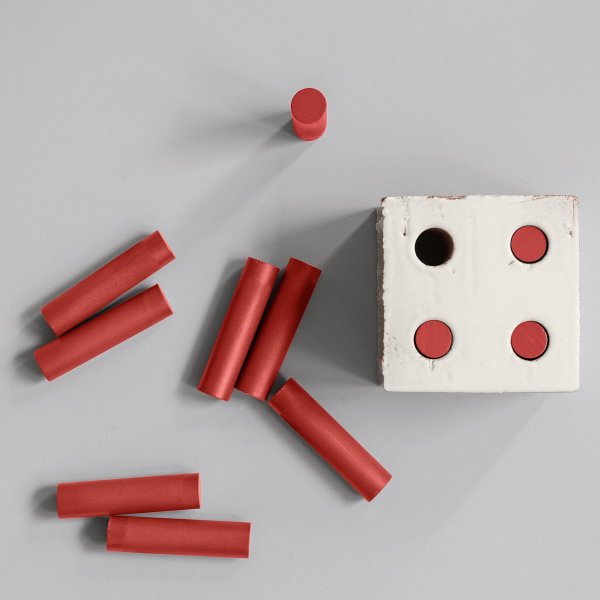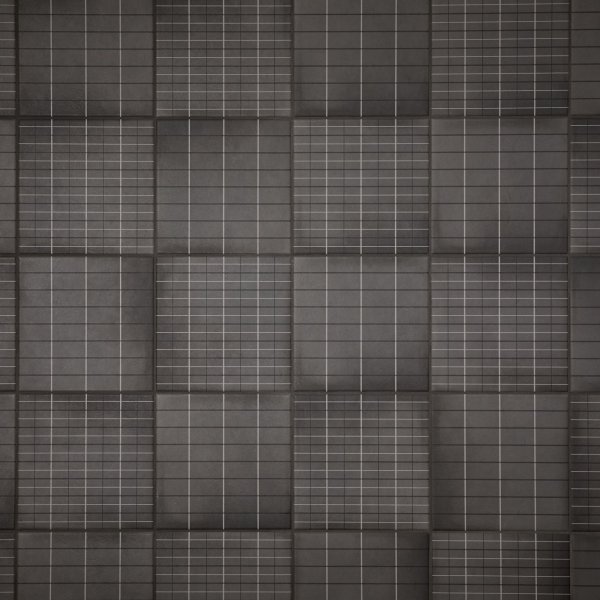
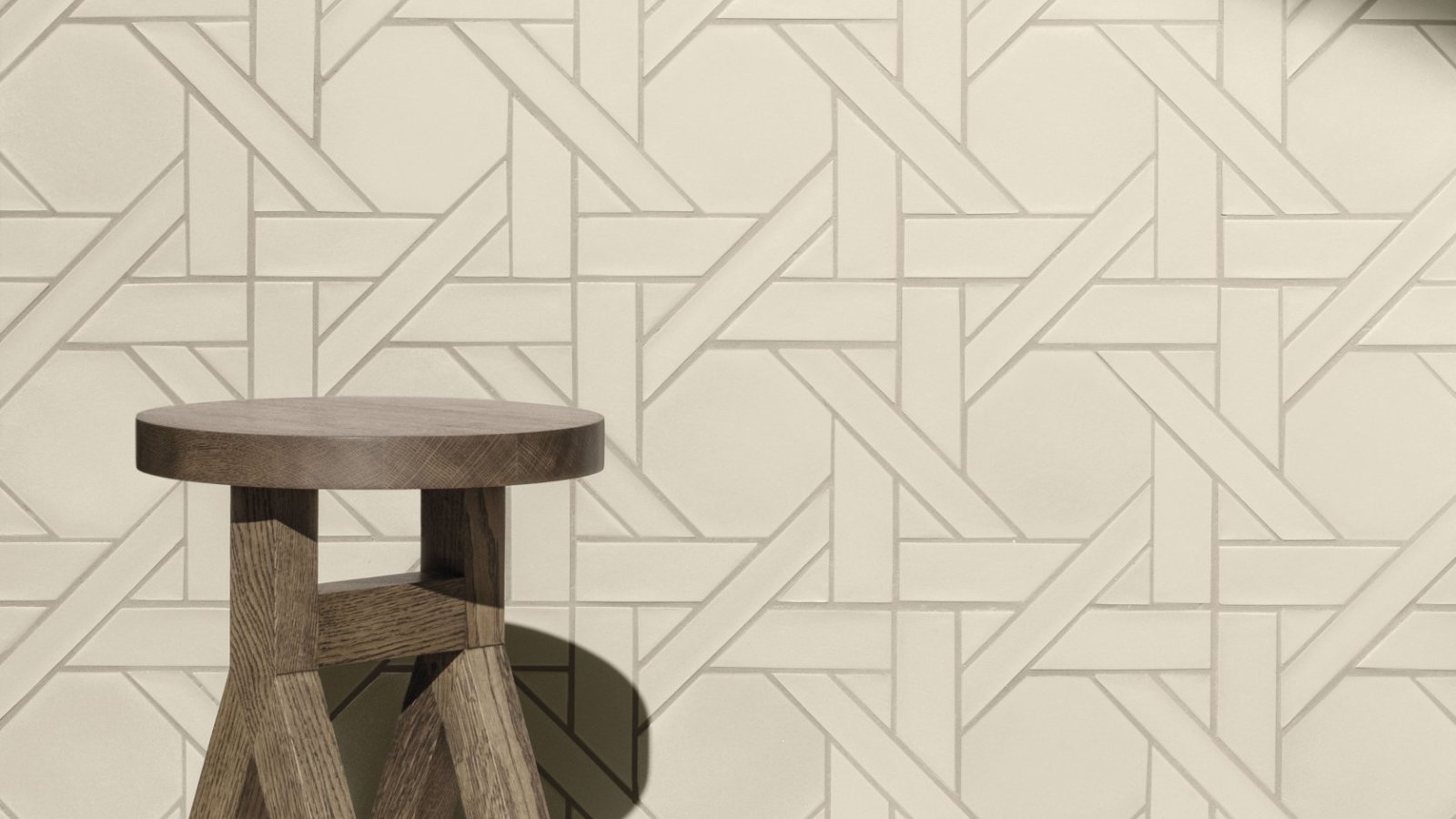
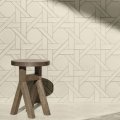
Weaving mosaic by Mutina with the Ba Leng interlocking pattern in white

Weaving by Mutina — every great pattern needs an opening move

Mutina

Neri & Hu

Weaving Cream
Weaving Cream Available now
£ 677
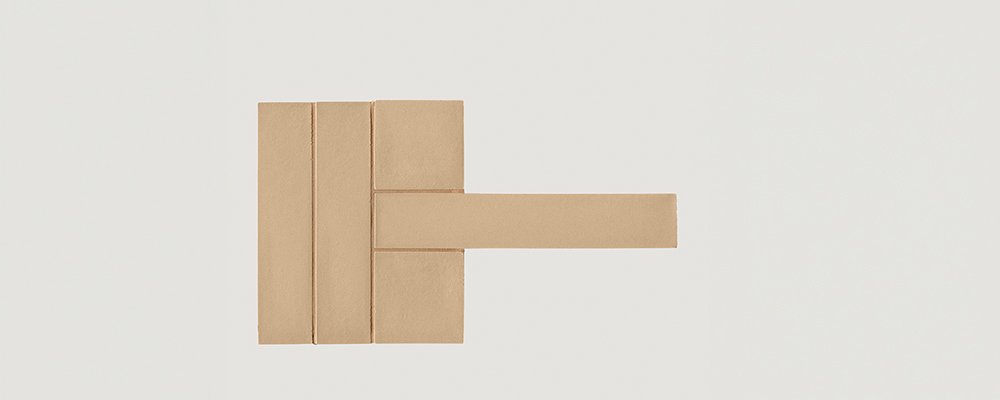
Chess players know that a game is decided by its opening; tilers know the same is true of a woven pattern. Mutina took the point seriously: for the San Jiao and Ba Leng patterns of Weaving you can order a dedicated starting piece — a first move that sets the interlock correctly, so the whole floor inherits a clean geometry. It is the kind of detail that separates a collection designed as a system from a tile with a pretty face.

The system itself comes from Neri&Hu, the Shanghai practice behind the Waterhouse at South Bund: the ancient Chinese art of bamboo weaving abstracted into three interlocking patterns — San Jiao (triangle), Si Fang (square), Ba Leng (octagon) — each with its own rhythm of density and transparency. The tesserae are unglazed full-body porcelain, individually pressed and mounted on mesh; five natural matt tones plus one two-colour mix per pattern, inspired by bamboo as it matures. Floor and wall, indoors and outdoors: 0.1% absorption, frost-proof, stain class 5, Mohs 7 — with Mutina holding a Registered Community Design on the drawing.

Technical information based on data declared by the manufacturer.

Collection: Weaving
Manufacturer: Mutina
Design: Neri & Hu, 2026
Material: unglazed homogeneous full-body porcelain tesserae, individually pressed and mounted on mesh (UNI EN 14411, BIa UGL); 9 mm (0.35 in) thick
Patterns and sizes: San Jiao (triangle) 42.9×30.3 cm (16.9×11.9 in) — Si Fang (square) 35.7×20.3 cm (14.1×8 in) — Ba Leng (octagon) 34.3×34.3 cm (13.5×13.5 in)
Colours: White, Grey, Cream, Green, Black (natural matt tones) + one mix per pattern: Bi-Grey & Black (Ba Leng), Bi-White & Black (Si Fang), Trio G (San Jiao); V3 variation
Performance: water absorption 0.1% (ISO 10545/3); frost-proof; thermal shock resistant; stain class 5; chemicals A-B/A; deep abrasion 123 mm³; surface hardness Mohs 7 (EN 101)
Slip data: R10 (DIN EN 16165 B); barefoot class B (DIN EN 16165 A); DCOF 0.64 (ANSI A.326.3); pendulum 50 dry / 40 wet (BS EN 16165 C); Robinson test: heavy-duty and high-impact use
Use: floor and wall, indoor and outdoor
Installation: mesh-mounted sheets laid with the same 4 mm (0.16 in) joint as within the sheet; porcelain adhesive; cement-based or epoxy grout; starting piece for San Jiao and Ba Leng available on request
Design protection: Registered Community Design, Ceramiche Mutina
Documents: VOC, Declaration of Contents, SDS, BPD3 and HPD on request — certificates downloadable directly from the product page

La Mercanti Srl — trusted supplier for design and contract projects since 1997.
San Benedetto del Tronto (AP), Italy · +39 0735 753833 · info@lamercanti.com
Supply, quotations, specifications and project support across the UK and worldwide.

Tell us which finishes you'd like to assess
£ 170

Fully redeemable against your first order

FAQ

What is the starting piece of Weaving and why does it matter?
It is a dedicated element, available on request, that begins the installation of the San Jiao and Ba Leng patterns correctly. Interlocking geometries live or die by their first row: the starting piece sets the weave in register, so every following sheet simply continues the logic. Order it with the material, not as an afterthought.
How do the three Weaving patterns differ in practice?
By rhythm: San Jiao, the triangle, is the densest and most mineral; Si Fang, the square, is the most orderly; Ba Leng, the octagon, is the most open. Mutina describes each as a different balance of density and transparency, inspired by a different weaving technique — which lets one collection serve a corridor, a boardroom wall and a terrace without repeating itself.
Is Weaving suitable for outdoor floors in a wet climate?
The declared use is floor and wall, indoor and outdoor, and the data backs it: 0.1% water absorption, frost resistance, R10 with DCOF 0.64 and a pendulum value of 50 dry / 40 wet, plus a Robinson rating for heavy-duty use. Project-specific requirements should always be confirmed on the manufacturer's documentation.
What makes Weaving different from a printed mosaic look?
There is nothing printed about it: the tesserae are unglazed porcelain coloured through the full body, each one pressed individually in its own mould and removed by hand — the catalogue notes that the slight irregularities of the edges make every piece unique. The pattern is real geometry with real joints, not an image of one.
How is a mesh-mounted mosaic like Weaving installed and maintained?
In sheets, laid with the same 4 mm joint that runs inside the mesh, using a porcelain adhesive and either cement-based or epoxy grout. Maintenance is ordinary neutral detergent diluted in water, with a common limescale remover when needed — no special regime, despite the crafted look.

Specifying a woven mosaic: five moves that decide the result

From the opening piece to the grout choice — how to plan Weaving by Neri&Hu so the pattern arrives on site as drawn.
Open with the right piece
For San Jiao and Ba Leng, put the starting piece on the order form from day one: it sets the first row of the interlock in register. Beginning a woven pattern from a cut sheet is how clean geometry turns into approximation.
Match pattern to programme
Choose density by room: San Jiao for surfaces seen up close, Si Fang for calm order, Ba Leng where you want the weave to breathe. All three share the same porcelain body and data, so the choice is purely compositional.
Quantify by the sheet
Count in sheets, not tesserae: Si Fang boxes cover 0.502 sqm (11 pieces), San Jiao 0.517 (8), Ba Leng 0.498 (8), with 42 boxes to a pallet. Add cutting margin at the perimeter and around drains and frames.
Keep the joint the sheet gives you
Lay the sheets with the same 4 mm joint that exists inside the mesh — that spacing is the drawing. Use a porcelain adhesive; grout in cement or epoxy depending on the job, and clean each residue with its declared method.
Hand over a one-line care sheet
Daily care is neutral detergent in water, plus an ordinary limescale remover when needed. That is the whole regime — for a surface rated frost-proof, stain class 5 and heavy-duty under the Robinson test.

You May Also Like