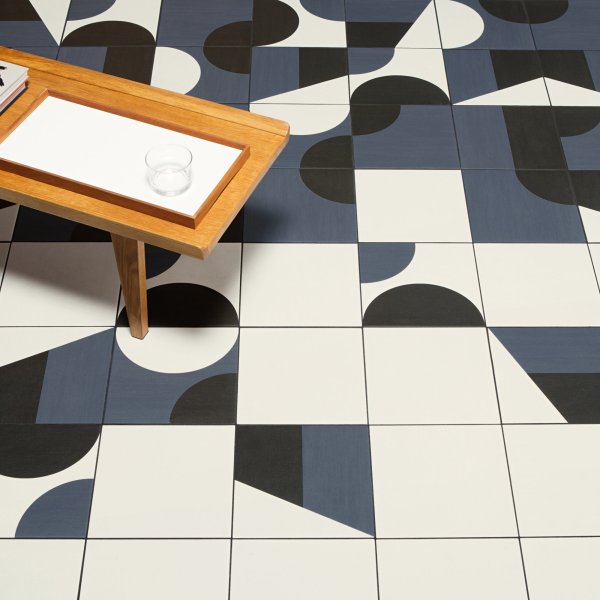
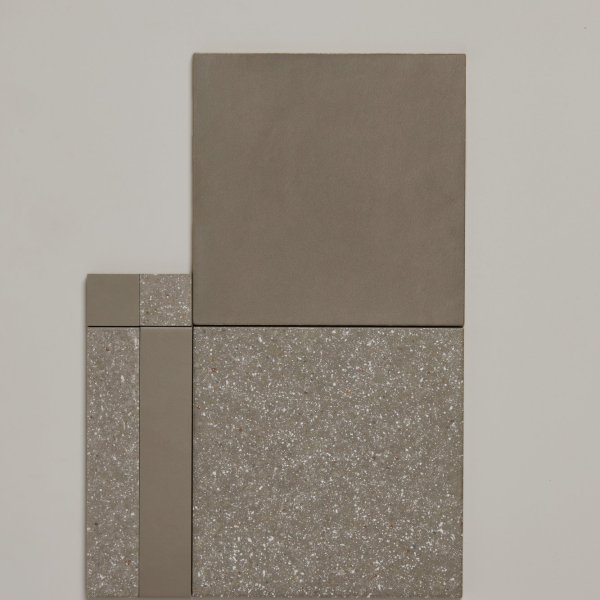
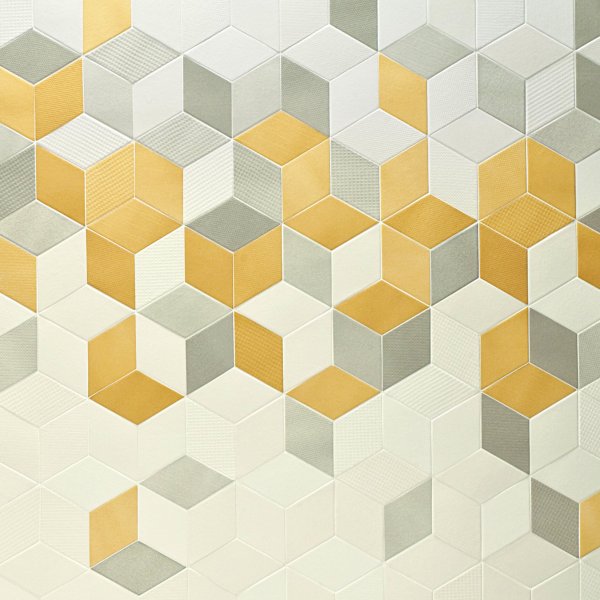
Tape by Mutina laid with mixed graphic patterns in glazed porcelain stoneware

Tape by Mutina: Side A, Side B — a Raw Edges mixtape in stoneware

Mutina

Raw Edges

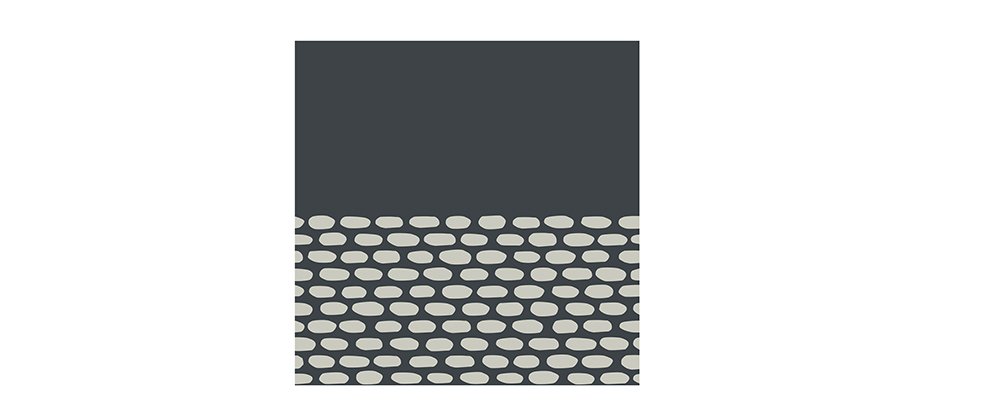
Cobble Half Black
Cobble Half Black Available now
£ 124

Let's discuss your project

Trade terms for professionals and design studios

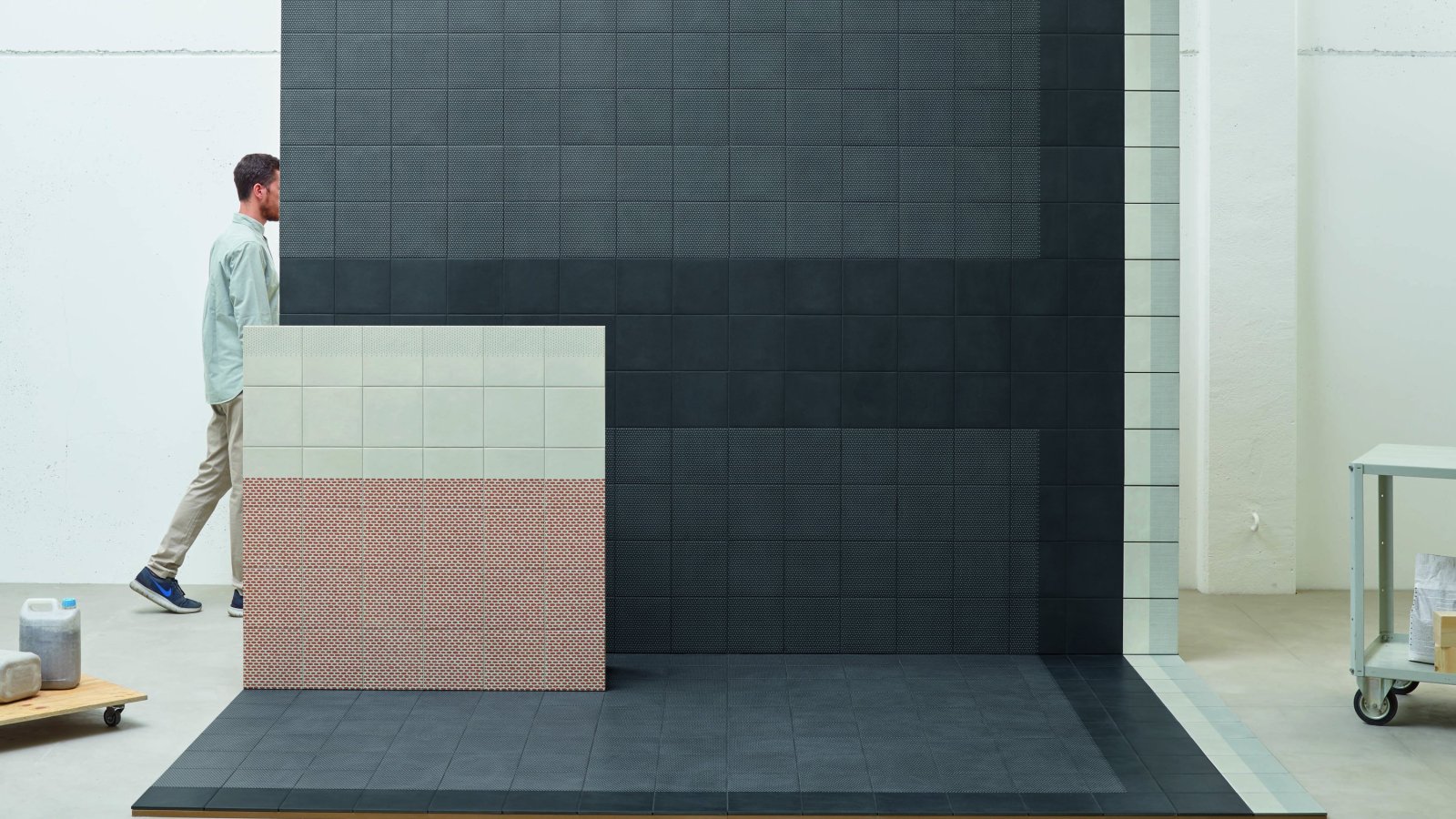
Every mixtape worth keeping has two sides. Tape, the glazed porcelain stoneware collection Raw Edges designed for Mutina in 2017, presses them into a single 20.5×20.5 cm format: Side A is Base White, carrying four colour combinations — white, blue, green, brown; Side B is Base Black, with its own black graphics. The eight patterns are the tracks, and the eight half patterns write the segues, easing one motif into the next instead of cutting.

The grid holds more detail than a first listen reveals. Under each graphic runs a faint, chalky ground; over it, five different glazing textures are mixed at random, so a laid floor shimmers slightly instead of repeating itself. The tiles are not rectified, yet the patterns are perfectly centred — set them with a 2 mm joint and spacer wedges and the surface reads as continuous.

The liner notes are all published: 0.06% water absorption, stain class 5, frost-proof, R10 and DCOF 0.69, with the Robinson test rating the surface for heavy use. So the tracklist can run from the meeting room to the courtyard without changing collection. Match the slip values to the duty of each surface, and download the technical sheet, VOC class A+ and LEED declarations from this page.

Technical information based on data declared by the manufacturer.

Collection: Tape
Manufacturer: Mutina
Design: Raw Edges (Yael Mer and Shay Alkalay), 2017 — registered design no. 004427748-0001/0027 (31/10/2017)
Material: glazed porcelain stoneware — UNI EN 14411 App G (BIa) GL
Size: 20.5×20.5 cm (8.1×8.1 in) (8"×8") — non-rectified, perfectly centred patterns
Thickness: 10 mm (0.39 in)
System: 2 bases (White, Black) — 8 patterns + 8 half patterns (Mesh, Cobble, Grainy, Zigzag) — 5 colour combinations (white, blue, green, brown, black) — 5 glazing textures mixed at random — V2 shade variation
Use: floor and wall — indoor and outdoor
Declared values: water absorption 0.06% (ISO 10545/3) — breaking strength min 1300 N — resistant to frost, thermal shock and chemicals — stain class 5 — R10 (DIN 51130) — DCOF 0.69 — Pendulum 27, P2 (AS/NZS 4586) — Robinson test: heavy use
Sustainability: LEED 4.1 declaration — 20% pre-consumer recycled content across all colours — VOC emission class A+ — HPD available
Installation: 2 mm (0.08 in) joint with spacer wedges — adhesive for porcelain stoneware — cement-based or epoxy grout; the catalogue pairs Nero 06 with Base Black and Calce 01 with the White bases — mix tiles from several boxes
Packing: 16 pieces per box (0.67 sqm) — 23.88 pieces per sqm — 96 boxes per pallet (64.32 sqm)
Documentation: technical sheet, VOC, LEED and HPD downloadable; EPD, SDS and BPD3 on request

La Mercanti Srl — trusted supplier for design and contract projects since 1997.
San Benedetto del Tronto (AP), Italy · +39 0735 753833 · info@lamercanti.com
Supply, quotations, specifications and project support across the UK and worldwide.

Tell us which finishes you'd like to assess

£ 170

Fully redeemable against your first order

FAQ

What does a half pattern do in Tape?
It closes the gap between a full motif and the base tile. Each of the four graphic families has its half version, so a floor can fade from Zigzag to plain in a couple of courses — a designed segue rather than a hard cut.
Does Tape cope with a British exterior?
The declared data says yes: 0.06% absorption, frost resistance, thermal shock tested. Slip values are published as R10, DCOF 0.69 and Pendulum 27 (P2), so match the surface to its duty — a covered terrace reads differently from an exposed ramp.
Why is Tape not rectified, and should I mind?
Mutina prints every pattern perfectly centred on the tile, so the drawing stays continuous; a 2 mm joint with spacer wedges absorbs the calibre differences. The soft edge is part of the collection's chalky, cement-tile character.
Which grout did Mutina choose for Tape?
Cement-based or epoxy, with two catalogue pairings: Nero 06 for Base Black and Calce 01 for the White bases. Keeping the joint in the palette is what lets the eight patterns read as one surface.
How does Tape behave in a hard-working interior?
Stain resistance is class 5, breaking strength is declared at 1300 N minimum, and the Robinson test rates the surface for heavy use — measured on Zigzag Half White, the busiest graphic of the range.

Recording both sides: laying out Tape in five steps

How to sequence eight patterns, two bases and their segues into one continuous floor — from first tracklist to final mix.

Pick your side
Base White carries four colour combinations, Base Black one. Decide which side of the tape each space plays: light workrooms on White, an evening-facing bar or lounge on Black.
Sequence the tracks
Give each function its own pattern — Mesh, Cobble, Grainy or Zigzag. A meeting room, a break area and a reception can each hold a track without changing format: everything stays 20.5×20.5 cm.
Write the segues
Where two areas meet, specify the half pattern of the outgoing motif. One or two courses are enough to fade the graphic into the base — no trims, no thresholds, no abrupt key change.
Lock the joint
Specify a 2 mm joint with spacer wedges and porcelain adhesive, then keep the grout in the palette: Nero 06 on Base Black, Calce 01 on the White bases, cement-based or epoxy as the room requires.
Blend from several boxes
Five glazing textures are mixed at random through the production. Draw tiles from different boxes as you lay, and order by area at 23.88 pieces per square metre, 16 to a box.

You May Also Like