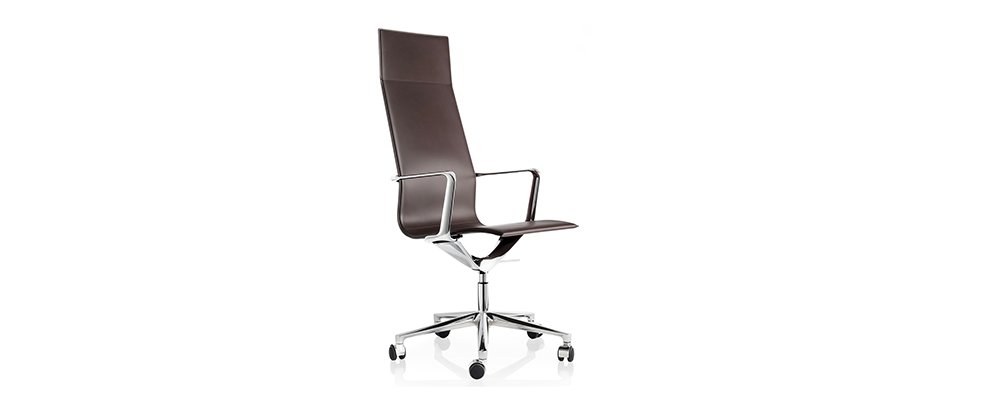
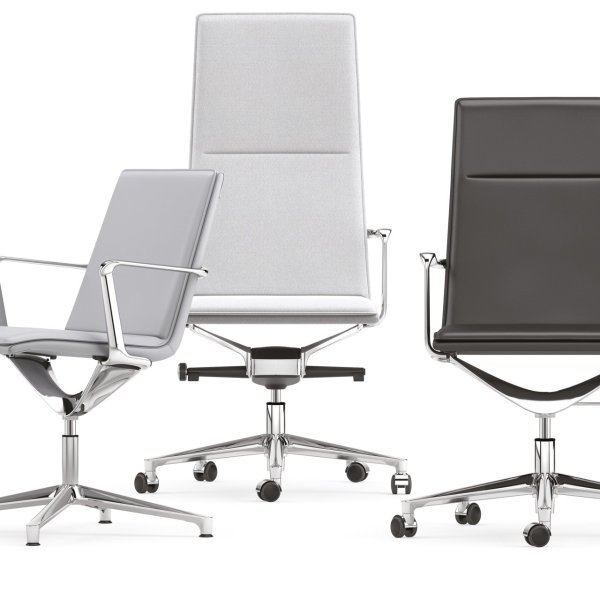
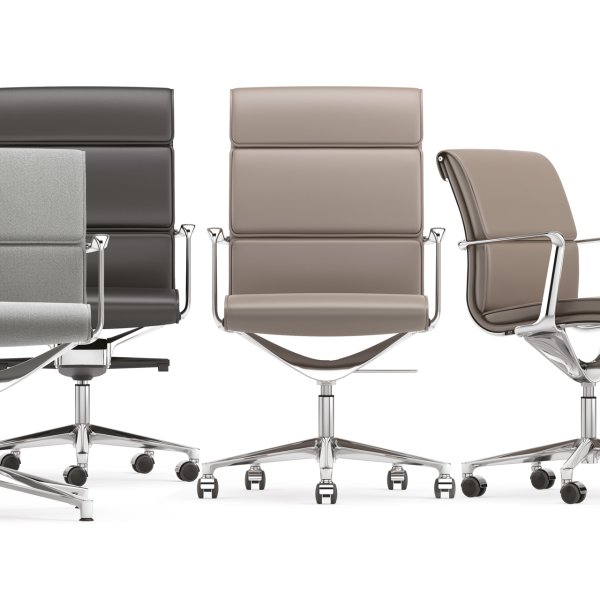
Kuna Chair by ICF Office in a boardroom

Warm and cold in the same object: the two materials of Kuna Chair

ICF Office
Executive chair
Kuna Chair 713 Most chosen configuration Executive chair
£ 3,187

Let's discuss your project

Trade terms for professionals and design studios

ICF opens the Kuna presentation on a contradiction and does not try to resolve it: the warmth and tradition of leather against a clean, modern aluminium line. Most executive chairs pick a side. This one keeps both materials visible and lets the eye move between them.

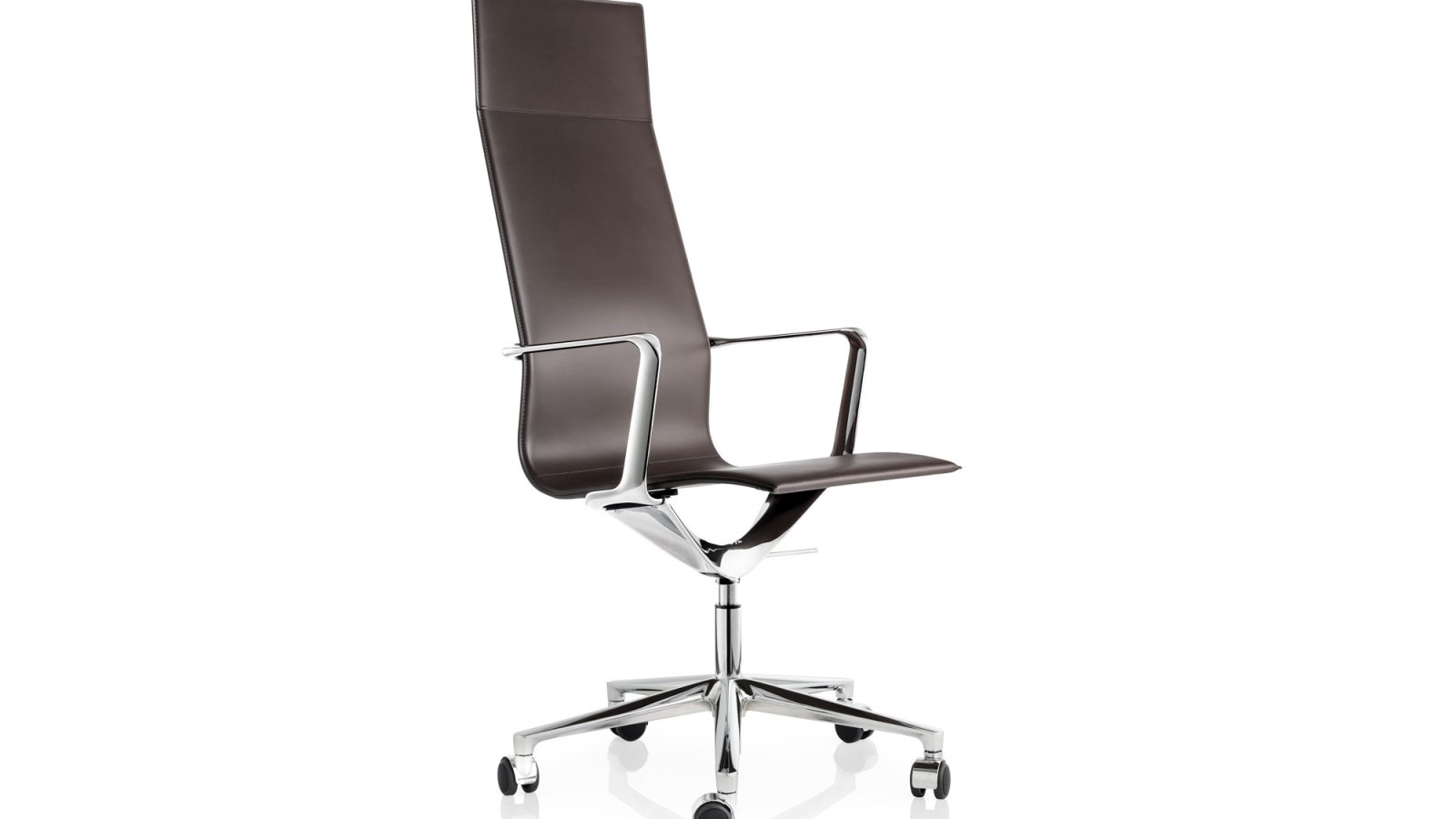
It works because neither is treated as decoration. The leather is not a cover laid over foam: a panel is wrapped around the padded frame and left suspended, so it takes the body's weight as a stretched surface. The aluminium is not hidden either — the load-bearing elements are exposed, cast rather than bent, and finished polished or chrome to match the base and the closed armrests.

The consequence is a chair with only two materials in it, which is unusually few for the category and the reason it settles into a panelled boardroom and a glass-walled office equally well. Leather comes in four colours: black, white, dark brown and Bulgarian red. La Mercanti specifies Kuna Chair across the UK with samples in hand and the finish schedule agreed before anything is ordered.

Technical information based on data declared by the manufacturer.

Collection: Kuna Chair
Manufacturer: ICF Office — ICF S.p.A., Vignate (Milan), Italy
Frame: steel tubular sections forming a rigid construction that holds its shape under considerable stress; exposed load-bearing elements in die-cast aluminium, finish 47 polished or 55 chrome; three back heights
Back and seat: leather panel wrapped around the padded load-bearing structure over variable-density polyurethane foam sheets; the panel remains suspended, distributing body weight evenly
Armrests: closed form in die-cast aluminium, finish matched to the frame; optional leather covering; can be omitted without compromising the integrity of the chair
Leather: category S full-grain cowhide, 2.7–3 mm (0.11–0.12 in) thick, 100% vegetable re-tanned; four colours: S01 black, S02 white, S03 dark brown, S05 Bulgarian red
Models: low back KUNA.708 (fixed height with auto-return mechanism, four-star base on glides), .709 (height-adjustable, five-star base on castors) and .717T (with tilt mechanism); medium back .715, .718 and .719T; with headrest .710, .713 and .714T; hide-covered armrests on request on every model
Dimensions: width 60 cm (23.6 in) and depth 48 cm (18.9 in) across all nine models; overall height from 83 to 133 cm (32.7 to 52.4 in) depending on model and back height; seat height 48 cm (18.9 in) on fixed-height models, 43-54 cm (16.9-21.3 in) on adjustable models, 44-56 cm (17.3-22 in) on tilt models
Height adjustment: pneumatic unit with lever, maximum travel 12 cm (4.7 in); gas lift compliant with EN 16955:2017
Auto-return mechanism: not height-adjustable; the swivel seat turns freely and returns automatically to the front-facing position; standard on four-star base models
Tilt mechanism: seat pivot point set well forward of the gas column axis to reduce pressure on the lower limbs while tilting; up to 13 degrees of movement; side knob adjusts balance spring tension to the user's weight and sitting style; lever controls combine seat height, locking and unlocking the tilt in four positions, and the safety lock
Base: four or five-star in die-cast aluminium, chrome or polished to match the frame; with castors or glides
Castors and glides: castors in black plastic, 50 mm (2 in) diameter, soft central element for use on any floor, safety brake compliant with EN 12529:2001, chromed zamak top cover; hard-tread castors available on request; glides in black nylon, 37 mm (1.5 in) diameter, with a soft rubber central element
Weight and materials: approx. 12.4 kg (27 lb) (technical sheet), 14–20 kg (31–44 lb) depending on model (price list); aluminium 48 per cent, metal 28 per cent, miscellaneous 24 per cent; approx. 77 per cent recyclable when the components are fully and correctly separated; every component can be dismantled for repair, reuse and recycling; formaldehyde-free and free of hexavalent chromium; designed according to eco-design guidelines. Data refer to model KUNA.708 and may vary by model, structural materials and finishes
Certification: EN 16139:2013 level 1, declaration of conformity no. 11108 of 13 January 2014 on KUNA 715 following tests to EN 16139, EN 1728 and EN 1335; ANSI-BIFMA X5.1, CATAS test report on KUNA MID BACK 708
Care: leather is a natural product and the wrinkles and scars on the grain attest to its origin and quality rather than being defects; avoid direct light so the leather does not dry out or harden. Aluminium: soft cloth with water and neutral soap, never solvents, thinners, alcohol, abrasive or chemical cleaners or polishing sprays; chrome aluminium keeps its brightness over time, polished aluminium undergoes a natural oxidation process. Only trained personnel may replace or repair the gas lift
Spare parts and accessories: set of five castors with chrome cap, set of four or five black glides

La Mercanti Srl — trusted supplier for design and contract projects since 1997.
San Benedetto del Tronto (AP), Italy · +39 0735 753833 · info@lamercanti.com
Supply, quotations, specifications and project support across the UK and worldwide.

Tell us which finishes you'd like to assess

£ 170

Fully redeemable against your first order

FAQ

Why does a chair with only two materials look richer than one with five?
Because nothing competes. Kuna Chair is leather and aluminium, and both are shown rather than covered: the leather panel is left suspended around the padded frame, the load-bearing elements are exposed and cast. There is no third material asking to be explained.
Is the leather laid over foam like a normal upholstered seat?
Not quite. A panel is wrapped around the padded load-bearing structure, over variable-density polyurethane sheets, and then stays suspended — ICF describes it as distributing body weight evenly. It behaves as a tensioned surface rather than a cushion sitting on a shell.
Which of the two finishes should the aluminium have?
Polished or chrome, and they age differently: chrome keeps its brightness over time, while polished aluminium undergoes a natural oxidation process. Both are matched across frame, base and armrests, so the decision is made once for the whole chair.
Can it be ordered without armrests?
Yes, and ICF is explicit that omitting them does not compromise the integrity of the chair. It is the sensible choice where chairs have to tuck fully under a table, or where a minimal profile matters more than the arm.
How is the leather looked after?
Keep it out of direct light so it does not dry out or harden, and treat the marks it develops as part of the material: ICF states that wrinkles and scars on the grain attest to origin and quality rather than being defects.

Reading an executive chair made of two materials

Five checks before the finish schedule is signed off.

Look at what is left exposed
On Kuna the load-bearing elements are visible by design. If a chair hides its structure, you are buying the cover; if it shows it, the casting quality is part of what you are paying for.
Decide the aluminium finish before the leather colour
Polished or chrome runs across frame, base and armrests and sets the temperature of the whole piece. The leather colour then works with it, not against it.
Choose the leather from four, not from a swatch book
Black, white, dark brown, Bulgarian red. A short palette is faster to decide and far easier to reorder identically in two years.
Settle the armrest question room by room
Aluminium, leather-covered, or none at all. Meeting rooms with tight table clearances usually want the third answer.
Write the model code, not the model name
The code carries the mechanism and the base. Without it, a repeat order is a different chair with the same name on the invoice.

You May Also Like