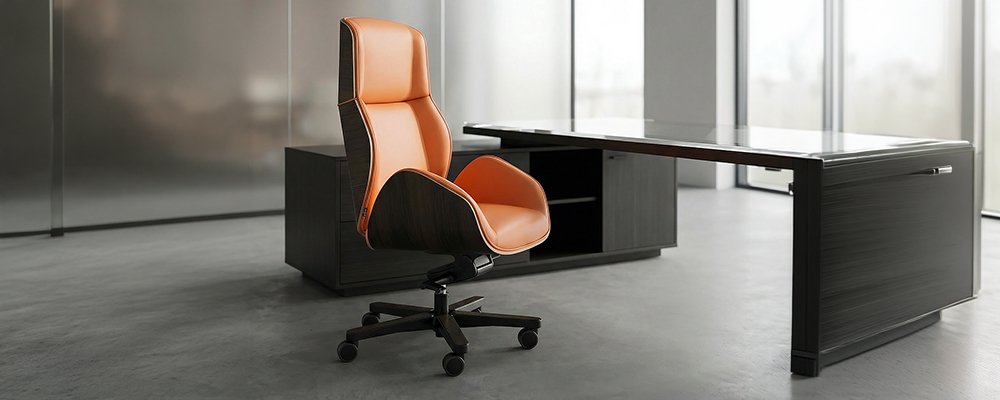
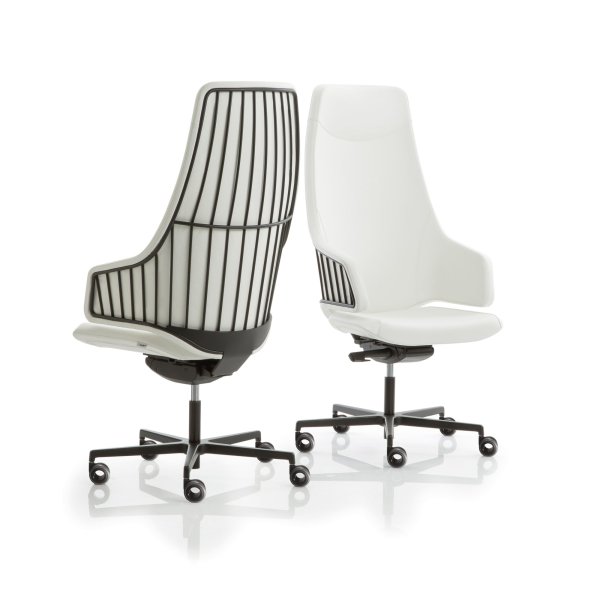
Executive office chair Suoni by Vaghi seen from three quarters

An executive chair with a wooden outer shell: Vaghi Suoni

Vaghi
Executive chair
Suoni The piece that makes the room Executive chair
£ 2,904

What did you have in mind?

Trade terms for professionals and design studios

Almost every executive chair on the market is upholstered on all sides. Suoni can be specified with a wooden outer shell: the back of the chair — the part everyone sees when the desk is occupied — is timber, finished in rosewood, with aluminium base caps in the same material.

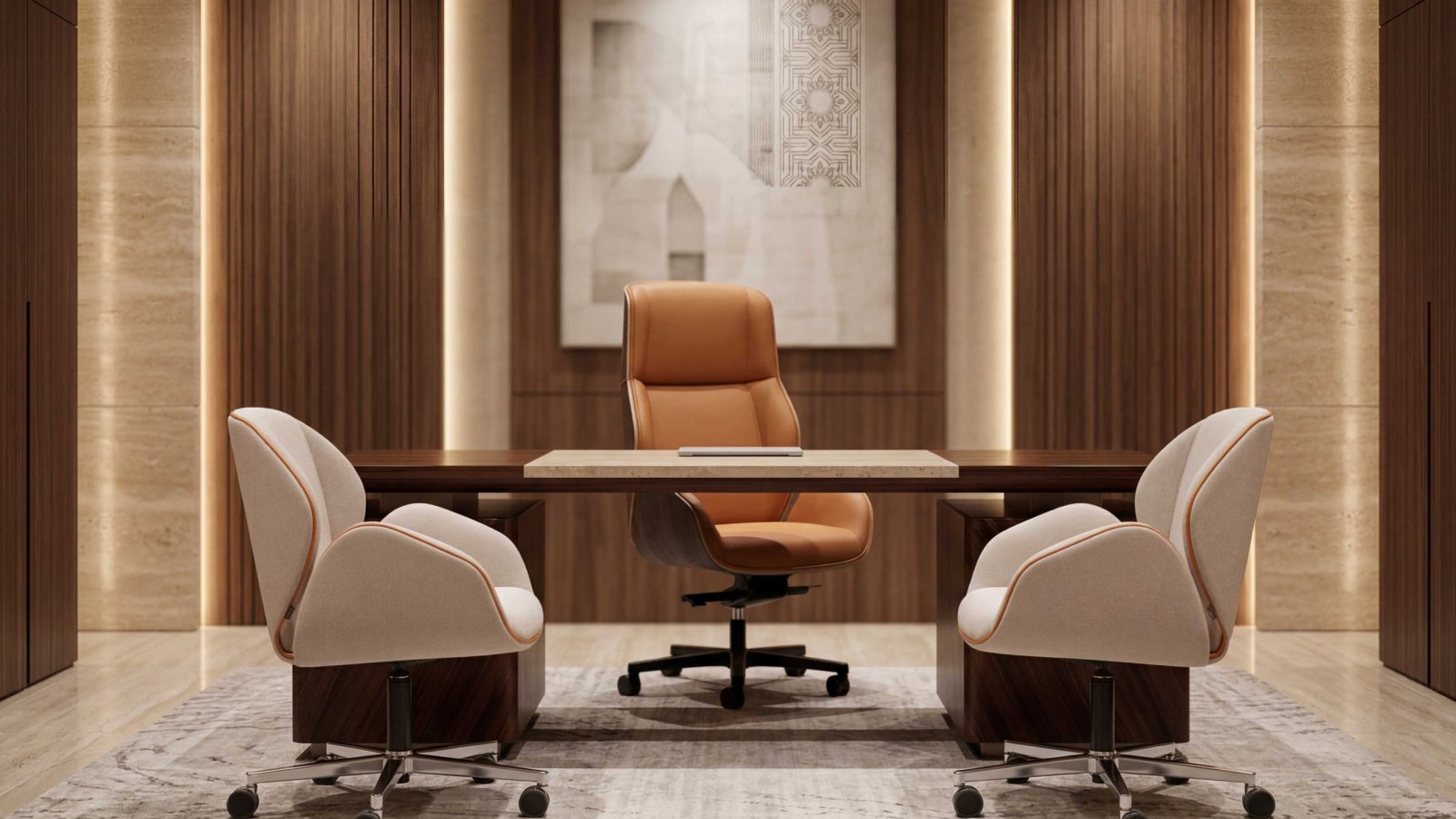
That changes what the chair does in a room. Upholstery absorbs light and mass; wood reflects the joinery around it, so the chair belongs to the same family as the desk, the bookcase and the door rather than sitting on top of them. Vaghi offers it in two forms — SL with a plain edge and SM with a contrasting one — alongside three fully upholstered versions for rooms where softness matters more.

The design comes from the company's own research department, and the armchair is tested to EN 1335 by CATAS. La Mercanti specifies the shell configuration, the fabric and the base finish for offices in the United Kingdom and beyond.

Technical information based on data declared by the manufacturer.

Model: Suoni Executive Armchair, Vaghi — design Vaghi R&D

Shell configurations: SI upholstered shell with plain edge · SL wooden shell with plain edge · SM wooden shell with contrasting edge · SH upholstered shell with contrasting edge · SB two-tone upholstery

Versions: high and low backrest · Executive codes SBD8X, SHD8X, SHD6X, SLC8L, SLC6L, SLD8L · matching Guest Chair in codes SHO6X, SHO6K, SLO6L, SLO6K

Executive dimensions: width 690 mm (27.2 in) · depth 690 mm (27.2 in) · overall height 1190/1290 mm (46.9/50.8 in) with the high backrest, 890/990 mm (35/39 in) with the low one · seat height 420/520 mm (16.5/20.5 in) · armrest height 650/750 mm (25.6/29.5 in)

Guest dimensions: width 690 or 730 mm (27.2 or 28.7 in) · depth 690 or 730 mm (27.2 or 28.7 in) · overall height 890/990 mm (35/39 in) · seat height 420/520 mm (16.5/20.5 in) · armrest height 650/750 mm (25.6/29.5 in)

Mechanism: height-adjustable seat · tilting mechanism with tension adjustment and anti-return lock

Base: polished aluminium, aluminium RAL 9017 or rosewood · SL and SM versions with aluminium base and rosewood caps

Certification: Executive Armchair tested to EN 1335 by CATAS · Guest Chair tested to EN 16139, EN 1022 and EN 1728 by CATAS

La Mercanti Srl — trusted supplier for design and contract projects since 1997.
San Benedetto del Tronto (AP), Italy · +39 0735 753833 · info@lamercanti.com
Supply, quotations, specifications and project support across the UK and worldwide.

FAQ

How many shell configurations are there?

Five, and they are genuinely different builds rather than colourways: SI fully upholstered with a plain edge, SL with a wooden shell and plain edge, SM wooden with a contrasting edge, SH upholstered with a contrasting edge, and SB in two-tone upholstery. The mechanics and dimensions are identical across all five, so the decision is about how the chair reads in the room and how it will be maintained.

Which standard is the chair tested to?

The Executive Armchair is tested to EN 1335 by CATAS, the Italian testing institute for furniture; EN 1335 is the European standard for office work chairs and covers dimensions, safety and strength. The matching Guest Chair is tested separately to EN 16139, EN 1022 and EN 1728, the standards that apply to seating for non-domestic use. La Mercanti supplies the manufacturer's current test documentation on request.

What are the seat and armrest heights?

The seat adjusts between 420 and 520 mm and the armrests sit at 650/750 mm from the floor. The second figure is the one people forget: it decides whether the chair slides under the desk at the end of the day or stays permanently pulled out. Measure the clear height under the desk frame, not the top of the worksurface, before confirming the order.

Can the base be specified in something other than aluminium?

The base is aluminium in every case, but the finish changes: polished, RAL 9017, or rosewood. On the SL and SM versions it comes with rosewood caps that pick up the wooden shell. In a room with timber joinery that detail is what ties the chair to the rest of the furniture; in a purely white interior polished aluminium keeps the base almost invisible.

Is there a chair for visitors in the same family?

Yes. The Suoni Guest Chair shares the shell configurations and the finishes, and comes in two widths, 690 and 730 mm. Specifying both from the same family means the desk chair and the two chairs in front of it carry the same edge detail and the same fabric, which is the difference between a room that was designed and one that was furnished in two separate orders.

How to choose between a high and a low backrest

Thirty centimetres of backrest change a room more than any finish does. Five questions that settle the choice before the order goes out.

Measure what stands behind the desk

A high backrest reads against whatever is behind it. In front of a window or a low bookcase it becomes the foreground of the room; against a full-height panel it disappears into it.

Check the sightline from the door

Sit where a visitor sits. If the backrest hides the person behind the desk, the room feels defensive; if it frames them, it does the opposite.

Count the hours spent reclining

A high back supports the head when you lean away from the screen. Someone who reads and listens for hours gains from it; someone who types all day rarely uses it.

Look at the ceiling height

Thirty centimetres of extra backrest are far more visible under a low ceiling. In a converted floor with beams, the lower version usually sits better.

Put both versions in the same room

La Mercanti can place the two heights side by side before the order; the difference is obvious in ten seconds and impossible to judge from a catalogue.

You May Also Like