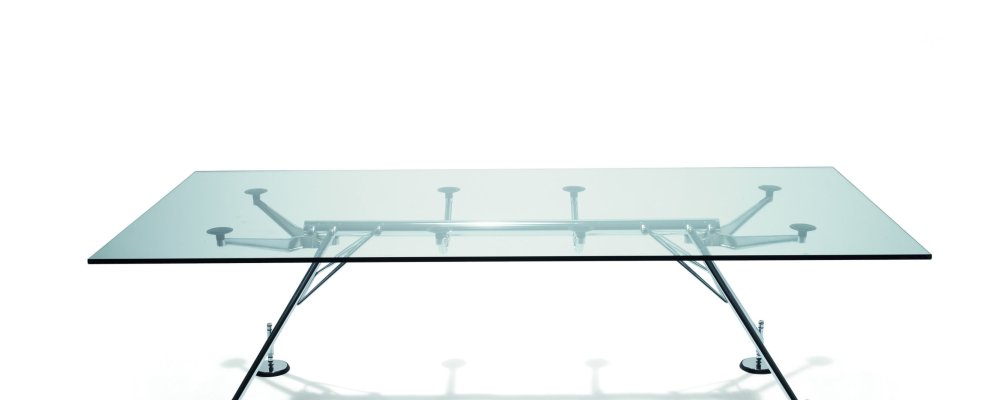
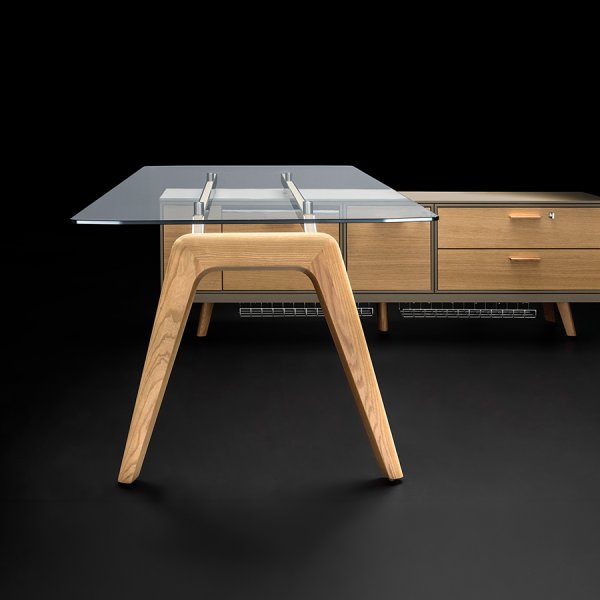
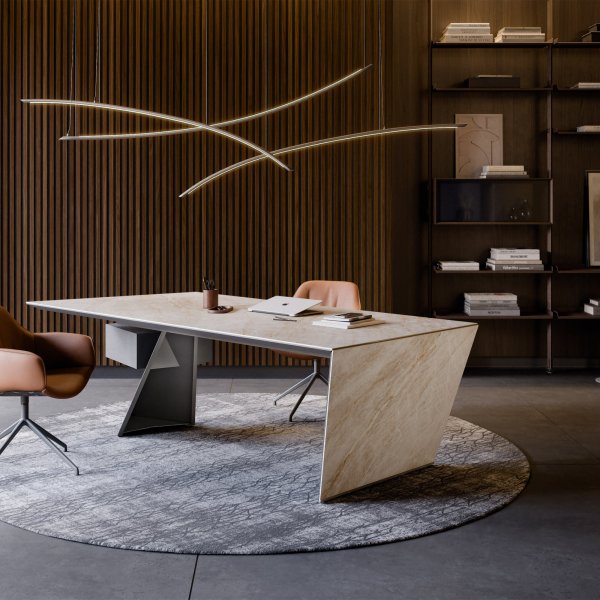
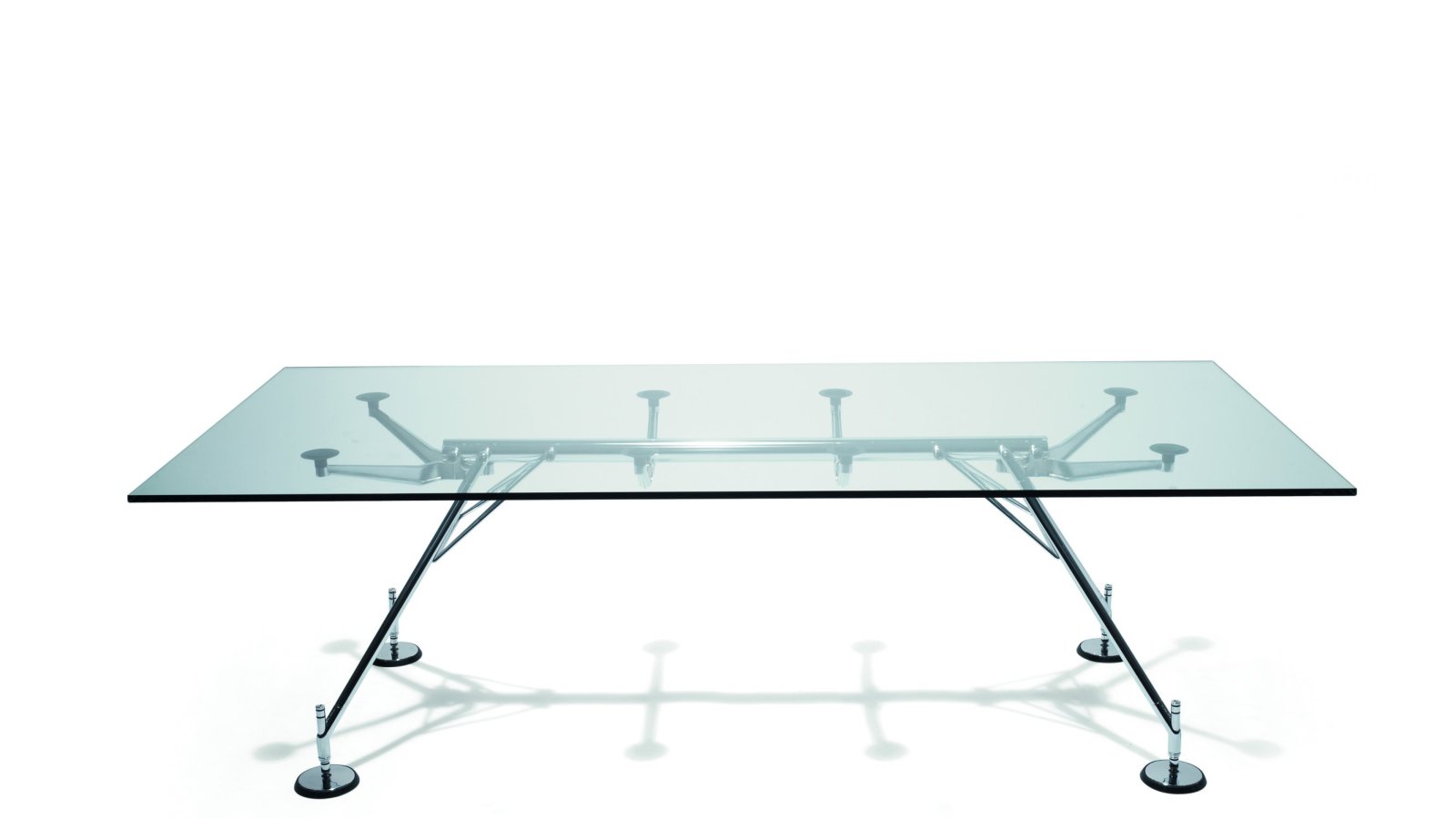
Nomos desk system by Tecno with tubular metal backbone and tempered glass top

Nomos by Tecno — the 1986 desk that became infrastructure

Tecno

Norman Foster

Executive desk only
Nomos An icon of Italian design Executive desk only
£ 5,616

Already have something in mind?

Trade terms for professionals and design studios

In 1986, Norman Foster and Tecno did something unusual with the office desk: they stopped designing furniture and started designing infrastructure. Nomos is built the way a building is built — a tubular metal backbone runs the length of the composition, and everything else clips onto it: legs, feet, worktops, superstructures, screens. A jury needed only a year to understand what had happened; the Compasso d'Oro followed in 1987.

Because the structure is shared, the desk has no fixed size. Compositions grow in length and depth, from a single workstation to shared benches and meeting tables cut to measure. Cabling rises from the floor through a black plastic vertebra fixed to the frame and travels in modular perforated-steel ducting beneath the tops — services routed like a building's, not taped under a desk.

The finishes keep the architectural register: chrome or nickel-painted frames in white, dark grey or gloss black, tops in HPL, lacquer, wood veneers or back-painted tempered glass, clear and ultra-clear. La Mercanti supplies Nomos the way it was conceived — as a drawn composition, dimensioned on paper and confirmed in writing before anything is built.

Technical information based on data declared by the manufacturer.

Collection: Nomos System
Manufacturer: Tecno S.p.A. (founded 1953)
Design: Norman Foster, 1986
Award: Compasso d'Oro 1987 (design Foster & Partners)
Structure: load-bearing tubular metal backbone; legs, feet, supports, worktops, superstructures and screens attach to the shared frame
Cable management: black plastic vertebra fixed to the frame for orderly cable access from the floor; modular painted perforated sheet-metal ducting beneath the worktops; cable tray and hooks
Tops: high-pressure laminate, white or dark grey lacquer, wood veneers, back-painted clear or ultra-clear tempered glass; top arranged for a leather desk pad available
Frames: chrome, or nickel paint in white, dark grey or gloss black
Variants: Nomos workstation, Nomos meeting, Nomos table
Components: end, intermediate and front screens, modesty panel, upper shelves, side return tops
Compositions: different lengths and depths, from individual workstations to large made-to-measure meeting tables

La Mercanti Srl — trusted supplier for design and contract projects since 1997.
San Benedetto del Tronto (AP), Italy · +39 0735 753833 · info@lamercanti.com
Supply, quotations, specifications and project support across the UK and worldwide.

Tell us which finishes you'd like to assess

£ 170

Fully redeemable against your first order

FAQ

Why is the Nomos system considered a design icon?
Tecno describes it as the pioneer of shared-structure systems and a recognised icon of industrial design: Norman Foster drew it in 1986, the Compasso d'Oro arrived in 1987, and the system is still in the catalogue today.
What does a shared structure mean in practice?
One tubular backbone carries several workstations: tops, legs, screens and shelves all attach to the same frame. Fewer parts, a cleaner floor, and compositions that can be re-drawn instead of replaced.
How does Nomos handle power and data cables?
Cables rise from the floor through a black plastic vertebra secured to the frame, then run in painted perforated sheet-metal ducting beneath the tops. The electrification is concealed without chasing walls or floors.
Can a Nomos boardroom table be made to a specific size?
Yes. Meeting compositions are built on the same backbone in different lengths and depths, up to large tables with made-to-measure dimensions — the drawing is agreed before production and confirmed in writing.
Which top finishes does the Nomos system offer?
High-pressure laminate, white or dark grey lacquer, wood veneers and back-painted tempered glass in clear or ultra-clear versions, combined freely with chrome or nickel-painted frames. La Mercanti puts the finish options side by side on one drawing, so the choice is made once and made well.

Specifying Nomos: from floor plan to backbone

Five steps to turn an empty plan into a Nomos composition that works as hard as the building around it.

Read the building
Note where power rises from the floor and where daylight falls: the backbone should follow the services, not fight them.
Draw the spine
Set the length and direction of the tubular backbone first — workstations, benches and meeting tops all descend from this one line.
Dress the frame
Choose chrome or white, dark grey or gloss black nickel paint for the structure; it stays visible, so it is a design decision, not a default.
Choose the tops
Glass for representation, HPL for heavy use, veneer or lacquer to match the interior — tops can differ along the same spine.
Fix the drawing
Close with a dimensioned drawing of the whole composition, screens and cable runs included, and have it confirmed in writing before ordering.

You May Also Like