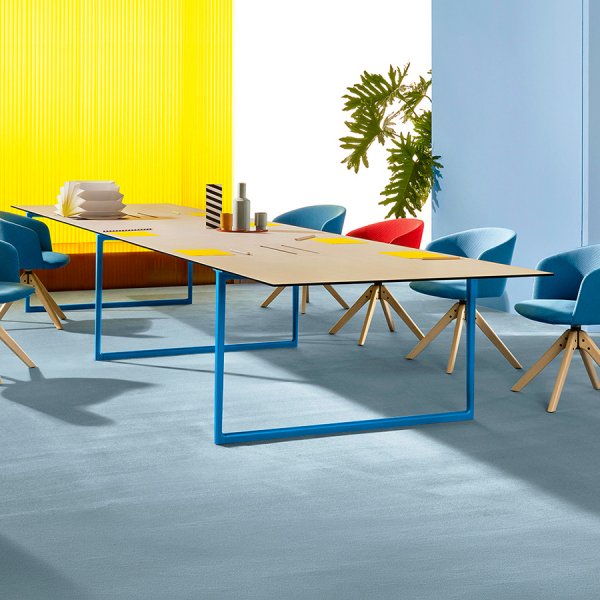
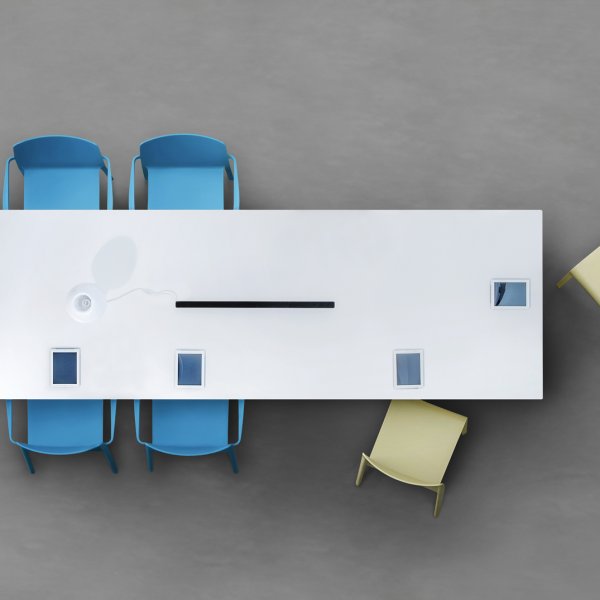
Trilo conference table by Bralco in a boardroom

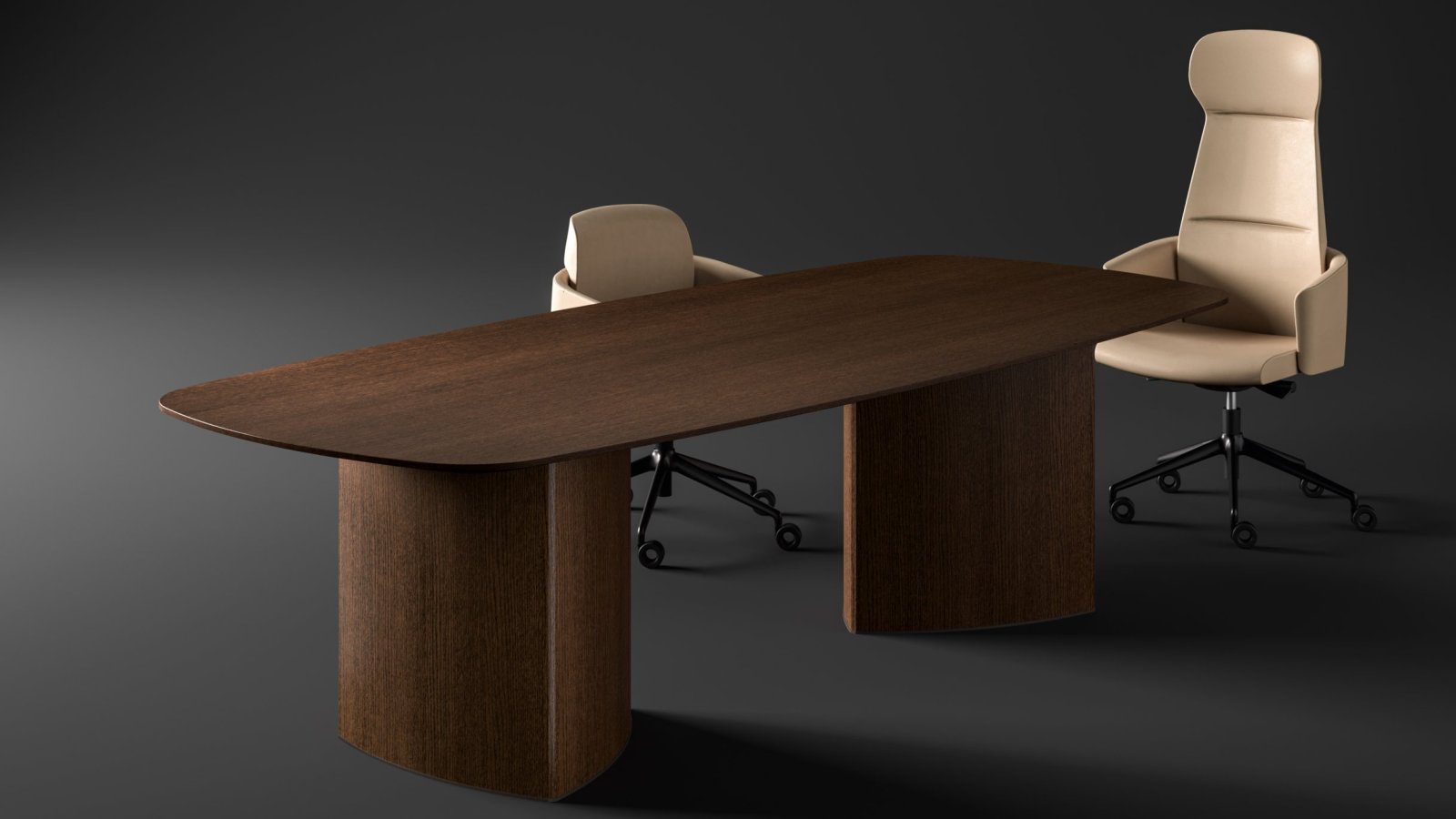
Trilo by Bralco, the conference table on moulded columns

Bralco
Conference table only
Trilo The piece that makes the room Conference table only
£ 8,595

Already have something in mind?

Trade terms for professionals and design studios

Moulded plywood has a distinguished history in seating; Bralco brings it to the conference room floor. The columns carrying the Trilo table are shaped panels of mould-formed plywood, veneered and edged in oak to match the top, joined by 6 mm plates lacquered on both faces. The result is a base that reads as sculpture — the sinuous curves the catalogue promises — while doing structural work and hiding cable runs inside the legs through dedicated openings.

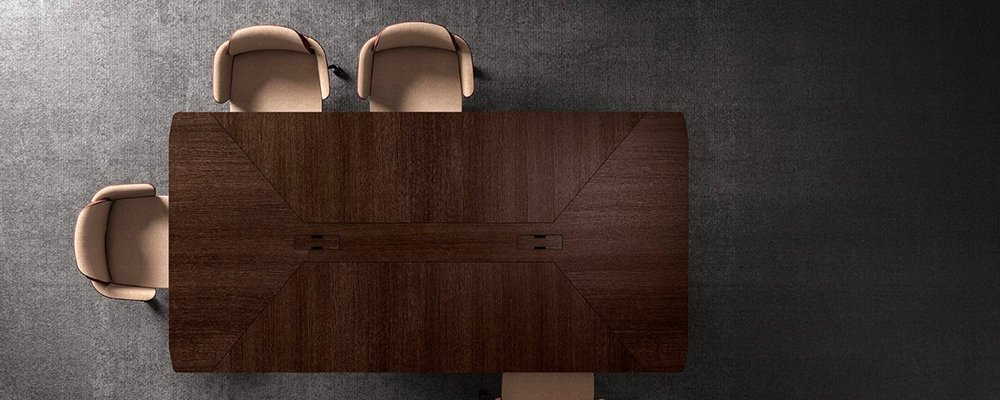
Above, the top is a 30 mm MDF core veneered on both sides, edged with solid wood rounded to a 2 mm radius, its perimeter tapered and chamfered so the thickness almost disappears at eye level. Finishes run from seven oaks to Ecomalta and leather inserts with visible stitching; sizes go from 140 cm up to 360-440 cm boardroom formats seating 12/14, plus round tables at ø 120 and ø 160. Designed by Gianantonio Perin and Monica Fernandes, Trilo reaches UK projects through La Mercanti — engineering below, cabinetmaking above.

Technical information based on data declared by the manufacturer.

Collection: Trilo
Manufacturer: Bralco
Design: Gianantonio Perin and Monica Fernandes
Type: conference and executive tables in wood
Tops: 30 mm MDF veneered 0.6 mm on both sides; solid wood perimeter edge 1 mm rounded to 2 mm radius; tapered and chamfered profile; marquetry tops available with grain laid in opposite directions
Finish process: water-based stain with clear acrylic topcoat, or open-pore lacquer
Structure: columns in mould-shaped plywood, oak veneered and edged; 6 mm joining plates lacquered on both faces; internal cable routing through leg openings
Power: concealed socket boxes with a flap opening from both sides, finished in the same veneer as the top
Sizes (h 75): w 140 · 160 · 179.4 · 240-280 (8/10 seats) · 280 · 282×171 · 360-440 (12/14 seats); round ø 120 and ø 160
Wood finishes: natural, grey, dark grey, tobacco, Carbon, black lacquered and white lacquered oak
Other finishes: Ecomalta H1/H2/H3 on tops and legs; leather or eco-leather insert with stitching detail; shadow grey metal
Recyclability: wood 100%, metal 100%, plastic 99.5%

La Mercanti Srl — trusted supplier for design and contract projects since 1997.
San Benedetto del Tronto (AP), Italy · +39 0735 753833 · info@lamercanti.com
Supply, quotations, specifications and project support across the UK and worldwide.

Tell us which finishes you'd like to assess

£ 170

Fully redeemable against your first order

FAQ

What does mould-shaping actually add to the table base?
Compound curves that flat panels cannot achieve: each column is pressed to shape in plywood, then veneered and edged in oak to match the top. The base carries the load, swallows the cabling through internal openings and still reads as a piece of furniture rather than a leg system.
How is power delivered to the middle of a long table?
Through concealed socket boxes cut into the top, with a flap that opens from both sides and a slot for cable exit; the flap is finished in the same veneer and colour as the surface, so a closed table shows nothing but wood. Cables continue down inside the legs.
Which sizes suit a twelve-person board?
The 360-440 cm formats are declared for 12/14 seats at the standard 75 cm height, with a 171.6 cm depth that keeps papers, screens and elbows comfortable. Below that, 240-280 cm tables seat 8/10, and round tables at ø 120 and ø 160 handle smaller sessions.
Is the veneer likely to bow or cup over the years?
The construction works against it: the 30 mm MDF core is veneered on both faces — balanced panels move far less than single-sided ones — and sealed with water-based stain plus a clear acrylic coat, or an open-pore lacquer. Care is ordinary: soft cloth, along the grain, no abrasives.
What happens to a Trilo table at end of life?
It separates into clean fractions: Bralco declares the wood 100% recyclable, the metal 100% and the plastic components 99.5%. Combined with a construction designed around replaceable elements, the table is an asset that exits the building as materials, not as waste.

Specifying a boardroom table that survives the refit

Five decisions that make a conference table a keeper — from the base geometry to the last socket.

Start under the top
Judge the base before the finish: moulded columns spread load and hide services, and a table you love in year one must still stand straight in year ten.
Match length to the room's breathing space
Allow circulation around the 360-440 formats before falling for them; a 280 that lets people move beats a 440 that traps the far corner.
Put the sockets where the laptops sit
Position the concealed boxes on the actual seating plan, not symmetrically; power that arrives at the wrong seat generates the cable spaghetti the flap was meant to prevent.
Choose one hero material
Oak, Ecomalta or the stitched leather insert — commit to one statement and let the others support; three heroes on one table is none.
Order the round table for the hard talks
Add a ø 120 or ø 160 alongside the main board: difficult conversations go better where no one owns the head of the table.

You May Also Like