Let's discuss your project
Trade terms for professionals and design studios
Let's discuss your project
Trade terms for professionals and design studios
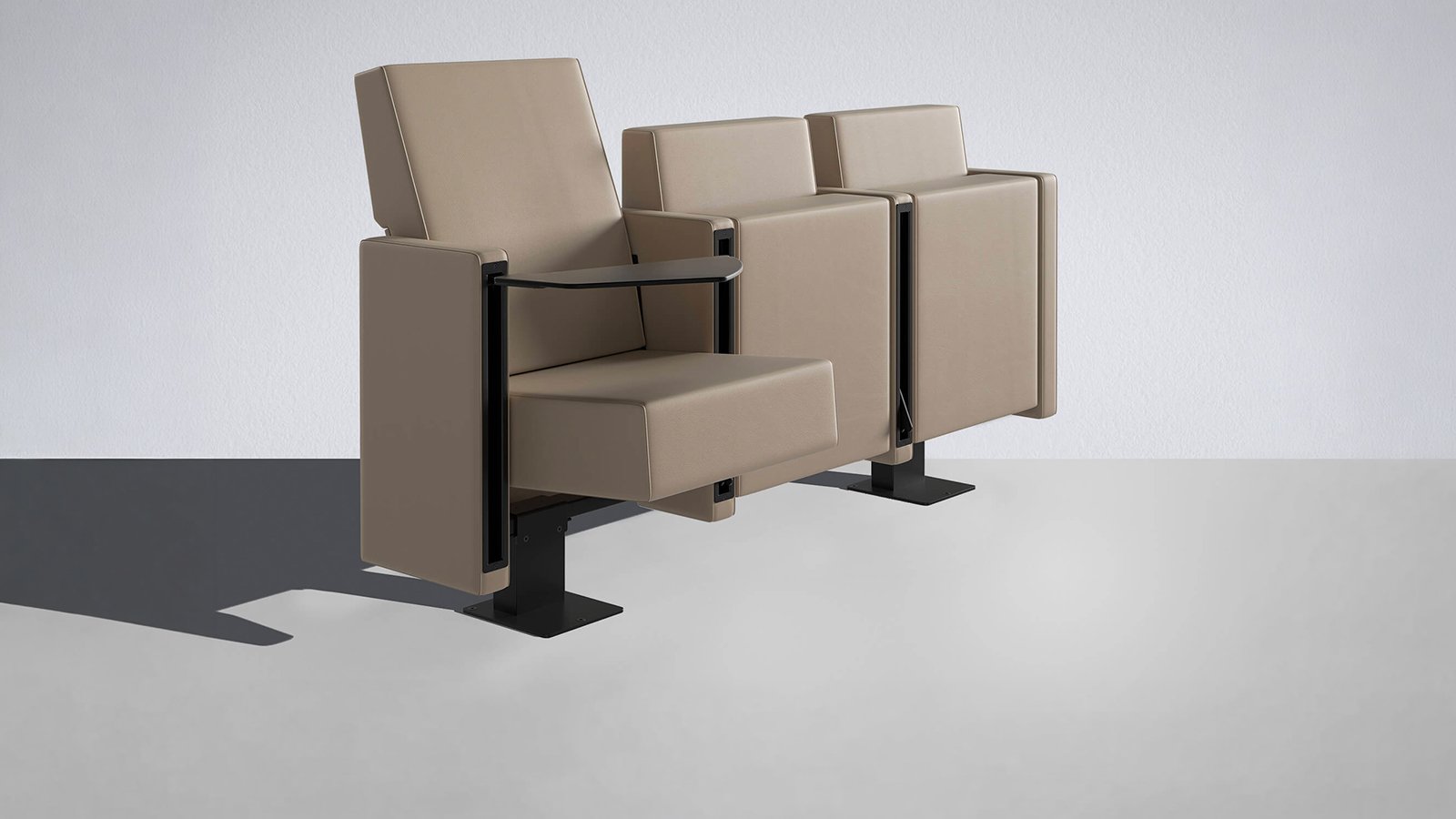
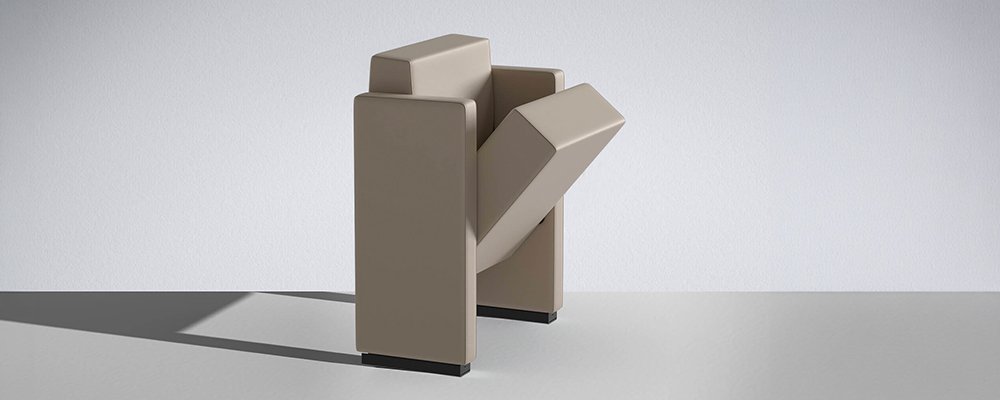
Walls: that is what Mura means in Italian, and the seating earns the name. Every side panel rises straight from the floor, 30 cm deep and 7 cm thick (11 7/8 by 2 3/4 in), upholstered on each face like the seat itself. Tip the seat up and the backrest settles into line with it, so nothing stands proud of the panels. An empty row reads as one continuous padded wall, 68 cm (26 3/4 in) high with the low back or 83 cm (32 5/8 in) with the high one.
Within that wall the seats sit at a pitch of 53 to 56 cm (20 7/8 to 22 in), centre to centre, and since two neighbours share one 7 cm panel, the end of a row is closed by a single panel rather than a pair. Gino Gamberini drew Mura for Lamm with that discipline in mind: an auditorium and theatre seating system whose closed profile is a flat surface, not a silhouette of seats.
The same architecture takes the other versions in its stride: a beam-mounted variant with the panels resting on a square steel tube, a slimmer 24 cm side made to order, and a tablet for writing that tucks inside the standard panel for lecture theatres and congress halls. Straight rows can also be fitted with castors so the seating is wheeled away between uses. La Mercanti settles how long the wall will be before anyone counts the seats inside it.
Collection: Mura
Manufacturer: Lamm S.r.l., San Secondo Parmense (Parma), Italy
Design: Gino Gamberini
What it is: compact armchair for conference halls and auditoriums; in the standard version the closed seat and backrest line up with the side panels
Versions: side panel to the floor, or beam-mounted; low or high backrest
Installation: level or sloping floors, or tiers; straight rows or curved rows
Centre-to-centre: 53 to 56 cm (20 7/8 to 22 in)
Row spacing: 85 cm (33 1/2 in) on a level floor; 90 cm (35 3/8 in) on tiers, as drawn; curved rows not less than the level-floor spacing
Minimum curve radius: 15 m (49 ft 3 in)
Seat and backrest: plywood structure; non-deformable flame-retardant polyurethane foam; backrest in two heights
Mechanism: gravity device that frees the seat and tips it up with a damped soft-close movement; the backrest lowers and goes vertical in sync, reducing the overall depth
Side panel: 30 cm (11 7/8 in) deep; same construction as the seat; covered in fabric, in leather or in faux leather
Side panel on project: 24 cm (9 1/2 in) deep
Floor fixing: foot in steel sheet, epoxy powder-coated, scratch-resistant and corrosion-resistant
Foot and beam finishes: two semi-matt paints, black RAL 9005 and silver, and two embossed ones, bronze and graphite
Beam version: beam for 2 or 3 seats in square-section tubular steel, painted in the same four finishes; painted steel foot fixed to the floor every 2 or 3 seats; side panels of a single height resting on the beam, except in the first row, where they may reach the floor
Tablet (accessory, standard side only): black stratified HPL top, die-cast aluminium joint; folds away inside the side panel with an anti-panic movement
Accessories: tablet; seat and row identification elements; provision for electrification (socket on request); castor system to move the armchairs away when not in use (floor-fixed feet, straight rows only)
Heights: overall 82 cm (32 1/4 in) with the low back, 96 cm (37 3/4 in) with the high back; side panel 68 cm (26 3/4 in) or 83 cm (32 5/8 in); seat 47 cm (18 1/2 in)
Depths: closed, equal to the side panel; 38 cm (15 in) or 41 cm (16 1/8 in) with the backrest in use; 68 cm (26 3/4 in) or 71 cm (28 in) with the seat open; 73 cm (28 3/4 in) or 76 cm (29 7/8 in) with the tablet open
Side panel thickness: 7 cm (2 3/4 in), front view
Upholstery by category: cat. 1 Inca, King, Trevi CS; cat. 2 Silvertex, Extrema Au; cat. 3 Luna CS, Revive 1, Remix 2 (the last two by Kvadrat); cat. 4 Steelcut Trio 3 (Kvadrat), leather
HPL: black (tablet)
Painted solid wood: beech, oak
Padding: CertiPUR® certified
Wooden components: low formaldehyde emission
Awards: Compasso d'Oro ADI, XV edition (1989), to the first version
Testing: tested to European standards

Tell us which finishes you'd like to assess
Mura comes with a backrest in two heights. Overall the seat stands 82 cm (32 1/4 in) with the low back and 96 cm (37 3/4 in) with the high one; the seat height stays at 47 cm (18 1/2 in) in both. The side panel follows the backrest, at 68 or 83 cm (26 3/4 or 32 5/8 in). The taller version screens more of the row behind, so the overall height is the figure to carry onto the section when sightlines are checked.
Mura is prepared for electrification, with the socket itself supplied on request. The provision belongs to the chair as built, so it is written into the order, not added once the rows are already fixed. Decide which rows need it: a congress hall might wire the whole stalls, a lecture theatre only the blocks where delegates work on laptops.
No. The same Mura goes on a level floor, on a slope or on tiers, in straight runs or along a curve. What changes is the setting-out: 85 cm (33 1/2 in) between rows on the flat, and 90 cm on tiers (35 3/8 in) in Lamm's drawings. Tell us which floor you have before the seat count, because the row depth decides how many rows the room takes.
Mura is made in two ways: with each side panel standing on the floor, which is the standard, or with the panels resting on a square-section steel beam fixed through a painted foot every two or three seats. The beam version carries panels of a single height; only in the first row may they run down to the floor. The beam itself is painted in the same four finishes as the foot, so from the aisle the row and its support read as one colour.
Lamm sets the standard minimum radius at 15 m (49 ft 3 in), with the rows kept at least 85 cm (33 1/2 in) apart. A radius that large is a shallow sweep rather than a fan, which is why it is drawn with the centre point marked on the plan and checked on site before the first panel is fixed: a curve that drifts tighter than 15 m is no longer the standard product.
How the writing tablet on Mura is ordered and used: which side panel takes it, what the top and the joint are made of, how it folds into the panel and what the anti-panic movement does in a full row.
The tablet is an accessory of the standard Mura side panel, the one 30 cm (11 7/8 in) deep. Rows ordered with the slimmer 24 cm panel cannot take it, so the decision about writing surfaces has to be made together with the choice of panel, not after the order is placed.
The writing surface is stratified HPL, black, and it turns on a joint that is an aluminium die casting. Those two materials are what a specification should quote: the HPL for the surface that takes pens and laptops, the casting for the hinge that does all the moving.
With the tablet in use the seat measures 73 cm (28 3/4 in) deep with the low back and 76 cm with the high one (29 7/8 in), against 68 or 71 cm (26 3/4 or 28 in) with the seat simply open. Check that figure against the row spacing on the drawing before confirming tablets on tiers.
When not in use the tablet folds away to disappear inside the side panel, leaving the row as deep as its panels. Nothing projects into the gangway, which is why Mura can carry tablets in a theatre as well as in a congress hall without changing the circulation.
The tablet moves with an anti-panic action: if people need to leave the row quickly, the top gives way instead of holding them in the seat. Explain it to the hall staff once, so that nobody tries to keep the tablet still while the audience is getting out.