Let's discuss your project
Trade terms for professionals and design studios
Let's discuss your project
Trade terms for professionals and design studios
Most furniture is lucky to catch the eye of one panel. Genya caught three: it won the Good Design Award 2009, it was named Best of NeoCon 2009, and it received an Honourable Mention at the XXII Compasso d'Oro ADI, which Lamm describes as one of the most prestigious international prizes in industrial design. Three different juries, three different briefs, one chair.
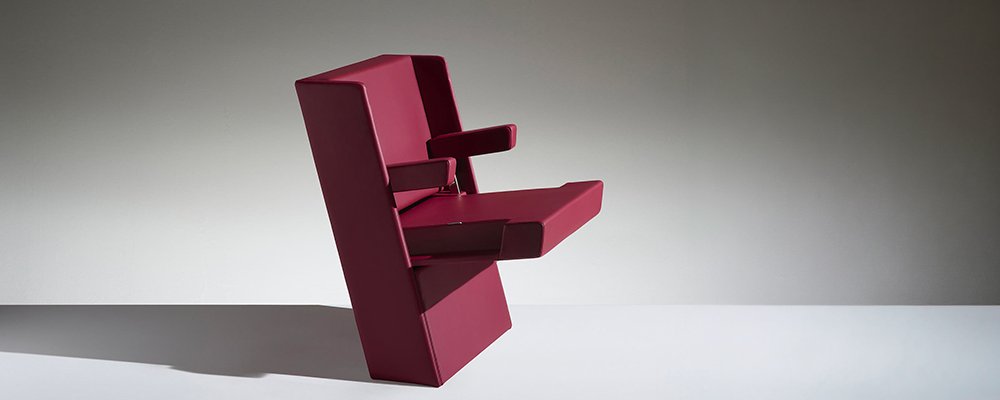
What they were judging is easy to describe and hard to do. Dante Bonuccelli paired a restrained, minimal outline with engineering that stays out of sight. The load-bearing frame sits inside the chair and is anchored straight to the floor, so nothing stands on show beneath the row; the visible metal parts are chrome-plated. Inside the back, springing and a lumbar support device settle into position as the seat comes down, which is why the first impression and the hundredth minute feel much the same.
Genya was conceived for auditoriums and theatres, and it is just as comfortable in conference halls and multi-purpose rooms. Fit the tip-up tablet behind each seatback and a row is ready for lectures or congresses; on project, Lamm's Floor Technology can lay the entire seat flat beneath the floor. Three juries looked at it once; an audience will look at it every evening, and that is the review that lasts.
Collection: Genya
Manufacturer: Lamm — Lamm S.r.l., San Secondo Parmense (Parma), Italy
Design: Dante Bonuccelli
What it is: armchair for conference halls, auditoriums and multi-purpose spaces, with a tip-up seat and arms that fold away automatically in a patented synchronised movement. When closed it keeps a compact shape, with every component contained within its volume
Seat, backrest and side panels: plywood; padding in differential-density polyurethane foam, non-deformable and CFC-free
Backrest: suspension on reinforced elastic belts; springing and a lumbar support device that settles through a patented synchronised movement as the seat opens
Movement: seat and both armrests open and close automatically in a synchronised fold-away motion, regulated by two cushioned gas devices
Upholstery: seat and armrests fully covered in fabric, faux leather or leather
Rear backrest (on request): painted wood or HPL laminate, oak or beech finish
Tablet (accessory): tip-up, mounted on the back of the backrest, with anti-panic movement and slow, cushioned closing (patent pending) for a controlled, safe and silent change from use to rest; top in HPL laminate, beech, oak or black
Structure: internal load-bearing frame in painted metal with rust-proofing treatment, chrome-plated visible parts, fixed directly to the floor with no visible support
Installation: on level or inclined floors or on tiers, in straight or curved rows (minimum radius 6 m (19 ft 8 in)); curved rows use a fully upholstered central infill panel between the chairs to keep the row continuous and linear
Floor Technology (on project): the manufacturer's fold-away system, which draws the entire seat into a horizontal position beneath the floor
Centre-to-centre: 58 cm (22 7/8 in) or 60 cm (23 5/8 in); end panels of the row 32 cm (12 5/8 in) with the 58 cm (22 7/8 in) pitch or 33 cm (13 in) with the 60 cm (23 5/8 in) pitch
Row spacing: 90 cm (35 3/8 in); clear passage with the seat closed 44.5 cm (17 1/2 in); curved rows at least 90 cm (35 3/8 in) apart
Heights: overall 88 cm (34 5/8 in) · seat 49 cm (19 1/4 in)
Depth: open 76 cm (29 7/8 in) · closed 22.5 cm (8 7/8 in)
With tablet: open depth 102 cm (40 1/8 in) · closed depth 46.5 cm (18 1/4 in) · tablet top 70 cm (27 1/2 in) from the floor
Upholstery options: ten covers in four categories — cat. 1 Inca, King, Trevi CS · cat. 2 Silvertex, Extrema Au · cat. 3 Luna CS, Revive 1 (Kvadrat), Remix 2 (Kvadrat) · cat. 4 Steelcut Trio 3 (Kvadrat), leather
HPL laminates: rear backrest beech, oak · tablet beech, oak, black
Painted wood (rear backrest): beech, oak
Accessories: tip-up tablet · painted wood rear backrest · base prepared for an aeration system, with painted metal grille (paint colours on request) · provision for an integrated monitor/audio system in the backrest · provision for an electric power supply (socket on request) · seat numbering · row identification element
Padding: CertiPUR® certified
Wooden components: low formaldehyde emission
Recognitions: Good Design Award 2009 · Best of NeoCon 2009 · Honourable Mention, XXII Compasso d'Oro ADI
Testing: tested according to European standards (the manufacturer states no standard numbers)

Tell us which finishes you'd like to assess
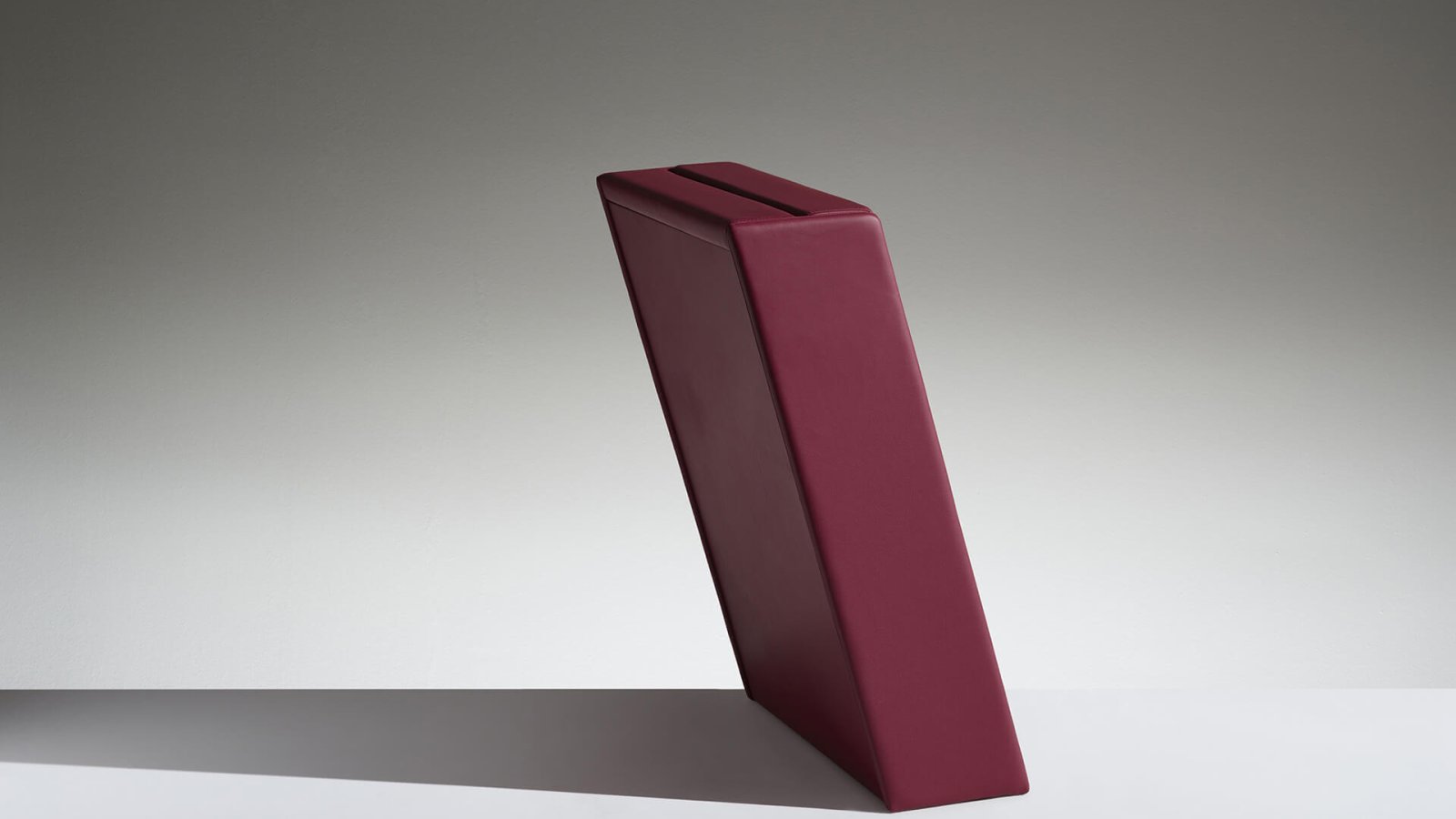
Closed, the chair is 22.5 cm (8 7/8 in) deep, against 76 cm (29 7/8 in) when open, according to Lamm's drawings. Seat and arms retreat inside the chair's own outline, so nothing juts into the gangway when the hall empties.
Lamm specifies differential-density polyurethane foam, non-deformable and free of CFCs, and certified under CertiPUR®. Combining densities lets the cushion keep its shape over long sessions instead of slowly flattening.
Two separate accessories: a row identification element, readable from the aisle, and individual seat numbering. Agreeing both before installation means the numbering follows the real order of the entrances.
No. Seat and both armrests open and close automatically and together, in a patented synchronised movement regulated by two cushioned gas devices. Stand up, and the chair tidies itself away.
Ten covers in four categories: Inca, King and Trevi CS; Silvertex and Extrema Au; Luna CS plus Revive 1 and Remix 2 by Kvadrat; Steelcut Trio 3 by Kvadrat and leather. We send physical samples, and their cost is fully credited once the order is confirmed.
What to check on site before Genya is installed: the floor type, the tier depth, the fixing lines, the services under the rows and the radius of any curved section.
Genya can go on level floors, inclined floors or tiers. Mark on the plan which zones are which, because the fixing method follows the surface, not the seat count.
Lamm's drawings set the rows at a 90 cm (35 3/8 in) spacing. Every tier needs that depth clear of nosings and lighting strips, or the passage behind the seats shrinks.
The internal frame is fixed directly to the floor, with a centre-to-centre of 58 or 60 cm (22 7/8 or 23 5/8 in). Snap the lines before the screed is finished, so the anchors land where the drawing says.
If the base will carry the aeration grille, or a socket is required, those runs must reach each position before the first chair is fixed down.
Curved rows need a radius of at least 6 m (19 ft 8 in), with a fully upholstered infill panel between chairs. Draw the arc on site first: tightening it later is not possible.