Already have something in mind?
Trade terms for professionals and design studios
Already have something in mind?
Trade terms for professionals and design studios
Le Corbusier admired one bentwood armchair enough to put it in many of his buildings, including those at Stuttgart’s Weissenhof estate in 1927: the 209. He once said of it that the chair “possesses nobility”. It had been drawn in 1900 by Gebrüder Thonet, the founder’s sons, and its whole character sits in one gesture: the projecting frame that makes the back and both arms is bent from a single piece of solid beech. Few classic designer chairs say so much with so little wood.
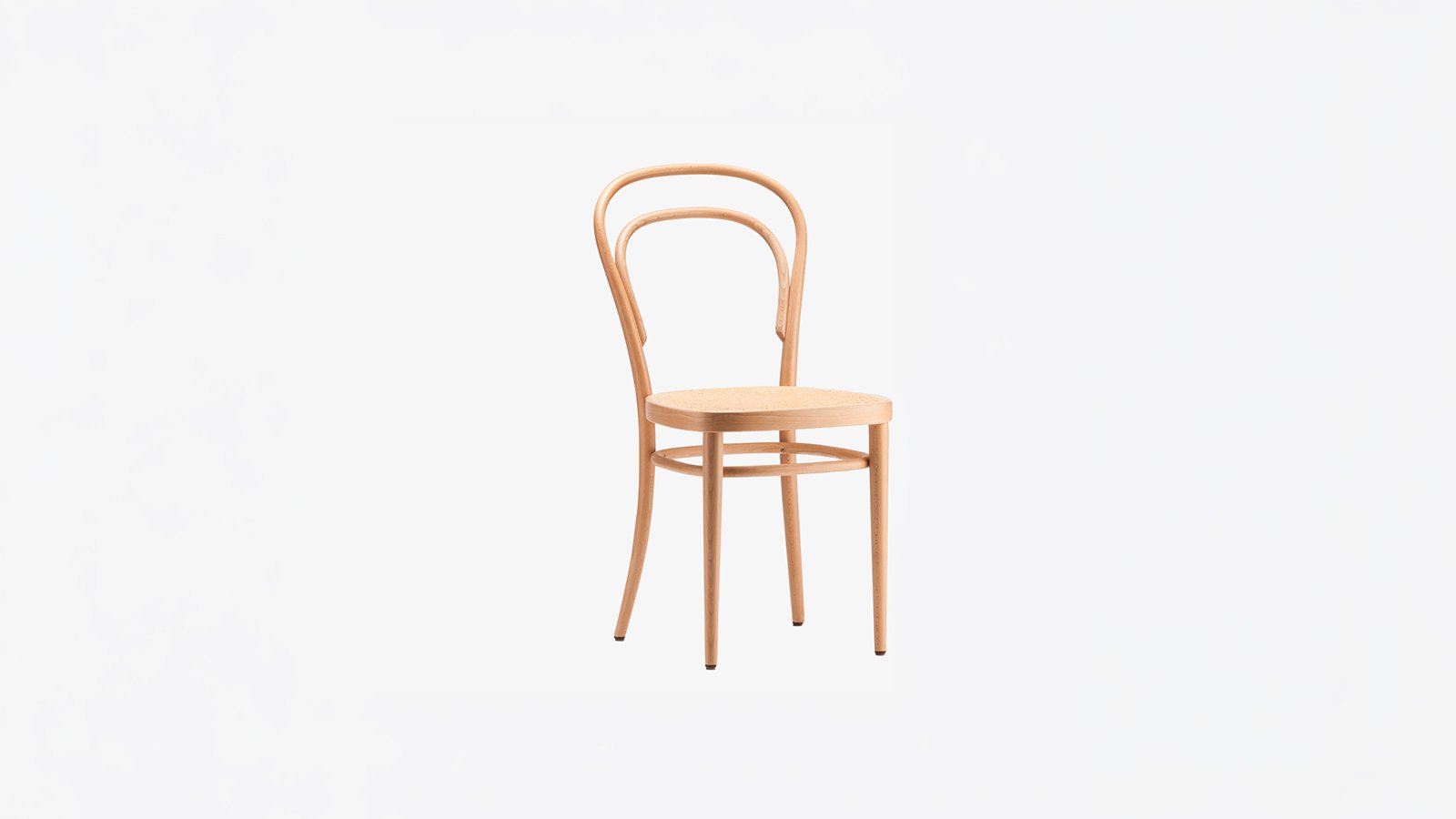
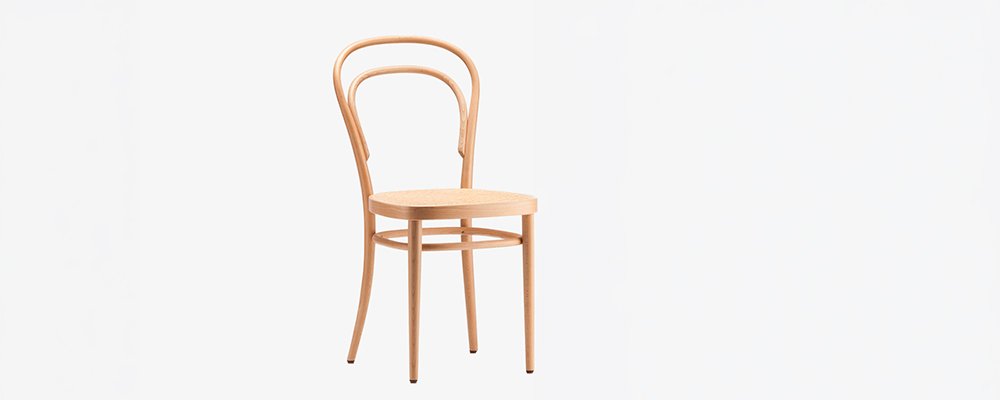
Its elder is a chair. Michael Thonet designed the 214 in 1859, the piece Thonet calls “the famous coffee house chair”: the same bent beech in a slimmer side chair, and in the photographs a back that rises in a double arch. Put the two at one table and the roles sort themselves out: 214s along the sides, a 209 at the head, where it holds its own among seating for the boardroom as easily as at a long dinner.
There are nine versions. The chair: 214 with a Vienna cane seat, 214 M in moulded plywood, 214 P upholstered, then 215 R and 215 P with an oval back. The armchair: 209 in cane, 209 P upholstered, then 210 R and 210 P with an oval set inside the arc. We see the 209 at the end of a dining table, in a partners’ room or in a restaurant’s private room, with 214s down the long sides. La Mercanti walks the room with the architect and marks on the plan each place that calls for arms.

Two, both German and both recent for a design from 1859. The German Sustainability Award Design went to the 214 in 2021, and the German Ecodesign Award gave it a special prize in 2024. Thonet ties the first to an idea it sums up as sustainability through longevity: solid wood, and a chair meant to accompany generations. For a client who must justify a purchase on environmental grounds, the argument is durability, set out by a jury, rather than a new material.
It becomes the 215. In Thonet’s photographs the double arch gives way to an oval panel: woven cane on the 215 R, padded on the 215 P, where the seat is upholstered too. Footprint and height stay those of the 214. Around a dining table this means the oval can be mixed with plain 214s without changing the spacing; the difference shows only in the back, where a guest leans.
It is the 209 with a second back. In the photographs an oval of woven cane sits inside the bent arc, and Thonet’s own word for this version is “wickerwork”. The dimensions stay those of the 209. A project that standardises on one armchair size can therefore still vary the look of the back, open on the 209, filled on the 210 R.
Yes. Thonet writes that the 214, made of solid wood, can be easily repaired should the need arise, and the company repairs its own furniture at Frankenberg, in Germany, where it is made. For a hotel or a café that replaces chairs on a fixed cycle, a frame that can be mended changes the sum: the chair stays in the room instead of being written off.
Thonet itself calls it “the famous coffee house chair”, and its clear, reduced lines have served in the most varied settings for more than 150 years. We still put it where many places are needed around small tables, in a café, a canteen or a family dining room. In a bistro today it carries that history without having to explain it.
Nine versions, three kinds of seat. A short sequence for deciding what each room needs, from Vienna cane to moulded plywood to upholstery, across the 214 chairs and the 209 armchairs.
Vienna cane is the seat Thonet gives the plain 214 and the 209, and the one on the 215 R and the 210 R. We would choose it wherever lightness and the historic drawing count most: rooms where the chairs are looked at as much as they are sat on.
The 214 M replaces the cane with a moulded plywood seat and keeps the bentwood frame and the double-arched back unchanged. It is the version we suggest where seats are wiped down many times a day, as in a staff canteen or a busy café.
The P versions, 214 P, 215 P, 209 P and 210 P, are upholstered. Where people stay seated through a long dinner or a meeting that runs on, padding is our choice; for a quick coffee, cane or plywood do the job and keep the chair visually lighter.
Thonet gives the upholstered seats a height of 47 cm (18 1/2 in), against 46 cm (18 1/8 in) for cane and plywood. Mixing padded and unpadded seats at one table is perfectly possible; it simply helps to know that the P versions sit that little bit higher.
On the 215 and the 210 the seat choice comes with an oval back, cane on the R versions, padded on the P. Where chairs are seen from behind, along a restaurant aisle or facing a window, these are the versions that give the room a fuller line.