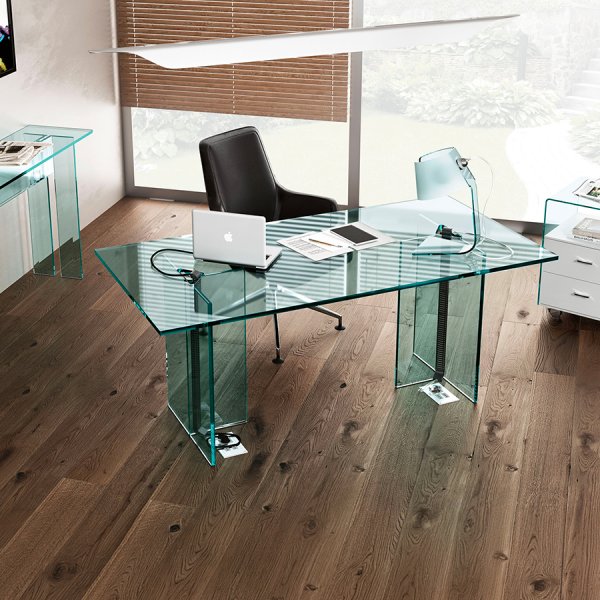
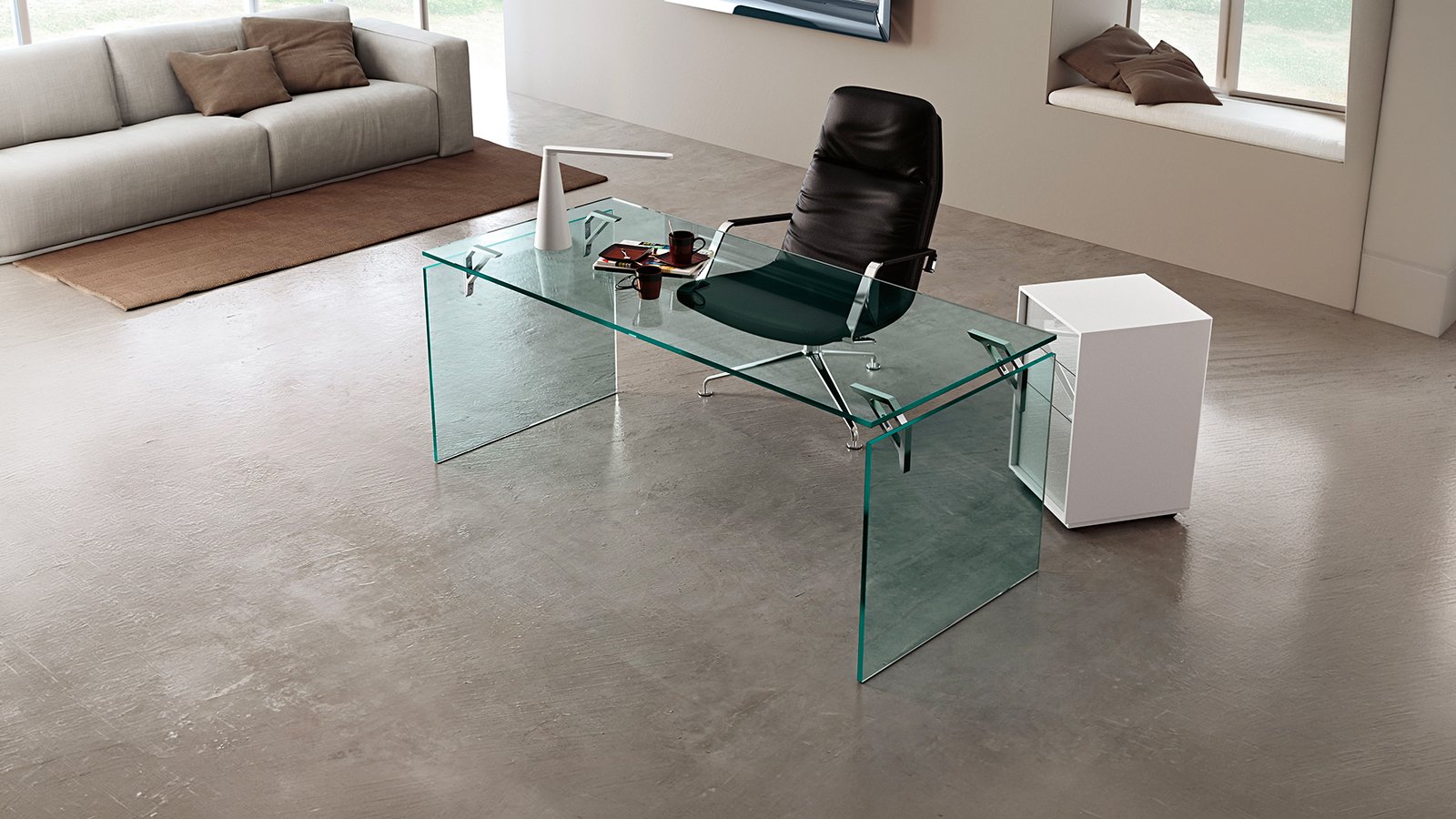
Concrete floor and tall windows around the Bright glass desk by Fiam, seen from above

Aluminium and steel where each leg meets the top: look closely at Bright by Fiam

Fiam

Valerio Cometti

Executive desk only
Bright An icon of Italian design Executive desk only
£ 4,329

Already have something in mind?

Trade terms for professionals and design studios

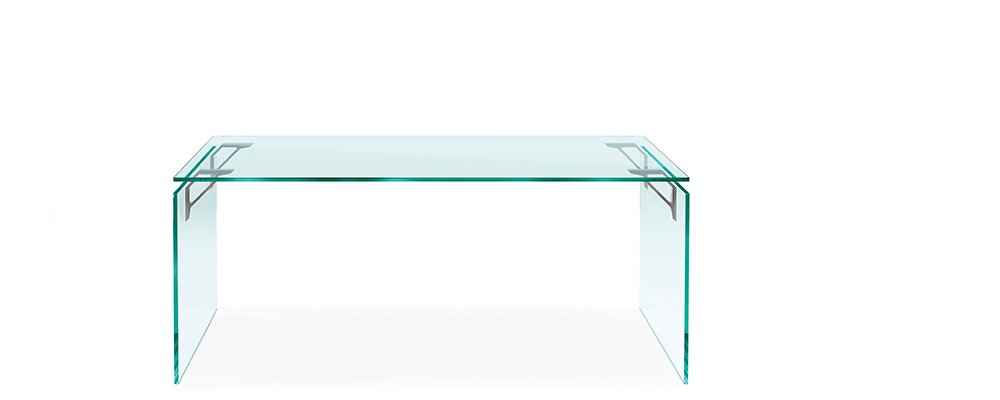
Look first at the corners. Where each leg of Bright rises to meet the top, Fiam sets a fixing of aluminium and steel, and in its photographs that fixing is the one solid thing in the frame: a polished bracket shaped like a set square, its screws visible against the glass. On a desk of clear sheets, this small piece of metal carries the drawing. It is the detail we point to when a client compares contemporary designer desks and wants to see how one is put together.

Fiam gives the finish of the fixings as polished aluminium, so they catch the light the way a well-made door handle does. Around them is toughened glass, 15 mm thick (19/32 in): a top and two solid legs, three sheets in all, and Fiam describes the desk as one that can be dismantled. Design: Valerio Cometti. Anyone weighing up desks with a glass top will notice that this one does not hide its joints, and we would rather specify a desk that shows them.

Work outwards from the bracket. Closest to it is the glass, Standard or Extralight. Then the footprint: five standard sizes, from 120 × 60 cm (47 1/4 by 23 5/8 in) up to 180 × 80 cm (70 7/8 by 31 1/2 in), all standing 73 cm tall (28 3/4 in). Furthest out, a top made to the centimetre, as large as 240 × 120 centimetres (94 1/2 by 47 1/4 in). La Mercanti opens with Fiam's close-up of the fixing and only then turns to the photograph of the whole desk.

Technical information based on data declared by the manufacturer.
  • Collection: Bright
  • Manufacturer: Fiam
  • Design: Valerio Cometti
  • Type: glass desk, demountable
  • Glass: toughened, 15 mm (19/32 in); Standard or Extralight
  • Fixing supports: aluminium and steel; polished aluminium finish
  • Standard sizes: 120 × 60 cm (47 1/4 × 23 5/8 in) · 130 × 60 cm (51 3/16 × 23 5/8 in) · 140 × 70 cm (55 1/8 × 27 9/16 in) · 160 × 70 cm (63 × 27 9/16 in) · 180 × 80 cm (70 7/8 × 31 1/2 in)
  • Height: 73 cm (28 3/4 in)
  • Made to measure: by the centimetre, up to 240 × 120 cm (94 1/2 × 47 1/4 in)
  • Legs on custom tops: flush with the ends up to a length of 180 cm (70 7/8 in); from 181 cm (71 1/4 in) fixed further in, standing no more than 180 cm apart (70 7/8 in)
  • Height on request: up to 90 cm (35 7/16 in)
  • Load on the top: 100 kg (220 lb)
  • Weight given on the data sheet: 59 · 62 · 74 · 79 · 96 kg (130 · 137 · 163 · 174 · 212 lb), smallest to largest
  • Model: registered
  • Fiam catalogue: Home Office section
La Mercanti Srl — trusted supplier for design and contract projects since 1997.
San Benedetto del Tronto (AP), Italy · +39 0735 753833 · info@lamercanti.com
Supply, quotations, specifications and project support across the UK and worldwide.

Tell us which finishes you'd like to assess

£ 170

Fully redeemable against your first order

FAQ

Why do the three smaller sizes differ by just ten centimetres?

Because the bottom of the range climbs in short steps: 120, 130 and 140 cm long (47 1/4, 51 3/16 and 55 1/8 in). The first two share a depth of 60 cm (23 5/8 in); the third already moves to 70 cm (27 9/16 in). In a box room turned into a study, or an alcove beside a window, ten centimetres can decide whether a door still opens freely, so we measure the wall before choosing among the three.

Sixty, seventy or eighty centimetres deep: what changes at the desk?

The depth comes with the size: 60 cm (23 5/8 in) on the two shortest, 70 cm (27 9/16 in) on the 140 and the 160, 80 cm (31 1/2 in) on the longest. In our experience it is the more important of the two dimensions. Sixty suits someone who works alone with a laptop; eighty leaves room for a full-size screen at a comfortable distance and for a visitor sitting across the glass.

How many pieces of glass make up the desk?

Three, as Fiam's photographs show: one sheet for the working surface and two solid sheets standing upright as legs, all toughened, each 15 mm thick (19/32 in). Fiam calls the desk demountable. For whoever plans the delivery, that means three flat pieces rather than one assembled object, which matters when the way in passes a narrow staircase or a small lift.

Standard or Extralight: which one suits a room with white walls?

Fiam offers both grades and names them without further description. Seen side-on in its photographs, the cut edge has a green-blue tone, and against white walls that line is what the eye catches first. We find Extralight the paler of the two at the edge. Our advice is to hold a sample edge against the floor and the walls of the actual room, because that is where the difference becomes visible.

What does the desk weigh, from 120 to 180 centimetres?

The data sheet gives 59 kg (130 lb) for the 120 × 60 cm size and 96 kg (212 lb) for the 180 × 80; in between, 62, 74 and 79 kg (137, 163 and 174 lb). Glass is heavy, and those figures make no secret of it. Since Fiam describes Bright as demountable, the weight need not travel as one load: in our view it is worth planning the move as three separate sheets whenever stairs are involved.

Ordering Bright to the centimetre, starting from the wall behind it

Beyond its five standard sizes, Bright can be made to measure by the centimetre, to a maximum of 240 by 120 cm (94 1/2 by 47 1/4 in). Five steps to reach the right figure, beginning with a tape measure on the wall.

Run the tape along the wall

Bright comes in five standard lengths, from 120 to 180 cm long (47 1/4 to 70 7/8 in); Fiam also makes the top to measure, by the centimetre. Start with the wall the desk will stand against or face. Note its full length, then take off what a door swing, a radiator or a chair at the end will need.

Settle on the exact length

The longest made-to-measure top Fiam draws is 240 cm (94 1/2 in). Between the 180 cm of the largest standard size and that limit, the figure the wall suggests can be ordered as it is. Below 180, check first whether one of the five standard lengths already matches, since those come with their weights stated on the data sheet.

Note what changes past 180

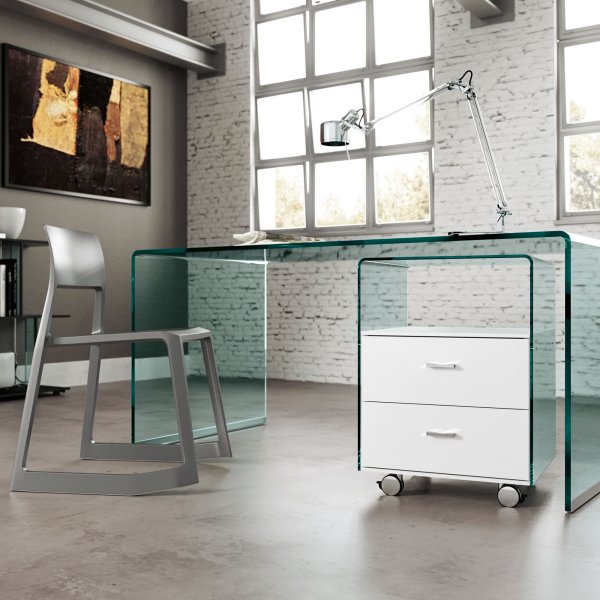
Up to 180 cm (70 7/8 in) the legs sit flush with the ends of the top. From 181 cm (71 1/4 in) Fiam fixes them further in, and the custom drawing keeps them no more than 180 cm apart. The longer the top, the more surface is left free at each end: a useful place for a pedestal on castors.

Choose the depth separately

Depth is a second decision. The standard sizes stop at 80 cm (31 1/2 in); a top made to measure can reach 120 cm (47 1/4 in). We suggest a generous depth where visitors sit opposite and papers spread out, and a shallow one where the study is narrow and the desk stands against the wall.

Raise the height if needed

Every standard size stands 73 cm high (28 3/4 in), the height for seated work. The drawing for custom sizes marks a maximum of 90 cm (35 7/16 in), on request, for someone who prefers a stool, or who likes to stand and lean on the desk while reading.

You May Also Like