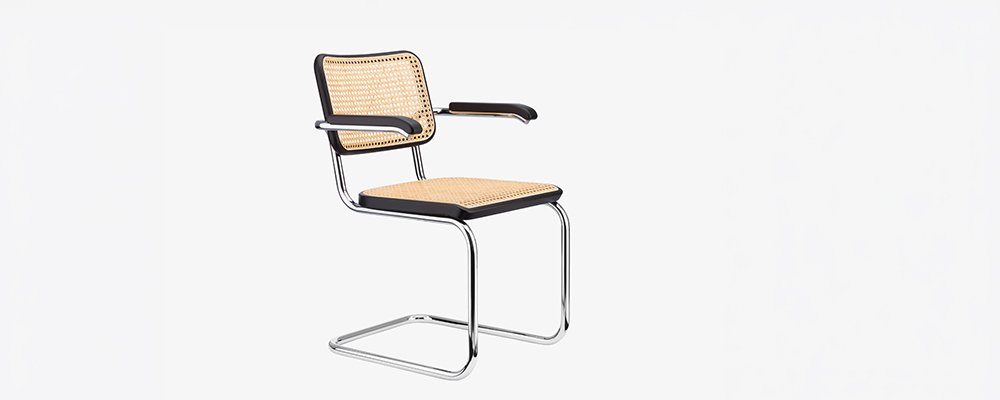
S 32 chairs around a wooden table in a room with tall windows onto the garden

From a plumber's fittings to the Thonet S 33: the cantilever chairs of Mart Stam and Marcel Breuer

Thonet
Meeting room chair
Cantilever S64V An icon of Italian design Meeting room chair
£ 2,176

Let's discuss your project

Trade terms for professionals and design studios

From 1925 Mart Stam was experimenting with gas pipes of small diameter, and at first he joined them with a plumber's standard fittings. Those trials led to a chair that no longer stood on four legs, a principle Thonet calls a building block of modern furniture history. We keep its descendants among our chairs for boardroom tables.

Stam's own pair caused a sensation at the Werkbund exhibition on the Weissenhof Estate in Stuttgart in 1927; today it is the S 33 and the S 34 with armrests. The second pair is by Marcel Breuer, who drew the S 32 and the S 64 with armrests in Berlin in 1928; Thonet has produced them since 1930 and credits the artistic copyright to Stam. On these the steel carries a seat and back of bent solid wood.

The S 32, S 64, S 33 and S 34 all seat you at 45 or 46 cm (17 3/4 or 18 in), so both pairs can share a table. Breuer's chairs come in Vienna cane, also in DARK MELANGE for the Edition Herkner, in mesh, fully upholstered or with a padded seat under a cane or mesh back; Stam's come in leather, fabric or mesh. Thonet sees them in meeting rooms, waiting areas, restaurants and homes, and we see them at their best in meeting rooms and boardrooms, where they stay on show between sessions. La Mercanti puts a cane S 32 beside a leather S 33 and asks the client to sit in each before choosing between the two frames.

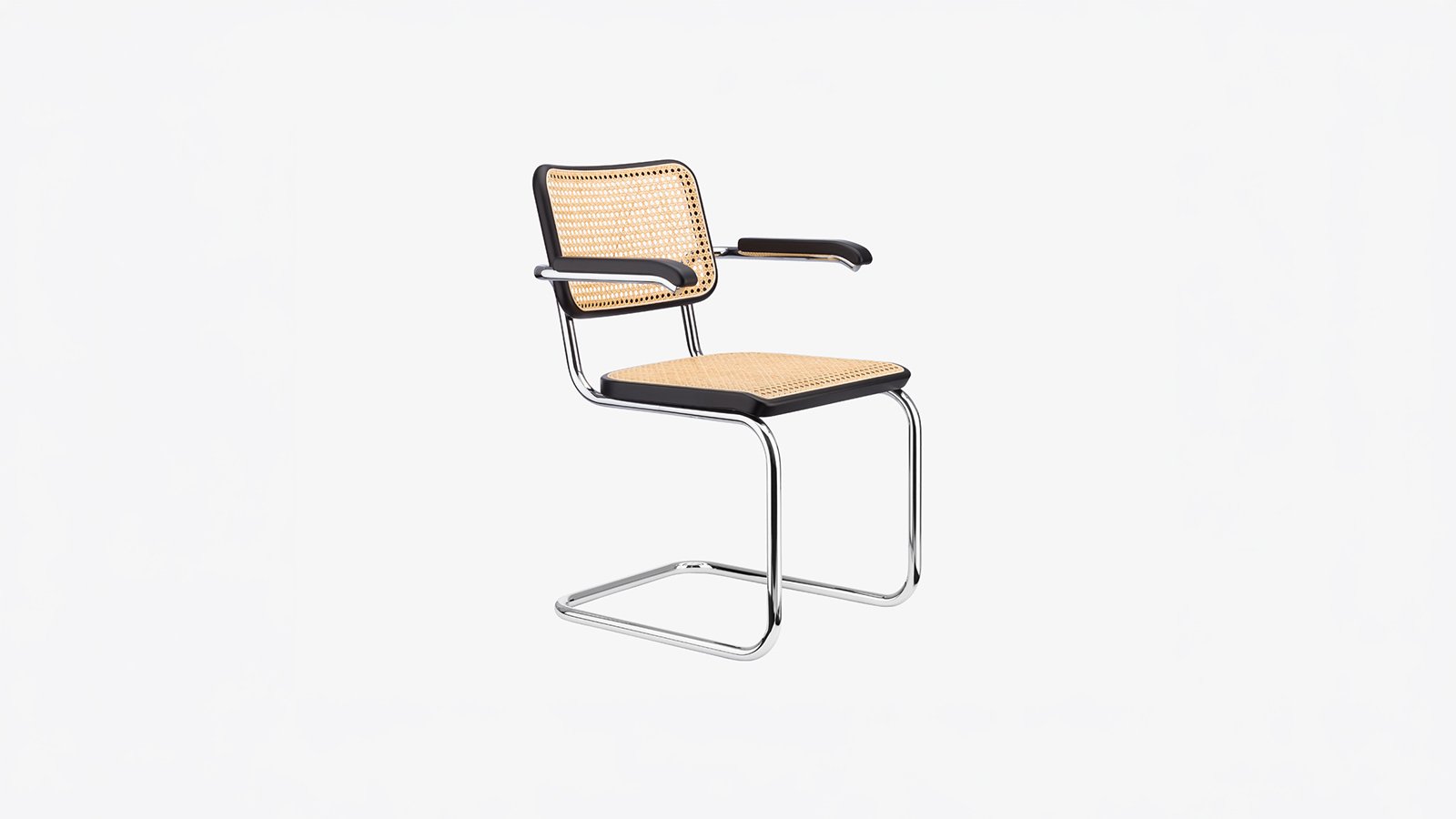
Technical information based on data declared by the manufacturer.
  • Name: cantilever chairs S 32, S 64, S 33, S 34
  • Manufacturer: Thonet, Frankenberg (Germany)
  • Design: S 32 and S 64 Marcel Breuer, 1929/30, artistic copyright Mart Stam · S 33 and S 34 Mart Stam, 1926
  • Type: tubular steel cantilever chairs and armchairs for meetings, waiting areas, restaurants and the home
  • S 32: 46 cm (18 in) wide, 82 cm (32 1/4 in) high, seat at 45 cm (17 3/4 in), 58 cm (22 3/4 in) deep; 5.8 kg (12.8 lb)
  • S 64 with armrests: height and seat as the S 32; width 58 cm (22 3/4 in), depth 60 cm (23 1/2 in), armrests at 67 cm (26 1/2 in); weight 7.3 kg (16.1 lb)
  • S 33: width 50 cm (19 3/4 in) · height 84 cm (33 in) · seat height 46 cm (18 in) · depth 64 cm (25 1/4 in); 7.5 kg (16.5 lb) in leather, 7 kg (15.4 lb) in fabric or mesh
  • S 34 with armrests: same height, seat and depth as the S 33, 57 cm (22 1/2 in) across, arm height 67 cm (26 1/2 in), 8.8 kg (19.4 lb)
  • Covers, S 32 and S 64: Vienna cane on a supporting synthetic mesh (V), Edition Herkner cane in DARK MELANGE, synthetic mesh (N), upholstered (PV), upholstered seat with cane back (SPV) or mesh back (SPVN)
  • Covers, S 33 and S 34: butt leather, fabric (V) or synthetic mesh (N)
  • Same programme: S 64 DR swivel chair, S 32 H and S 32 HT bar stools, S 32 L lounge chair
  • Configuration: built on request through the Thonet configurator; CAD data for planners; cane seat and back can be replaced
La Mercanti Srl — trusted supplier for design and contract projects since 1997.
San Benedetto del Tronto (AP), Italy · +39 0735 753833 · info@lamercanti.com
Supply, quotations, specifications and project support across the UK and worldwide.

FAQ

How heavy is each of the four models?

Thonet gives the S 32 as 5.8 kg (12.8 lb) and the S 64 with armrests as 7.3 kg (16.1 lb). The S 33 weighs 7.5 kg (16.5 lb) in leather and 7 kg (15.4 lb) in fabric or mesh, while the S 34 reaches 8.8 kg (19.4 lb). In our view, a room that is reset several times a day is easiest to manage with Breuer's lighter pair.

Who first questioned the need for four legs?

The artist Kurt Schwitters, in 1927, after seeing the first cantilever chairs in furniture history: “Why four legs if two will suffice?” Thonet quotes the line on the page of the S 33 and S 34, which it counts among the first of their kind, with a cubic form, fine proportions and a flexing movement. The question still explains why the chair stands without back legs.

Since when has Thonet been producing the Breuer pair?

Marcel Breuer drew the S 32 and the S 64 during his time in Berlin, in 1928, and Thonet has produced both since 1930; its own design date reads 1929/30, with the artistic copyright credited to Mart Stam. Thonet calls them the most famous tubular steel classics and says they are still bestselling cantilever chairs today.

What footprint does an S 32 take up at the table?

The S 32 is 46 cm (18 in) wide and 58 cm (22 3/4 in) deep, 82 cm (32 1/4 in) high, with the seat at 45 cm (17 3/4 in); the upholstered PV is a little lower at 80 cm (31 1/2 in), and seats you at 46 cm (18 in). The S 64 with armrests grows to 58 cm (22 3/4 in) wide and 60 cm (23 1/2 in) deep. On a plan, in our reading, the extra width of each armchair adds up quickly along a long table.

Do they suit a reception or waiting area?

Yes: Thonet names waiting areas among the places these chairs belong, between conference rooms, restaurants and private homes. Our suggestion for a reception is to add a few chairs with armrests, the S 64 or the S 34, for visitors who wait longer, and to pick mesh or leather where many people sit during the day.

Cane, mesh, padding or leather: dressing the Thonet S 32 and S 33

The four Thonet cantilevers share one principle but not the same covers. Five steps through cane, mesh, upholstery and leather, with our reading of where each one works best in a working building.

Start from the frame pair

The S 32 and the S 64 carry a seat and back of bent solid wood, so their covers are cane, mesh or padding. The S 33 and the S 34 come in leather, fabric or mesh. Settling on the pair first narrows the choice to one family of covers before any sample is opened.

Cane where the light is good

The V versions use Vienna cane over a supporting synthetic mesh; the Edition Herkner weaves the cane in DARK MELANGE for a darker tone. In our reading, cane suits bright rooms and wooden tables, where the open weave keeps the chair looking light even when every place is taken.

Mesh for the busiest seats

Both pairs have an N version in synthetic mesh. We suggest it for cafés, canteens and meeting rooms booked back to back, because a smooth mesh is quick to wipe down between users and keeps the same look on all four models.

Padding for the long sitting

On Breuer's chairs the PV is fully upholstered, while the SPV and SPVN keep a padded seat under a cane or a mesh back. Our advice is to use them where people stay seated for hours, such as boardrooms and dining tables, and to keep the back in cane if the room should still feel airy.

Leather or fabric for a clean outline

Stam's S 33 and S 34 come in thick butt leather or in fabric. In our reading they give the table a crisper outline than cane does. Whatever the choice, we recommend one cover for the whole room, with the armchairs at the head of the table in the same finish.