Let's discuss your project
Trade terms for professionals and design studios
Let's discuss your project
Trade terms for professionals and design studios
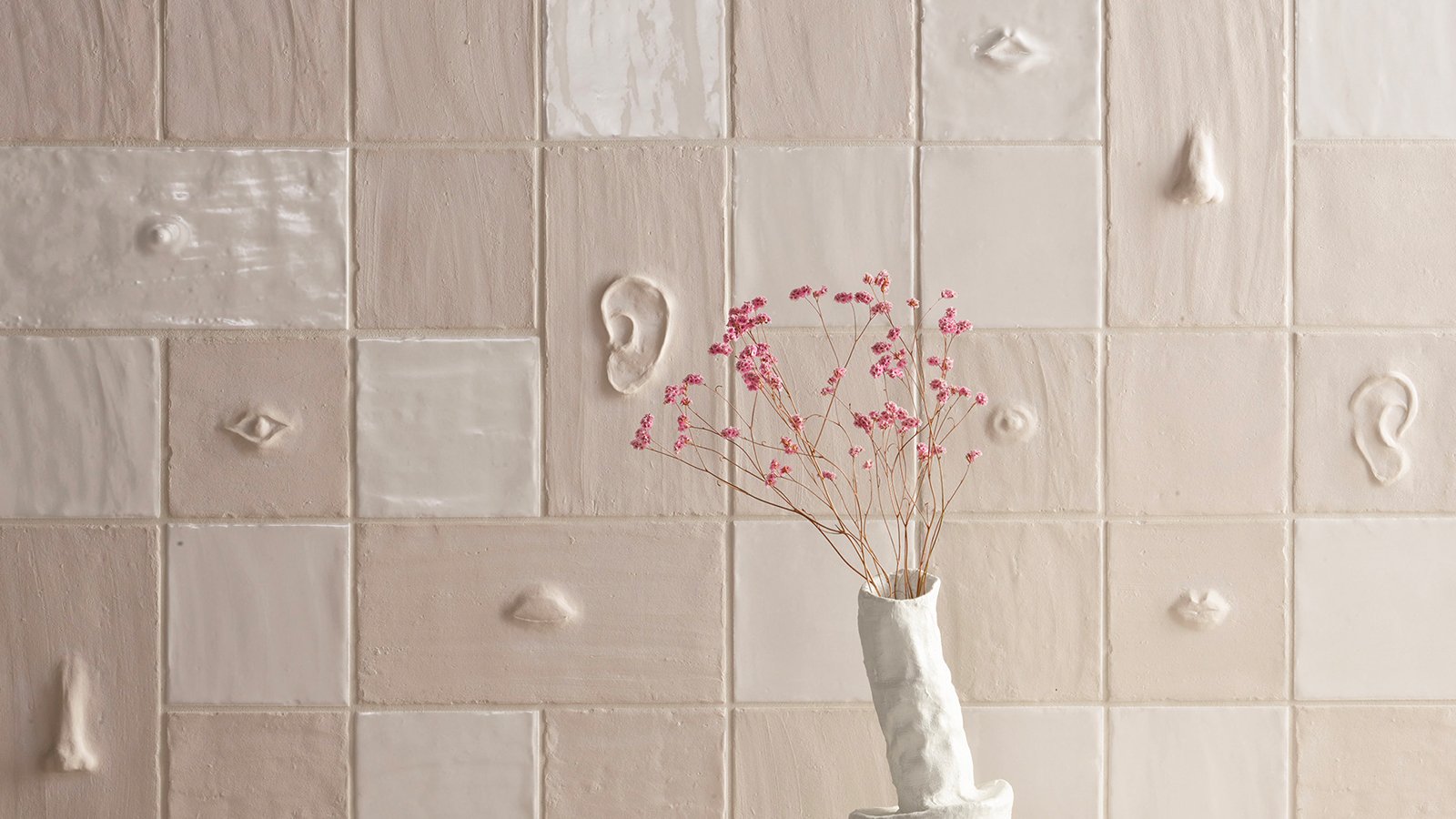
Gnarled oaks and ancient stone monoliths: Faye Toogood MBE has always drawn her shapes from the English countryside, and she starts every project with cardboard and clay. Faces & Figures, her first collaboration with Mutina, began the same way. «I wanted to begin with feeling. The sensation of clay meeting the body», she says, and from those sessions a face, an ear, a mouth, an eye and a nipple slowly surfaced, as memories rather than portraits.
Mutina has turned that sculptural language into ceramic tiles that behave like an architectural system. Dozens of hand-worked models and edges were distilled into archetypes, modules meant to repeat and combine. The face of each tile is wavy and lightly scratched, its edges carry asymmetries, cracks and roughness, yet the body is porcelain stoneware, unrectified, with a thickness of 10 mm, or 3/8 in, made industrially. In a director’s cloakroom, a wall of Ears on a Chalk ground reads as relief rather than pattern.
There are five families to work with. Plain Tiles come as 30 × 30, 15 × 30 or 15 × 15 cm (12 × 12, 6 × 12 or 6 × 6 in) in four colours (Chalk, Sand, Clay, Mud), each matt or glossy. Figure, at 20 × 30 cm (8 × 12 in), offers two organic outlines in matt alone. Eyes, Ears, Mouths, Noses and Nipples, plus the eight-piece Face, are made in Chalk alone, and the terracotta brick, Body, comes either in Chalk or in Cotto. Matt can be walked on outdoors; glossy belongs on floors only inside homes; the reliefs, Face and Body are for walls. Before an order is placed, La Mercanti sends a Chalk sample in both finishes, so the choice is made by hand.

Tell us which finishes you'd like to assess
Every porcelain piece in the collection is 10 mm (3/8 in) thick: Plain Tiles, Figure, the five relief subjects and Face. Only the Body brick differs, because it is a three-dimensional terracotta element rather than a tile.
Body measures 9.5 × 18.5 × 9 cm (3.8 by 7.3 by 3.5 in), width by height by depth. Its three shapes make up a single item and cannot be bought separately, so the wall is planned in complete sets.
No. Mutina states that the collection contains no VOCs. If a project needs it in writing, the VOC emission document, the EPD and the HPD can be requested for the porcelain pieces.
A box of 30 × 30 cm holds 12 tiles, or 1.08 m² (11.6 sq ft), and weighs 22.30 kg (49.2 lb). The 15 × 30 and 15 × 15 boxes each cover 0.68 m² (7.3 sq ft), with 15 and 30 pieces respectively.
Yes: Faye Toogood drew three suggested layouts for Face. They show how the eight figurative pieces can be combined into several different faces, so the faces are suggested by how the details sit together rather than drawn literally.
Mutina strongly advises laying the pieces out dry before final fixing. Five steps from a loose arrangement on the floor to a fixed design.
Before any adhesive is mixed, set all the pieces out loose on the floor. Mutina calls this dry lay strongly advised: it is the moment to position each element where it will finally sit.
Move the pieces until the tiling works with the way the joints divide the surface. That is the second purpose of the dry run, and it is far easier to settle on the floor than on the wall.
Where different sizes meet, a 4 mm (5/32 in) joint is required; with a single size it is only recommended. Leave the same gap in the dry run, or the loose layout will not match the finished one.
The five subjects and Face are for walls only. Use one of the three layouts Faye Toogood suggests for Face as a guide, and decide where each six-piece set of reliefs will fall.
Once the design is settled, fix the tiles with a porcelain adhesive that is not rapid-setting, as Mutina specifies, taking the pieces up in the order agreed during the dry lay.