
In the study at Chartwell, in Kent, the National Trust keeps a mahogany desk meant to be used standing up. Its top slopes towards whoever is working at it and finishes in a moulded rest for books; the flat shelf above is edged on three sides by a small gallery of spindles. Set into the top is a silver plaque engraved with family names and two words, Christmas 1949. That year Winston Churchill's children, with their husbands and wives, gave him the desk. It was designed by Sir Albert Richardson, whom the Trust's catalogue records as President of the Royal Academy, and made at the Pyghtle Works in Bedford.
It is a desk cut to the measure of one man, and it is a useful place to begin, because the figures on who supplies Britain's imported office furniture point mostly elsewhere. The world furnishes its offices from other countries. What it asks of Italy is the room in which decisions are made, together with an idea much older than Chartwell: that such a room ought to read as a portrait of whoever works in it.
Two traditions, one Italian name
In the 1400s a good many palaces and houses began to set apart a room given over to study and quiet thought, and it came to be known by an Italian word, studiolo. An essay on the studiolo published by Italian Renaissance Learning Resources, in partnership with Washington's National Gallery of Art, explains what possessing one meant: its owner was staking a claim to the learning and refinement by which that age defined itself.
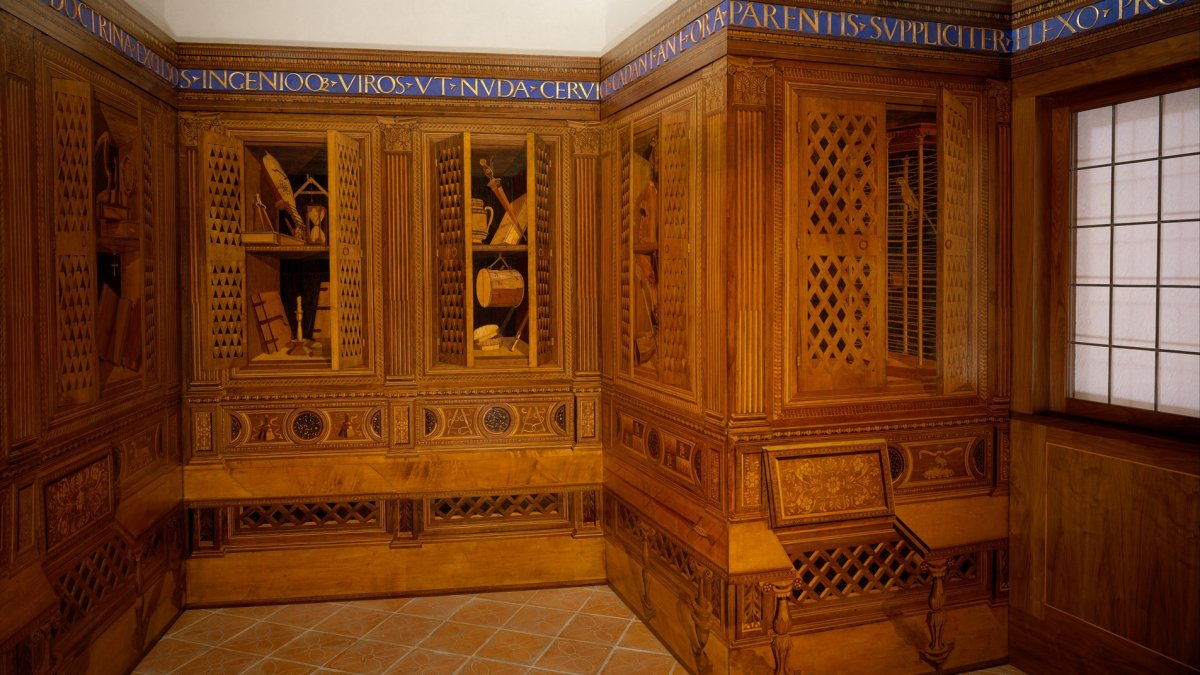
One of those rooms was made for Federico da Montefeltro's palace at Gubbio between about 1478 and 1482. Francesco di Giorgio Martini drew it and Giuliano da Maiano's workshop carried it out, its panels worked in oak, walnut, beech, rosewood and fruit woods; the Met in New York acquired it in 1939. Federico had another in the Ducal Palace at Urbino, in the Marche, the region La Mercanti works from. When it reopened to visitors on 30 May 2025, the arts magazine Artribune called it the most private room in Federico's apartment and, in the same breath, the one that best represented him in public. Twenty-eight portraits of illustrious figures, ancient and medieval, hung around its walls.
Put Urbino beside Chartwell and five centuries shrink. Richardson's desk follows a way of working, with its sloping top and its ledge for a book at the height of someone on his feet. Federico's study follows a way of thinking, with twenty-eight chosen faces on the walls and, in Artribune's reading, a public figure expressed through the most private room of his apartment. Both were built for one particular person. Chartwell shows the idea at home in England; Italy gave it a word. A tenth of the office furniture Britain imports already comes from Italy; what it can add is the older habit of treating the room as a portrait.
The customs ledger: a tenth from Italy, the most from China
That tenth deserves its figures. In the 2023 customs data compiled by UN Comtrade for the United Kingdom, imports of wooden office furniture reached 140.9 million dollars. China supplied 32.2 million of it, Lithuania 22.7 million, Poland 17.7 million and Italy 13.4 million, which puts Italy fourth. Imports of metal office furniture totalled 180.8 million dollars, and there the order changes: China first with 68.3 million, then Italy with 19.9 million, a whisker ahead of Germany on 19.3 million, with Turkey behind them. On my own division of those figures, Italy supplied about 9.5 per cent of Britain's wooden office furniture and 11 per cent of its metal office furniture; China supplied about 23 per cent in wood and 38 per cent in metal. For comparison, in the same wooden category Italy accounts for about 2.1 per cent of what the United States imported in 2023, again on my own division, and was sixth among its suppliers there. From Italy's side of the ledger, the Centro Studi FederlegnoArredo ranks the United Kingdom as Italy's third export market for office furniture in 2023, at 42 million euros, after France and the United States.
So Britain takes Italian office furniture seriously. China remains its largest supplier all the same.
The global table points the same way. In 2023 Italy was the fifth country among the world's exporters of wooden office furniture, behind China, Canada, Poland and Vietnam, and the fourth in metal, behind China, Canada and Germany. CSIL, the Milan research centre that puts the global office furniture market at around 50 billion dollars, describes an export trade led by Asia, with China and Vietnam as its hubs, followed by Canada, Germany and Poland; Italy does not appear among the names it gives. The data have a limit. The two customs headings for office furniture, one for wood and one for metal, do not separate an executive desk from any other desk or cabinet in the same material, and I have found no serious statistic that counts executive desk production country by country. The pages that claim to know are, as far as I can tell, retailers' own websites.
From abroad, three requests in four are for a desk
Between 2017 and today the forms on our websites have brought in 8,912 requests, 6,694 of them from outside Italy. Of those foreign requests, 3,028 named something particular in the catalogue, and among those 42.6 per cent concerned an executive desk and 74.2 per cent a desk of some kind. Seating came a long way behind at 15.3 per cent, meeting tables at 4.4. I have not separated British enquiries from the rest, so the aggregate is what I can report.
A single product page draws more of that foreign interest than any other: the Jera executive desk by Las Mobili, from which 789 requests have reached us, 11.8 per cent of everything that came from abroad. Treat it as a page count, not a search count: it records where the form was filled in, and nothing about what was typed to get there.
Your office briefs visitors before you do
Psychology has put the portrait idea to the test. Samuel Gosling and his colleagues reported in 2002, in a paper titled A room with a cue, what happened when strangers were shown the offices and bedrooms of occupants wholly unknown to them and asked to judge their personalities. Judges working separately arrived at impressions similar to one another; those impressions held some accuracy; and they rested on cues in the rooms that were genuinely linked to the occupants. The solicitor kept waiting in your office for five minutes leaves with a picture of you, and the auditor who waits there the following week leaves with a similar one.
For the person at that desk every day, the benefit is steadiness. The room makes your introductions on your behalf, including on the morning the train is cancelled and the week you spend at a trade fair. The study dealt with perceived personality, which to my mind makes it more useful: a visitor will work out what sort of person you are, and get it partly right. The only question left is whether the room is saying something true. An executive desk has to hold a quiet afternoon of drafting and, an hour later, a client across the top; it serves the second better when it was chosen with the first in mind.
Five figures worth keeping side by side
United Kingdom imports of wooden office furniture, 2023
140.9 million dollars; China first, Italy fourth with 13.4 million, about 9.5 per cent (UN Comtrade, our division).
United Kingdom imports of metal office furniture, 2023
180.8 million dollars; China first, Italy second with 19.9 million, about 11 per cent (UN Comtrade, our division).
Italy's share of United States imports of wooden office furniture, 2023
About 2.1 per cent, sixth supplier (UN Comtrade, our division).
The United Kingdom as a destination for Italy's office furniture exports, 2023
Third abroad, 42 million euros, after France and the United States (Centro Studi FederlegnoArredo).
Foreign requests to La Mercanti, 2017 to 2026
3,028 pointing to a particular product, of which 42.6 per cent for an executive desk and 74.2 per cent for a desk.
Read in order, they say that Britain's imports lean on Italy in far greater proportion than America's do, and that even here most imported office furniture comes from elsewhere. What people abroad ask us for, above all, is the desk at the centre of the room where decisions get made.
Deciding what the room should say
La Mercanti is a distributor; we manufacture none of what we sell. We select each desk from makers we know well and stay with it until it stands in the room of whoever will work at it, in Italy or abroad. From that vantage point, the advice I give anyone browsing our executive desks is to set the tape measure aside for a moment. Write down, in a single sentence, what you would like a stranger to understand about you after five minutes alone in the room, and hand that sentence to whoever helps you choose. The size, the timber and the finish are then answers to a brief rather than guesses.
The Churchill children put their names on a plaque; Federico put twenty-eight faces on his walls. Both rooms say one thing about one person, and that is the brief worth giving a desk.
Quick answers
Which countries supply Britain's office furniture?
On UN Comtrade data for 2023, China led in both the wooden and the metal category. Italy ranked fourth in wooden office furniture, behind China, Lithuania and Poland, and second in metal, just ahead of Germany.
How much of the office furniture Britain imports comes from Italy?
Roughly a tenth of imports in 2023: about 9.5 per cent of wooden and 11 per cent of metal office furniture imports, on our calculation from UN Comtrade figures. In the United States the comparable wooden share was about 2.1 per cent in 2023, on the same kind of calculation.
What do overseas clients ask La Mercanti for?
Among the 3,028 foreign requests since 2017 that pointed to a particular product, 42.6 per cent concerned an executive desk and 74.2 per cent a desk of any kind.
Can trade data show which country makes the most executive desks?
No. The customs headings for office furniture group executive desks with every other desk or cabinet of the same material, so public trade data cannot rank countries by executive desk output.
What is the standing desk at Chartwell?
A mahogany standing desk with a sloping top and book rest, given to Winston Churchill by his children and their spouses for Christmas 1949. It was designed by Sir Albert Richardson, made at the Pyghtle Works in Bedford, and stands in the study at Chartwell, which belongs to the National Trust.
What is a studiolo?
A room set aside for study in houses and palaces of the fifteenth century, known by the Italian word, whose owner presented himself through it as a man of learning. The Met acquired Federico da Montefeltro's studiolo from Gubbio in 1939; another of his studioli is in the Ducal Palace at Urbino.