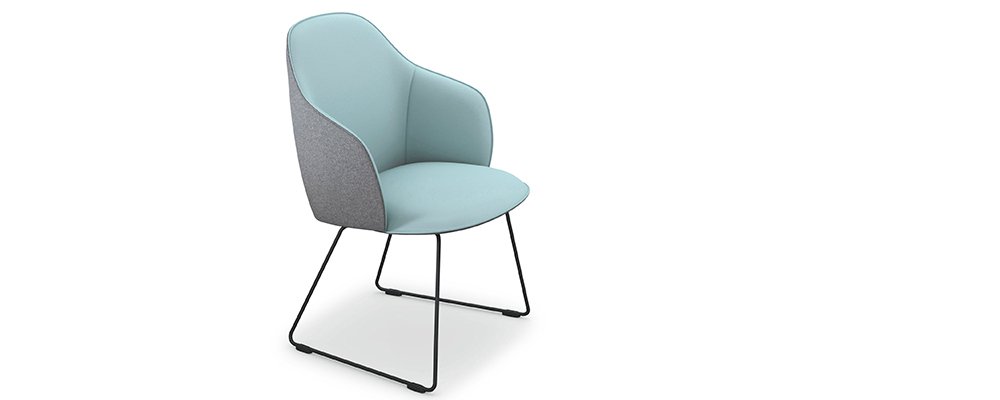
Reception seating from the se:café family by Sedus around a café table in an office

Visitor and reception seating shown in Clerkenwell: se:café, the chairs of the Sedus Work Café

Sedus
Visitor chair
se:café The piece that makes the room Visitor chair
£ 2,165

Let's discuss your project

Trade terms for professionals and design studios

In May 2025, during Clerkenwell Design Week, Sedus opened its London showroom at 9 Brewhouse Yard to present the Work Café, a concept built on three words, Work, Learn, Create, and on one sentence from its marketing director Ernst Holzapfel: freedom in the workplace no longer just means which desk you choose, it now means how you use the whole working environment. The seating that furnishes that idea is se:café, and it was on the floor in Clerkenwell.

Three lines make up the family. Falk Blümler drew the upholstered part: the se:café soft chair with a 445 mm (17½ in) seat, a lower and wider lounge chair, and a stool in two heights. Konstantin Thomas signed the bench without a back, the high bench and the diner with its own table, plus the wooden chair in solid beech or ash, which won a Red Dot and an iF award in 2025. In a British office the same pieces work as reception seating next to the front desk and as the furniture of the break area, which is exactly what the London showroom was showing.

Read by zone, the range sorts itself: tables get the soft chair or the wooden chair, corners get the two lounge versions, the counter gets stool and high bench at 625 or 780 mm (24⅝ or 30¾ in), which are bar stool heights, and the diner brings a 1,400 × 700 mm (55⅛ × 27½ in) table that can be wired. La Mercanti draws the zones with the client first and writes the order list afterwards, one height per zone.

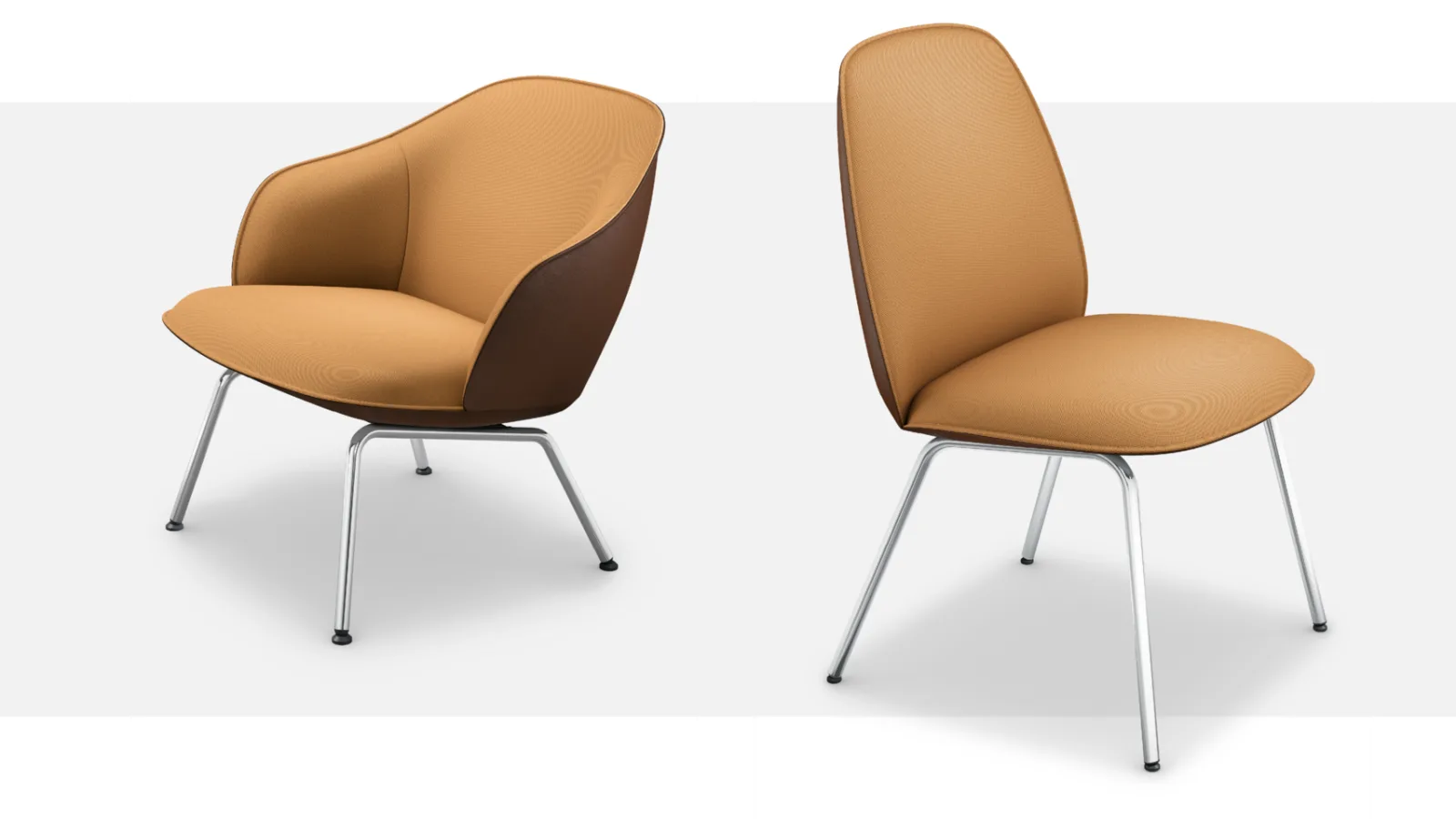
Technical information based on data declared by the manufacturer.
  • Collection: se:café by Sedus Stoll AG, seating family for work cafés and waiting areas
  • Design: Falk Blümler (soft line) and Konstantin Thomas (bench line and wooden chair), Sedus Design Team
  • Upholstered chair: se:café soft chair, fully upholstered shell, seat height 445 mm (17½ in), seat angle −3°, backrest angle 11°, sloping front edge, with or without integrated armrests, integrated lumbar support
  • Lounge chair: se:café soft lounge chair, lower and wider seat, backrest angle 17°, seat angle −5°, integrated armrests; lounge seating
  • Stool: se:café soft stool, seat heights 625 mm (24⅝ in) studio and 780 mm (30¾ in) bar, aluminium foot rail, no armrests; bar stools
  • Frames of the soft line: skid frame in 12 mm (½ in) tube, powder-coated or chromed; 4-leg steel frame in 22 mm (⅞ in) tube; 4-leg wooden frame with aluminium support and beech or ash legs, not stackable
  • Upholstery: 50 mm (2 in) padding; formal, taut finish as standard, informal finish with pleats on the inner backrest on request, not available with imitation leather, SILVERTEX or leather
  • Covers, soft line: seat, inner back and outer back configured separately; colour combinations within one collection; leather and imitation leather combinable with each other and with every fabric collection
  • Bench: se:café bench, fully upholstered with no back and no arms, seat height 450 mm (17¾ in), width 1,600 mm (63 in), upper and lower cushion in different covers, plug-in and screw assembly; reception seating and in-between zones
  • High bench: se:café high bench with backrest and foot rail, width 1,400 mm (55⅛ in), two seat heights, studio at 625 mm (24⅝ in) and bar at 780 mm (30¾ in); bar-height seating
  • Diner: se:café high diner, two facing high benches, 30 mm (1⅛ in) removable rear screen, overall length 2,010 mm (79⅛ in)
  • Diner table: 1,400 × 700 mm (55⅛ × 27½ in), 19 mm (¾ in) top in melamine, likewood, HPL or veneer, table height 900 mm (35⅜ in) with studio seats and 1,050 mm (41⅜ in) with bar seats
  • Diner power: on request, Point socket preparation, wireless charger hidden or visible Ø 60.5 mm (2⅜ in), PIX socket, Powerdot and Powerdot Mini
  • Wooden chair: se:café wooden chair at table height and wooden lounge chair at lounge height, solid beech or ash, conical legs, back and armrests from one curved moulded part, not stackable, delivered assembled
  • Wooden chair seat: veneered beech plywood, or Viennese cane in thin rattan strips over a semi-transparent plastic mesh
  • Interchangeable cushion: for the veneered seat, about 17 mm (⅝ in) thick with 10 mm (⅜ in) of PUR foam, anti-slip underside, fitted over the seat without tools, also later on
  • Wooden chair codes: cw-223 table height with wooden seat, cw-224 with Viennese cane, cw-267 lounge height with wooden seat, cw-268 with Viennese cane
  • Steel frame colours: black, pure white, fjord green, cayenne red, sand beige, deep green, dark bronze, chrome
  • Woods: natural beech, black beech, ash stained natural oak on the soft line and the bench; the wooden chair adds ruby red, deep green and midnight blue beech and natural or black ash
  • Glides: plastic for soft floors or felt for hard floors on the soft line, hybrid glides on the bench, adjustable reversible plastic/felt glides on the wooden chair
  • User weight: up to 130 kg (287 lb) on steel and skid frames, up to 110 kg (243 lb) on wooden frames; 130 kg (287 lb) on the wooden chair; per seat on the benches
  • Declared weights: soft chair 11.13 kg (24.5 lb) with wooden frame, bench 24.21 kg (53.4 lb) with steel frame, without packaging
  • Recycled content: 53.24 % on the soft chair, 21.99 % on the bench; 99 % recyclable; covers not glued, CFC-free foams, 10-year guaranteed repairability
  • Standards and certificates: GS mark by TÜV Rheinland LGA to DIN EN 16139 L1 and DIN 4573, GREENGUARD UL 2818 for the soft chair and the wooden chair, TÜV tested for harmful substances on the wooden chair, OEKO-TEX Standard 100 fabrics
  • Awards: Red Dot Award 2025 and iF Design Award 2025 for the se:café wooden chair
  • Guarantee: 5 years, declared by Sedus
  • Manufacturer: Sedus Stoll AG, Dogern, Germany; production site of the wooden chair declared on the GS certificate: Veneta Sedie, Casale di Scodosia, Italy
La Mercanti Srl — trusted supplier for design and contract projects since 1997.
San Benedetto del Tronto (AP), Italy · +39 0735 753833 · info@lamercanti.com
Supply, quotations, specifications and project support across the UK and worldwide.

Tell us which finishes you'd like to assess

£ 170

Fully redeemable against your first order

FAQ

What do the codes cw-223, cw-224, cw-267 and cw-268 stand for?

They are the four wooden chairs of the family, as listed on the TÜV Rheinland certificate. cw-223 is the table-height chair with a wooden seat and cw-224 the same chair with Viennese cane; cw-267 and cw-268 are the lounge-height versions, wider and lower, again with a wooden or a caned seat. Each code is then completed by the frame code for beech or ash and its finish.

What keeps the cane seat from sagging over time?

A stable, semi-transparent plastic mesh stretched underneath the weave. Sedus describes the Viennese cane as thin rattan strips worked into a woven pattern, and the mesh is there precisely to extend its life. The caned version sits on a finger-jointed, glued frame with the legs screwed to it, which is a different substructure from the veneered seat.

Is there a flame-retardant version of se:café?

Yes, on more than one line. The soft chair, lounge chair and stool can be ordered flame retardant with the cover fabrics One or Step; the cushion of the wooden chair with One, Step or Nobel; the bench line with the fabric Umber. The fabrics are the variable, the padding and the shell stay the same, so the choice is made at the moment the covers are specified.

How heavy is a single se:café chair or bench?

Sedus publishes the figures in its environmental product information: the soft chair with a wooden frame and Cyber fabric weighs 11.13 kg (24.5 lb) without packaging, the bench with a steel frame 24.21 kg (53.4 lb). In the bench, steel accounts for 9.21 kg and aluminium for 3.46 kg; in the chair the largest single material is polypropylene at 4.22 kg.

Can the chairs be stacked between events?

Not on the wooden frames. Sedus states that the 4-leg wooden frame of the soft line is not stackable, and the same applies to the se:café wooden chair. The listing does not declare stacking for the steel or skid frames either, so a project that needs chairs put away between uses should be planned around storage space rather than stacks.

How to write se:café into a specification, code by code

A specification for se:café is a list of codes and heights rather than adjectives. Five steps to write it so that the order matches the drawing.

Start from the wooden chair codes

The four solid wood versions of se:café carry their own codes on the GS certificate: cw-223 and cw-224 at table height, cw-267 and cw-268 at lounge height, the even numbers with Viennese cane. Write the code, then the wood (beech or ash) and its finish.

Give every upholstered seat its height

The se:café soft chair is 445 mm (17½ in) high, the stool and the high bench 625 or 780 mm (24⅝ or 30¾ in). Put the figure on the line: two products with the same name and different heights cannot share one specification line.

Name the frame and the glide

For the soft line state skid, 4-leg steel or 4-leg wood, then plastic glides for soft floors or felt for hard floors. The bench takes hybrid glides, the wooden chair reversible ones. The frame also fixes the load: 130 kg (287 lb) on steel, 110 kg (243 lb) on wood.

Break the covers down by surface

The se:café soft line lets the specifier name three surfaces, the seat and both faces of the back; a bench has an upper and a lower cushion instead. Colours combine within one collection only, so the specification names the collection first and the colours after.

Attach the test marks

Close the se:café line with the marks the manufacturer declares: GS to DIN EN 16139 L1 and DIN 4573, GREENGUARD UL 2818 for the soft chair and the wooden chair, TÜV harmful-substance testing on the wooden chair. La Mercanti supplies the certificates as downloads from the product page.