What did you have in mind?
Trade terms for professionals and design studios
What did you have in mind?
Trade terms for professionals and design studios
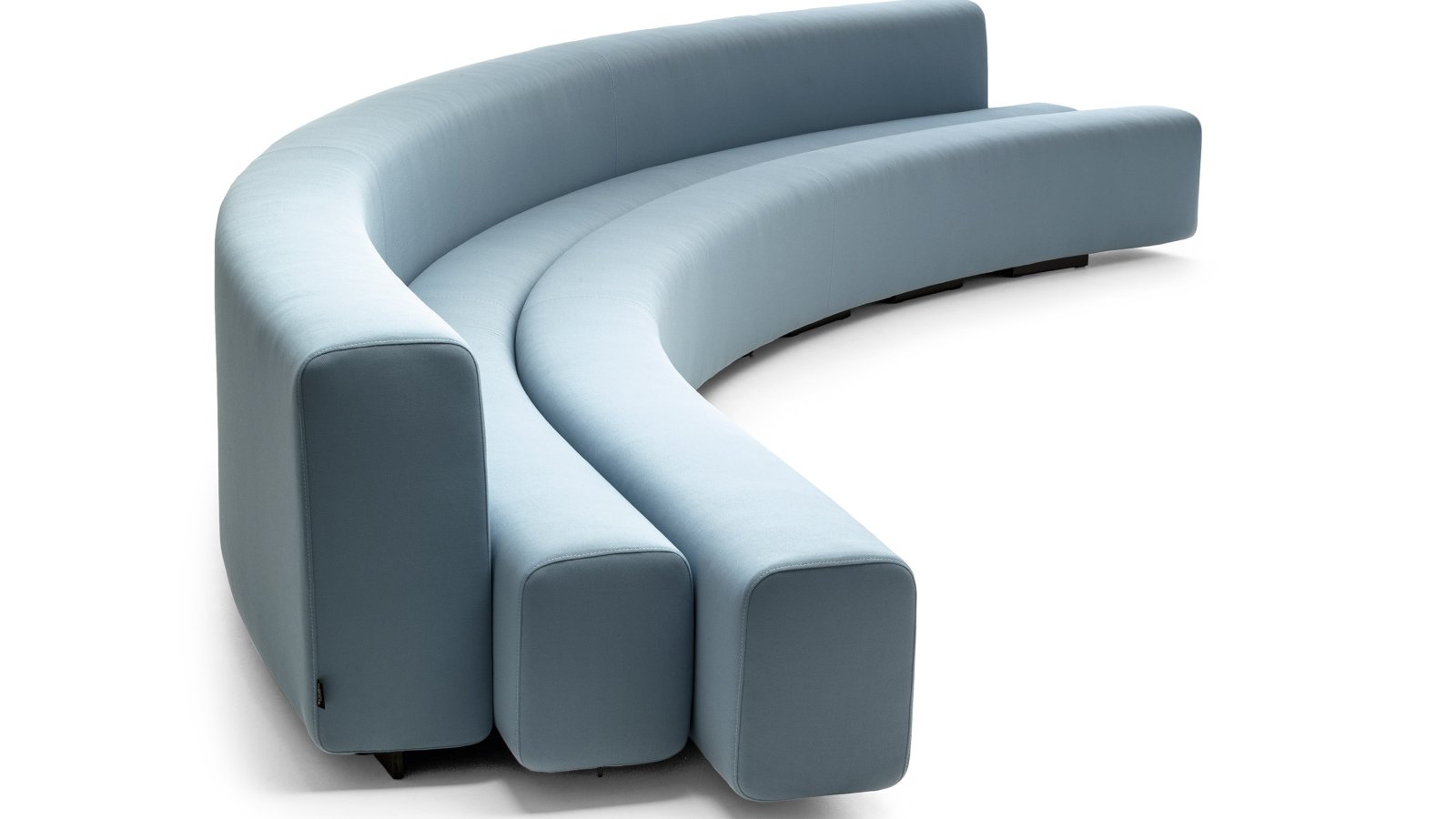
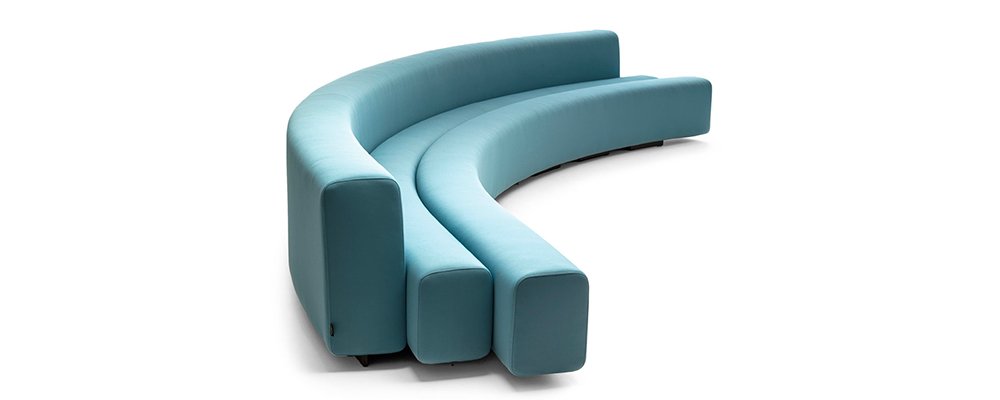
Most curved sofas come in two shapes: the concave one and the convex one, and the plan has to fit them. With Osaka the plan comes first. LaCividina publishes a minimum back radius of 258 cm (101⅝″) and a minimum front radius of 180 cm (70⅞″), and within those limits the bend is drawn to the room. The steel plates under the cushions have their own floor, 246 and 171 cm (96⅞″ and 67⅜″): a technical drawing, not a range of models.
That is why the piece behaves so well as reception seating. A lobby with a column, a lift core or an awkward corner does not get a compromise; it gets an arc set to its own geometry, and the run of seating reads as one continuous line from the door. Pierre Paulin drew it in 1967 with «naturally winding lines», and the reissue keeps the idea while the frame is built for public areas.
Read as a modular sofa, the family covers ten lengths from 180 to 630 cm (70⅞″ to 248″), each available as a sofa with a back or as a backless bench, plus straight elements to join the bends and an Outdoor version in cataphoresis-coated steel. Where the brief asks for sofas for a breakout area, the same pieces serve. La Mercanti lays every arc over the published radii on the plan and only then releases the codes to LaCividina.

Tell us which finishes you'd like to assess
Ten, in 50 cm (19⅝″) steps: 180, 230, 280, 330, 380, 430, 480, 530, 580 and 630 cm (70⅞″ to 248″). Each length exists as a sofa with a back, codes 8801 to 8810, and as a bench without one, codes 8811 to 8820. The two families share the same seat height, so they can alternate in one run.
Because the cover follows a bend. LaCividina lists the upholstery as removable and made in selected stretch fabrics: Stretchy, Trio, Bit, Mosaic 2, Uniform Mélange, Arda, Regos, Triangle and Gentle 2 are the recommended references. A rigid cloth would pull on the outer curve and sag on the inner one.
The data sheet names them in order of insertion: the back cushion first, then the front seat cushion, then the central seat cushion. They slide onto the steel frame after the base has been assembled, which is why the sofa is delivered as a kit rather than as one padded block.
More than half of its weight. Every code in the LaCividina price list carries the French eco-fee classification «sous famille >50% métal», meaning steel accounts for over 50% of the piece. The longest sofa weighs over two hundred kilograms (more than 450 lb) net; most of that is the frame, not the foam.
LaCividina documents the Louis Vuitton Cruise 2015 show in Monte Carlo, where 55 two-tone Osaka sofas ran for 330 linear metres (1,083 ft) along the catwalk before travelling to New York for the maison’s press day. The same page cites the 10 Corso Como concept store in Shanghai and the Chanel Ginza Building in Tokyo.
An Osaka element arrives as a steel kit plus cushions. LaCividina publishes the parts and their sequence; this is how the base goes together on site.
Lay out the parts of the Osaka kit and find the base connection clip: it is the piece that ties one base to the next, and knowing where it goes tells you the direction of the run before anything is bolted.
Position the side base at each end of the Osaka element and the central base between them, following the numbered sequence on the LaCividina sheet. Check they sit flat before adding any support.
Fit the side seat supports first, then the central ones. These carry the front and central seat cushions of Osaka, so their alignment decides whether the seat reads as one plane.
The side back support and the central back support go on last among the metal parts. They are what makes an Osaka sofa a sofa rather than a bench, so leave them off on bench codes.
Hook the clip to the neighbouring base and repeat. La Mercanti hands over each Osaka run with the sequence sheet, so a facilities team can extend or reconfigure the seating later.