Already have something in mind?
Trade terms for professionals and design studios
Already have something in mind?
Trade terms for professionals and design studios
“Less structure. More possibilities.” ICF puts the line above the Void Chair; it reads like the brief the designer was handed. Taken out: the layers most upholstered chairs lean on. Put in: a minimal aluminium frame round the perimeter and a self-supporting textile membrane tensioned inside it to fit the body and spread the load. For anyone weighing up task chairs for the desk, that is the proposition: comfort from tension, not from what is piled under it.
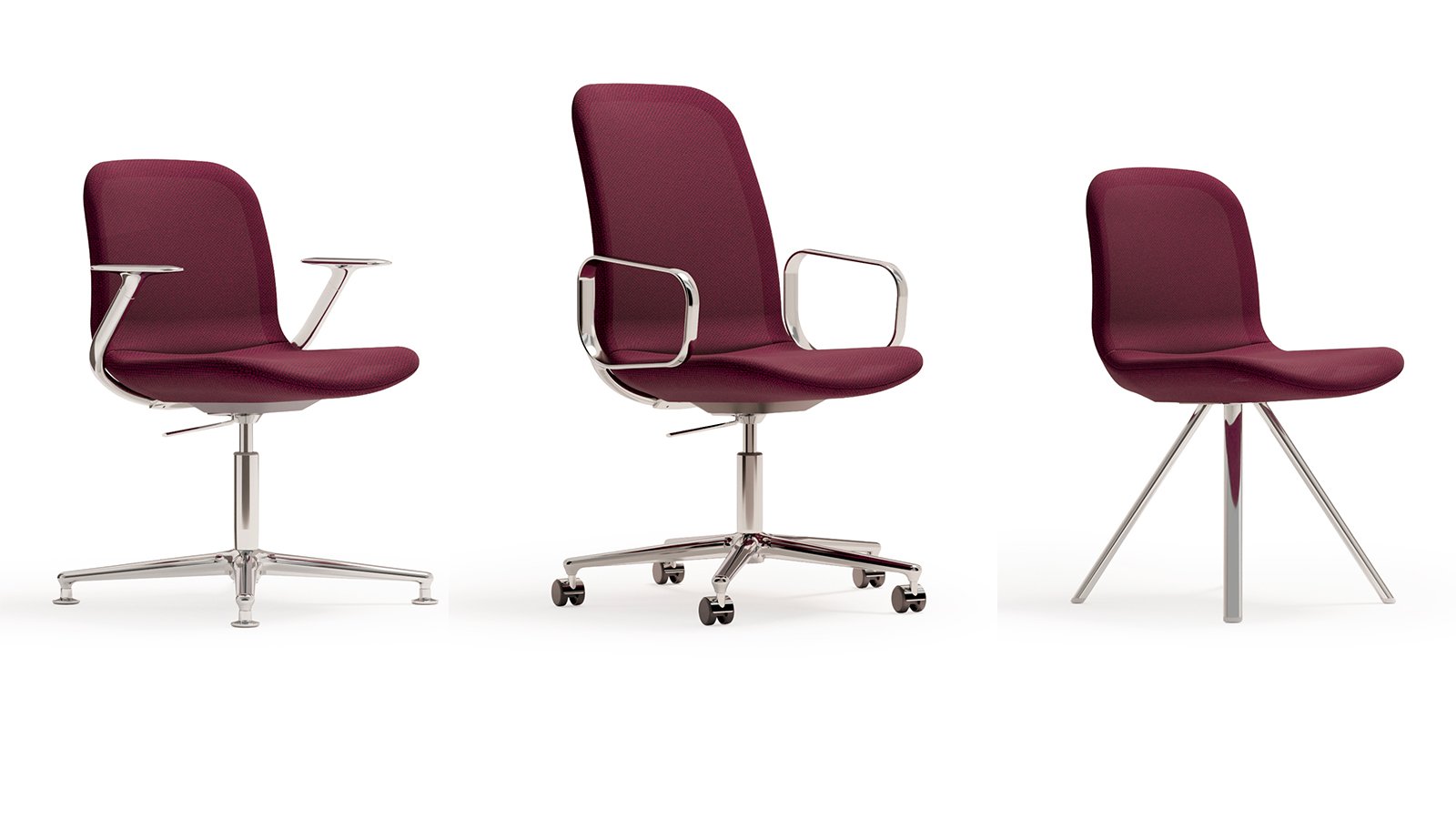
Design Khodi Feiz, 2026. The possibilities are the second half: the Void is a system, one frame and membrane carrying more than one backrest height, different arm types and a fixed or a swivel base. Frame, membrane and connections stay in plain sight. ICF lists it under task seating and again under executive, meeting and multipurpose chairs, rare candour about where one structure can go.
Three coverings dress it: bare structural membrane, slim Soft Pad, or a fully upholstered interpretation. On an open-plan office floor the swivel base earns its place; at the meeting table, the fixed one. Between versions the backrest, the arms and the base change; the idea does not, and which versions can be ordered is, in ICF's words, subject to the final product programme. La Mercanti lists, request by request, which possibilities ICF has already confirmed as orderable, so the brief is answered with a configuration and not a promise.

Tell us which finishes you'd like to assess
ICF names home-office among the settings the Void was conceived for, next to meeting and executive use, and separately describes it as at home in residential spaces as well as professional ones. The reason is in the form: essential, ICF says, but not neutral, so the chair keeps its character whether the room is a corner office or a spare bedroom with a desk in it. For someone furnishing both, the practical upside is one object that does not have to be explained twice: the same frame and membrane at work and at home, with the base chosen for the room.
ICF describes it as a slim Soft Pad, one of the design options alongside the structural membrane in its most essential form and a fully upholstered interpretation. The three differ in what the hand and the eye meet: a little more softness and a more closed surface, without changing the structure underneath, since the perimeter frame and the suspended membrane remain the chair. What it changes, in ICF's words, is the tactile and visual quality; what it keeps is the principle of a surface that supports through tension rather than through thickness.
Because there is so little else to look at. ICF puts it plainly: when a chair is made of fewer elements, every detail matters more. A change in curvature, the balance between solid and open, a finish or a colour can alter the character of the whole chair. It cuts both ways for a specifier: a dark frame under a dark membrane reads as a quiet technical object, a pale structure under a strong colour almost domestic. ICF adds that the construction stays recognisable without forcing an exclusively technical look, which is why the same chair can be specified for a boardroom and a hotel lobby.
On the panel of its stand at Orgatec 2026, ICF states that both the aluminium and the fabric are fully recyclable, and sums the project up as structure, comfort and circularity in one chair. That is a declaration by the manufacturer about its two materials, not a certificate and not a percentage, and it should be quoted as such in any document. What backs it is the construction ICF describes: one metal for the frame, one textile held inside it, nothing hidden under a cover. Two materials, both declared recyclable by ICF: the sentence is short because the list is.
The opposite, by ICF's own account. Where most upholstered chairs create comfort by adding layers, the Void defines a generous volume without filling it, and uses a tensioned textile surface to adapt to the body and distribute its weight. Comfort is produced by the shape of that surface and by how much it gives, not by how much sits under it. ICF describes the result as a surface that adapts to the body: comfort produced by tension, not by thickness.
The textile membrane of the Void is the part that gets touched all day. ICF's care guide gives simple rules for open-weave surfaces: a hidden test first, then dust, then stains, then water and air.
Before any cleaning product goes near the membrane of a Void Chair, ICF asks for a trial on a spot that will never be seen: the underside of the seat, the lower edge of the back where it meets the frame. Apply, let it dry, check that the colour and the surface are unchanged. It takes a minute, and it is the only step that cannot be undone once skipped.
For everyday dust ICF's guide allows two tools, the vacuum or a soft brush, and specifies that the brush must not be metallic. The membrane is a tensioned textile, so the brush follows the weave lightly rather than scrubbing against it; a metal bristle would mark the surface. Seat and back are treated the same way, following the weave.
A stain on the membrane is treated with that same soft brush, or with a sponge, using water plus a detergent, worked gently over the area. Nothing abrasive and no solvent: the guide is explicit that it is water and detergent, not a stronger product applied in frustration. The guide names the tools and nothing stronger.
After the detergent, ICF asks for the membrane to be rinsed abundantly. ICF puts the rinse in the guide as a step of its own, not as an afterthought. Clear water, plenty of it, over the whole area that was treated and a little beyond its edge.
ICF's last instruction is air drying, nothing else. Leave the chair where air circulates and give the membrane time; no heat, no hurry: air drying is the only drying ICF names for the membrane. Once dry, the chair goes back into use.