Already have something in mind?
Trade terms for professionals and design studios
Already have something in mind?
Trade terms for professionals and design studios
There is air inside the seat of Team Strike, and it is there on purpose. Sitland calls the system Comfort Air: the cold-foamed polyurethane is cast with trapped air that works as a spring, so the cushion answers the weight and recovers when it leaves. Sitland declares two gains: a seat that does not pack down, and less foam for the same support, booked as a lighter footprint. For whoever specifies Italian task seating, that is a line to carry into the material brief: less foam, same seat.
Under it runs the family mechanics: a synchronised movement tying backrest and seat, five lock positions with antishock, a tilt tension set on the sitter's own weight, a lumbar support that travels higher or lower on the back. Sitland's monograph calls it a shape-retaining upholstered seat with Comfort-Air technology.
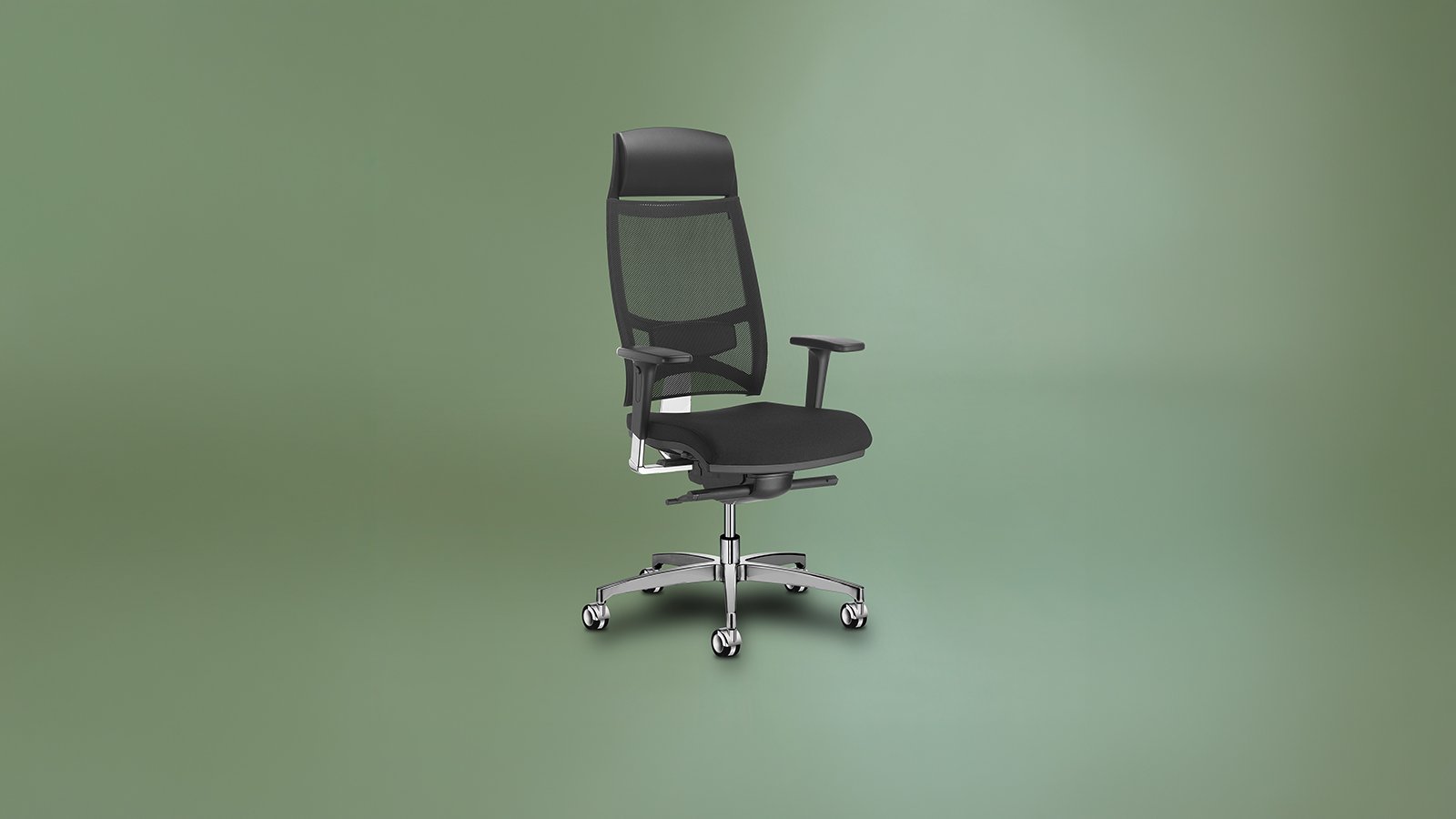
Four versions, sorted by the backrest. In mesh: the Executive, headrest as standard and the only one declared to UNI EN 1335:2020 type B, and the Manager, no headrest, lumbar and sliding seat as options. Upholstered: the Executive with padded back, same fittings, and the Operative, lumbar as standard. Sergio Bellin drew it in 2008; in Sitland's pictures the chairs stand at island desks in open plan. La Mercanti asks the people who will use it to sit on Team Strike for the length of a meeting, not a minute: an air-sprung seat shows what it does after the first half hour.

Tell us which finishes you'd like to assess
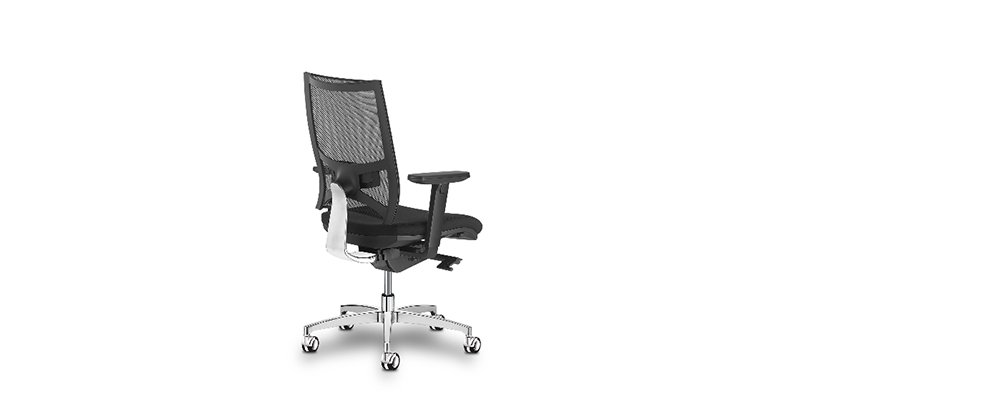
The Manager is the mesh-backed Team Strike without a headrest, and Sitland sells it lean on purpose. As standard the seat has a fixed depth and there is no lumbar support; both return as options, a sliding seat and a soft black polyurethane lumbar pad that rides higher or lower on the back, and a headrest can be added as a separate item. The mechanism is the one shared by all four versions: the buyer is not choosing a lesser chair, only a shorter list of fittings. Each addition is a separate item on the order, so what the chair arrives with is exactly what was written, nothing assumed.
Only in the surface. The upholstered Executive keeps the full fitting of its mesh twin, sliding seat, lumbar support set in height and headrest as standard, and replaces the mesh with a padded back in the same cold-foamed polyurethane Sitland uses for the seat. Seat and back are then covered in one category, the one chosen for the seat. For a specifier the point is simple: the two Executives share fittings and mechanism, and the backrest surface, mesh or padding, is the only line that changes on the order.
They are the four meshes Sitland offers for the backrest of the mesh-backed versions, and the code is how the choice is written. RR is Runner, the only one Sitland calls by name; for RF, RP and RY it gives the code alone, so that is what goes on the order. RY has one more job: it is the mesh Sitland pairs with the two fabrics that give the chair its Italian fire class on request, so a specifier who needs that class is choosing RY before any colour. The rest is weave and tone, which the code does not describe: the buyer settles them by eye, the code settles the order.
Two options, two recipes. NX is a coated fabric at 91 % PVC and 9 % polyester, filed by Sitland in category 1. Secret, by Flukso, is coated at 76 % PVC, 2 % polyurethane and 22 % polyester; Sitland describes it as flame-retardant, resistant to sun and weather, waterproof and easy to clean, with a light fastness of 6 on the 8-point scale. Secret sits in category 4, so the choice between the two moves the covering category on the order line and nothing else on the chair.
Three heights, one backrest. The upholstered Operative stands 990-1090 mm overall; the Manager 1030-1130, or 1015-1115 once the sliding seat is fitted; the two Executives 1190-1290. What changes is not the back, which is 570 mm high on all four, but the headrest sitting above it on the Executives. On a floor that mixes versions the three figures tell the buyer at a glance which chair stands where, before any of them is unpacked. La Mercanti puts the three figures on the plan before the version is chosen, because the room decides them more often than the sitter.
Seat height, seat depth, lumbar, backrest tension and lock, then arms and headrest: the five adjustments Team Strike offers, with the ranges Sitland publishes, in the order a new sitter should take them.
Sit on the Team Strike with both feet flat and bring the seat to the point where thighs rest level and knees sit at roughly a right angle. The gas lift gives 420 to 520 mm on the two Executives and the Operative, 410 to 510 on the Manager, or 415 to 515 if the Manager has the sliding seat. Everything else depends on this number, so it goes first and is not revisited later.
Where the sliding seat is fitted, standard on the Executives and an option on Manager and Operative, move it until two or three fingers fit between the front edge and the back of the knee. The travel is 420 to 492 mm; on the upholstered Executive 420 to 480. The seat locks where you leave it, so a shared chair keeps the depth of its last user until someone changes it.
The lumbar support travels in height. Lean back, find where the small of the back wants to be met, and set the pad there, not higher. On the Manager this is an option, so a chair without it simply moves on. On the three versions where it is standard the right position is usually lower than people expect, just above the belt line.
Before locking anything, set the tilt tension to your own weight so the backrest follows you back and returns without pushing. Then pick one of the five lock positions if you want the back to stay put; when you release it, antishock keeps the backrest from snapping forward. Free movement or a fixed angle is the sitter's call, and the chair holds either for as long as it is wanted.
If the chair has armrests, set their height so the shoulders drop and the forearms rest without lifting; some tops also move in width, slide in depth and pivot. If there is a headrest, standard on the Executives, it rides higher or lower to meet the back of the head when you recline, never pushing it forward while you type.