Let's discuss your project
Trade terms for professionals and design studios
Let's discuss your project
Trade terms for professionals and design studios
Wool is a rare word on a task chair specification: polyester has the field, and the warmer hand is usually paid for with the swivel base. Not on Skipper. Among the collections Sitland proposes for the seat are three Camira wools, Main Line Flax at 75 % wool and 25 % flax, Yoredale at 93 % New Zealand wool, Synergy at 95 % virgin wool, picked seat by seat on mesh-back task chairs the way it should be: by the hand, not from the swatch card.
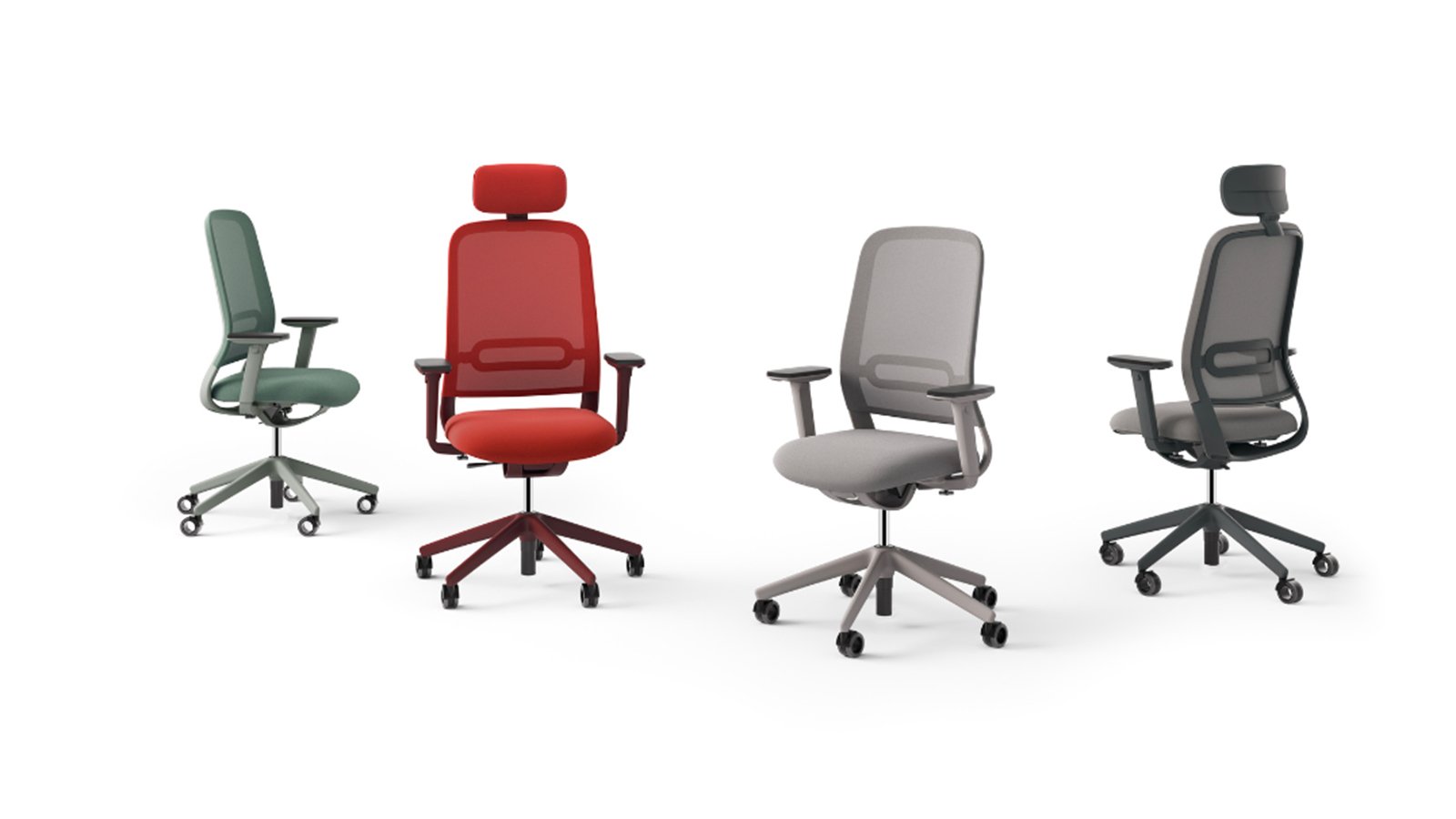
The chair under the wool is the one Sitland's own R&D department drew as its first task chair in colour: two earth tones, sandstone and brownish red, two cool greys, lichen and anthracite, plus classic black, on frame, base and mesh. Behind the mesh, a lumbar pad that moves up and down; below it a seat upholstered or meshed; beneath either, one of three synchronised mechanisms on a single table of dimensions.
Dress the seat and you have named the Skipper: two textures in fabric, one in mesh from the TT, RR Runner, RY Rhythm or HQ Harlequin ranges. Both accept Syncro, Syncro Plus or Swing beneath, black 2D arms or 4D arms in the frame tone, and a headrest in mesh or upholstered. Sitland's own pictures seat six of them at a long table, which puts Skipper forward as meeting room seating. La Mercanti puts the wool swatch and the polyester swatch on the client's desk side by side, because on a task chair the hand decides what the eye cannot.

Tell us which finishes you'd like to assess
Syncro is the first of the three mechanisms Sitland fits to Skipper: a self-weight synchronised mechanism, in the brochure's words, lockable in the working position. Synchronised means seat and backrest move together as you lean back; self-weight means the resistance of the backrest comes from the weight of the person sitting in it, which is all the brochure claims for it. The single lock is for the hours spent typing: hold the chair upright, release it for the phone call. On a desk that changes hands during the week, it is the mechanism with the least to explain.
It is the sentence on the brochure cover, and the product page spells it out: Skipper is drawn for «creative, flexible and energetic workspaces», and Sitland says it brings colour into the operative world. Read as a buyer, the promise is modest and checkable: a task chair whose frame, base and armrests take colour, one of five tones, matched by the mesh, for rooms where the seating is meant to be seen rather than hidden under the desk. It is not a claim about performance; that sits in the dimensions and the mechanism data, not in the tagline.
The brochure gives Skipper a seat depth of 430 to 500 mm (16.9 to 19.7 in), quoted as a range and the same on Syncro, Syncro Plus and Swing. Depth is the dimension most specifications ignore and most sitters feel: a seat that runs too far forward presses behind the knee and pushes the pelvis away from the backrest, so the lumbar support works on the wrong part of the spine. The upper end serves a tall user who would otherwise perch on the front edge; the lower end keeps a smaller person in contact with the back. Sitland publishes it as a dimension of the chair, not of one mechanism.
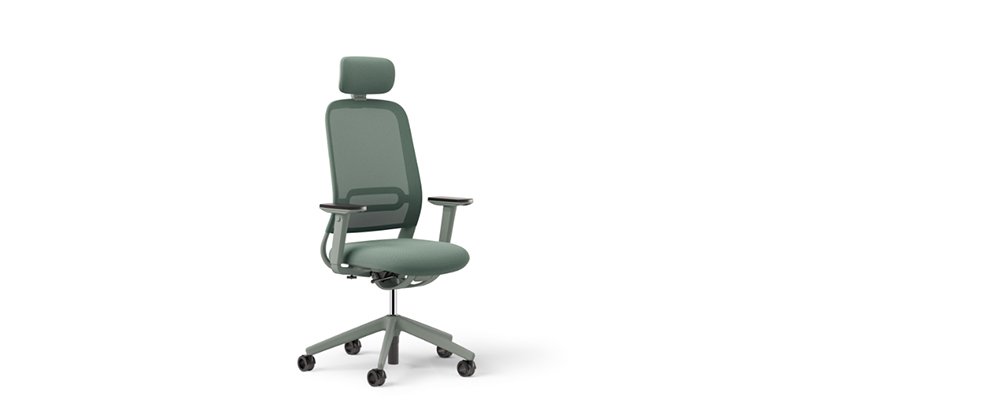
Look at a Skipper from behind and the mesh backrest shows an oval opening with a moulded element behind it. That is the lumbar support, and the brochure lists it as adjustable in height. The point of moving it is simple: the inward curve of the lower spine sits at a different height on a tall man and a small woman, and a fixed bulge fits the average person nobody is. On Skipper the support moves up or down until the push lands where the back hollows, then stays put: a once-per-person setting. Height is the movement Sitland declares, and height is what a specification should quote.
Skipper is ordered with or without a headrest, and the brochure gives the option two faces: mesh or upholstered, with the structure in the same colour as the chair frame. It adjusts in height and tilts, the pair of movements that matters: height puts the pad at the nape rather than the crown, tilt angles it towards the head so it is there when the backrest reclines. In the Sitland photographs the upholstered version shows a seam and a hinge above the mesh; the mesh version continues the backrest. On a long day it is the part people miss; on a desk nobody owns, the part most often left off.
Five lines from the Sitland brochure carry the weight in a tender or a fit-out specification. Here is what each one says, what it does not say, and how to copy it without adding a claim Sitland never made.
The Skipper brochure prints EN 1335-1:2020 with the letter A in its box, and the words D.Lgs. 81/08 beneath it. Write it on the specification in that form: standard, year, type A. Do not attach the type to one mechanism; the brochure prints it once, for the chair. The D.Lgs. reference is Italian workplace law quoted by Sitland, not a British requirement, and should be labelled as such.
Next to the certificates sits the word CAM, the Criteri Ambientali Minimi used in Italian public procurement. On a UK specification it is a declaration by Sitland, useful as context for the environmental line and nothing more. Quote it as «CAM indication, as declared by the manufacturer», and resist turning it into a compliance statement for a British framework it was never written for.
Sitland gives Skipper four environmental declarations on one page: a recyclable share at end of life, a share of recycled materials going in, repairability and disassembly declared in full. Copy the four together, in Sitland's wording and figures; one line lifted out of the group reads like marketing. Add no label or scheme: what the brochure prints is what the buyer can defend at handover.
The same page breaks Skipper down by material: plastics first by a wide margin, then metals, then polyurethane and polyester in small shares. For a client with a waste or circularity policy this is the line that matters, because it says what will be separated at end of life. It is a composition by share, not a bill of weights: copy the percentages as Sitland prints them and leave kilograms out.
Skipper Syncro, Syncro Plus and Swing share a single table of dimensions: backrest width, seat height, overall height, seat depth and base diameter are printed once, with the same figures for the three. Put that table in the specification once and name the mechanism per workstation; one drawing covers all three, and the mechanism becomes a word on the line rather than a second table.