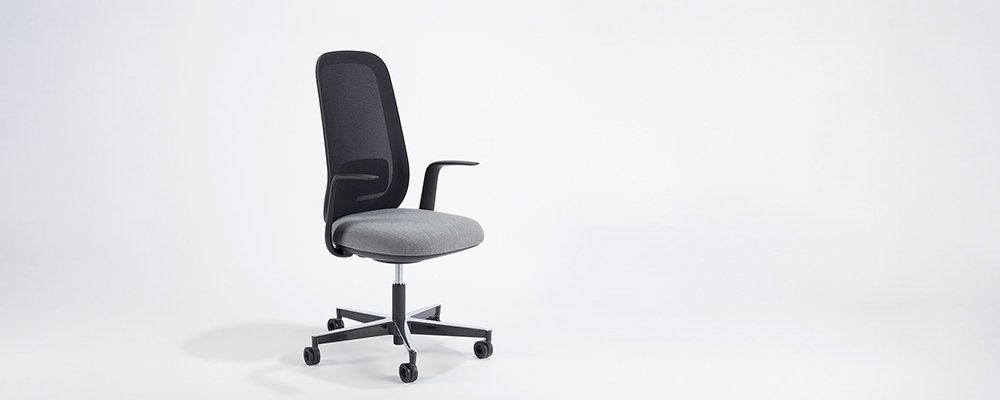
Skate Active by Sitland, a task office chair with black frame and mesh back

One task chair, two mechanisms: Skate by Sitland comes as Active, with nothing to set, or Synchro

Sitland
Task chair
Skate Available now Task chair
£ 1,243

Prefer a tailored configuration?

Trade terms for professionals and design studios

Most chairs in a catalogue differ by trim. Skate differs by mechanism, and the choice changes how the chair is used. Active has nothing to set for its movement: Sitland’s patented DAT®, Dynamic Adaptive Technology, lets seat and backrest rock freely with the body while keeping a sound posture, with no levers or knobs, and the motion follows each sitter’s own weight. Synchro is the other temperament: a self-weighing synchronised mechanism, a seat that slides from 445 to 520 mm (17½-20½ in) in depth, a lock in four positions with an anti-shock system, and back tension that can be regulated on request.

Both are the same task office chairs underneath. Seat height is set by pressing anywhere on the disc beneath the seat, from any side, a further Sitland patent. The lumbar support travels 105 mm (4⅛ in) and moves while you are seated. The polyamide back frame takes mesh or fabric, and a five-star base of 700 mm (27½ in) rolls on braked 65 mm (2½ in) castors. The listing grades Active as EN 1335 type B and Synchro as type A.

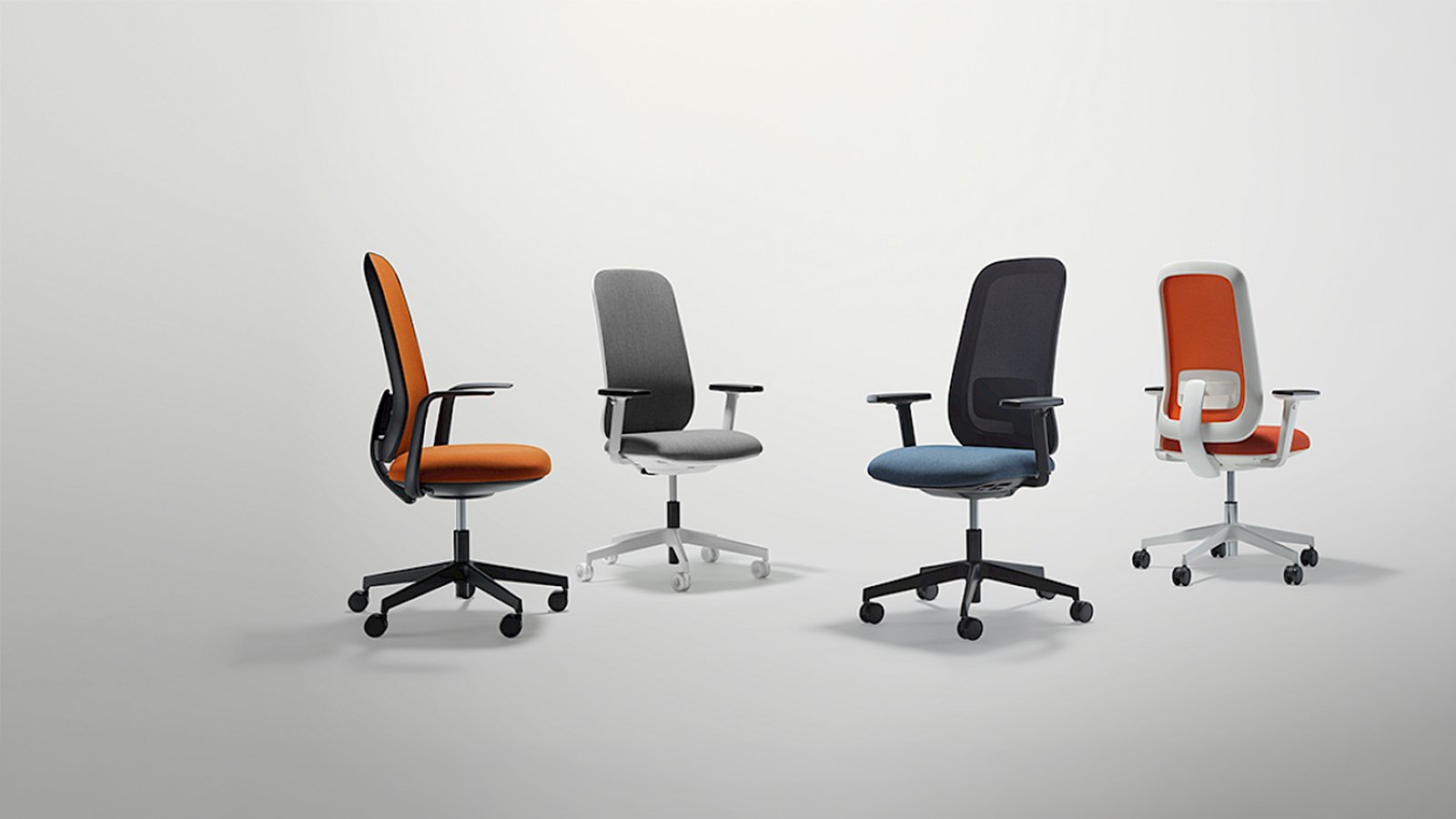
The rest is a matter of fit-out. Frames come in black or white; arms on Active run from fixed through step-by-step to 3D, on Synchro from 1D to 4D, and either can go without. Buyers after a mesh office chair choose between Runner and Rhythm by Gabriel for the back. Sitland drew it for the office and for a home study, and recommends Active for shared and co-working spaces, which is why both versions often share one open-plan floor. Ahead of any order, La Mercanti sends RR and RY mesh swatches so the back is chosen with the material in hand.

Technical information based on data declared by the manufacturer.
  • Type: task office chair
  • Manufacturer: Sitland, part of the We Do Spaces group
  • Design: Emanuele Bertolini, Jeremiah Ferrarese, Paolo Scagnellato, 2020
  • Versions: Active with DAT® mechanism; Synchro with synchronised mechanism
  • Active mechanism: patented DAT® Dynamic Adaptive Technology; seat and back rock with the body, no levers or knobs, according to body weight
  • Synchro mechanism: self-weighing synchronised movement, adjustable seat depth, lock in 4 positions with anti-shock system; backrest tension regulation by body weight on request
  • Seat height: activated by pressing anywhere on the disc under the seat, 360° (Sitland patent); Active 430-560 mm (17-22 in), Synchro 385-515 mm (15¼-20¼ in)
  • Active dimensions: back width 500 mm (19¾ in), depth 485 mm (19⅛ in), height 1070-1200 mm (42⅛-47¼ in)
  • Synchro dimensions: 1030-1150 mm (40½-45¼ in) tall and 520 mm (20½ in) wide, depth adjustable over 445-520 mm (17½-20½ in)
  • Lumbar support: height-adjustable from the seated position, 105 mm (4⅛ in) travel
  • Active armrests: fixed polyamide (top 200 mm / 7⅞ in above the seat); step-by-step height adjustment 155-225 mm (6⅛-8⅞ in); 3D, height 140-250 mm (5½-9⅞ in), soft-touch TPE top adjustable in depth and pivoting
  • Synchro armrests: 1D height; 2D height and width (460-520 mm / 18⅛-20½ in between arms); 4D also pivoting left and right and sliding in depth; soft TPU top 240 mm (9½ in) long, set 170-240 mm (6¾-9½ in) above the seat
  • Backrest: polyamide frame with RR Runner or RY Rhythm mesh by Gabriel, or fabric; die-cast aluminium back support on Synchro
  • Seat: Active padded in fire-retardant class 1IM foam; Synchro in cold-moulded flexible polyurethane, non-deforming, class 1IM, over a polypropylene inner shell
  • Frame colour: black or white
  • Base: five-star, 700 mm (27½ in), nylon or die-cast aluminium with polished top and painted profile; Synchro also offers a flat polished die-cast aluminium base
  • Castors: 65 mm (2½ in) braked as standard; free-running for textile floors; braked rubber for hard floors; hollow rubber Moebius by Starck in white or black
  • Upholstery: Alba and Bondai by FiDiVi; Xtreme Plus, Main Line Flax and Sinergy by Camira; Medley, Step, Crisp and Chili by Gabriel; Remix 3 by Kvadrat; coated Secret by Flukso
  • Customer’s own material: 0.55 m (21⅝ in) linear at 1.40 m (55⅛ in) width for the seat
  • 1 IM version: AB fabric seat with RY mesh back
  • Standards: UNI EN 1335:2020 type B (Active) and type A (Synchro); Italian D.Lgs. 81/2008; GREENGUARD; Italian class 1IM
  • Sustainability: Econa line; 100 % disassemblable, 69 % recyclable at end of life, 21 % recycled content, 71 % of suppliers within 50 km (31 mi) — measured on Active with aluminium base and fixed arms
  • Packing: one carton for self-assembly, 0.524 m³ (18.5 cu ft), or fully assembled, 0.57 m³ (20.1 cu ft)
  • Origin: made in Italy
La Mercanti Srl — trusted supplier for design and contract projects since 1997.
San Benedetto del Tronto (AP), Italy · +39 0735 753833 · info@lamercanti.com
Supply, quotations, specifications and project support across the UK and worldwide.

Tell us which finishes you'd like to assess

£ 170

Fully redeemable against your first order

FAQ

Where do you press to raise or lower a Skate seat?

Anywhere on the disc beneath the seat. Sitland patented a height control that works through a full 360°, so there is no single lever to find. The same disc sits under both versions, Active and Synchro, whatever the frame colour.

Does Skate suit a home office as well as a workplace?

Sitland designed it for both: the brochure names the office and the corner of the home where you work or study, and credits its ease of use and minimal lines. The mesh or fabric back and the black or white frame are chosen as for any office order.

Which castors should a Skate have on carpet or on a hard floor?

Free-running 65 mm (2½ in) castors for textile floors, braked rubber castors for hard floors. Braked castors come as standard, and there is a third option, the hollow rubber Moebius by Starck in white or black, also meant for hard floors.

Can a Skate be taken apart at the end of its life?

Entirely. Sitland’s data, measured on an Active with aluminium base and fixed arms, give the chair as 100 % disassemblable, with 69 % of it recyclable once it is retired. The same data record 21 % of recycled material in the chair as built.

Can Skate armrests be ordered later?

Yes. Both Active and Synchro can be ordered without arms, and the listing carries the armrests as a separate option shipped in their own carton, for Active and for Synchro alike, so chairs and arms appear as separate lines on an order.

How to keep a Skate cover clean

Sitland’s care note for the upholstery of its chairs is short and strict: regular vacuuming, a barely damp cloth for marks, and no rubbing.

Vacuum the Skate cover monthly

Sitland asks for the upholstery of a Skate to be vacuumed at least once a month. The instruction covers the padded seat and, on fabric-back chairs, the back as well.

Use only a slightly damp cloth

If grease marks the cover, the only tool Sitland names is a cloth that is barely damp. Wet cleaning, solvents and stain sprays are not part of the instructions.

Add a little neutral soap

The cloth can carry neutral soap, and nothing stronger. The note is the same for every fabric Sitland lists for the chair, from the Alba of FiDiVi to the Remix 3 of Kvadrat.

Do not rub the stain

Sitland is explicit that the mark must not be rubbed. The cloth goes onto the stain and comes away again, without working back and forth across the weave.

Let the seat dry naturally

The last step is to leave the upholstery to dry on its own, at room conditions, before the chair goes back into use. Sitland gives no other drying method for its covers.