What did you have in mind?
Trade terms for professionals and design studios
What did you have in mind?
Trade terms for professionals and design studios
Humanscale's testing sets Path a long horizon: after more than ten years of heavy use the chair should still look and feel new, and still work flawlessly. Behind it sit parts made to be renewed: contoured cushions that are modular and fitted without glue, a gas cylinder that keeps its grease sealed in the lower unit, layered Duron armpads. Set beside other task chairs for daily work, the Humanscale Path is one to judge in its tenth year, not its first week.
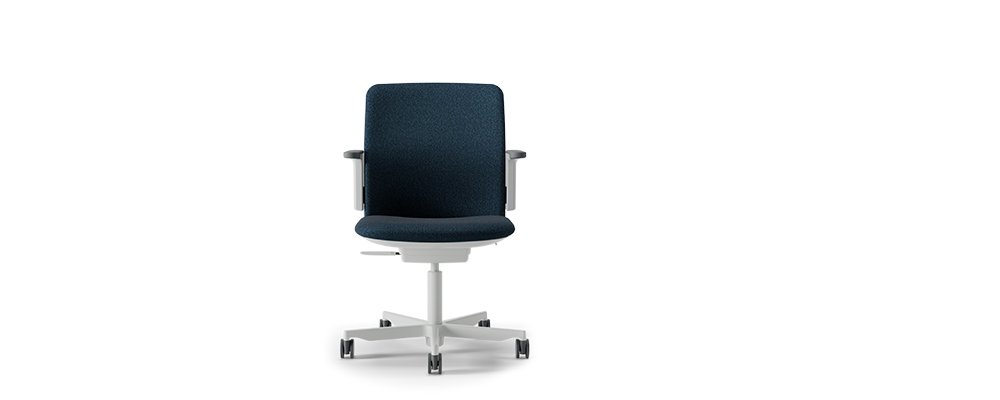
Design Todd Bracher, to a brief that took on the industry's habit of complicated hand-set mechanisms. His answer is the patented Gravity Mechanism: it engages as you sit and lifts you gently as you lean back, so body weight becomes the counterbalance, with no spring to dial in and no lock to find. The arms grow out of the backrest and travel with it. Seat and back wear FormSense Eco Knit, a recycled-polyester 3D knit that gives the lower back its support. On open-plan workstations, nobody has to be shown how the recline works.
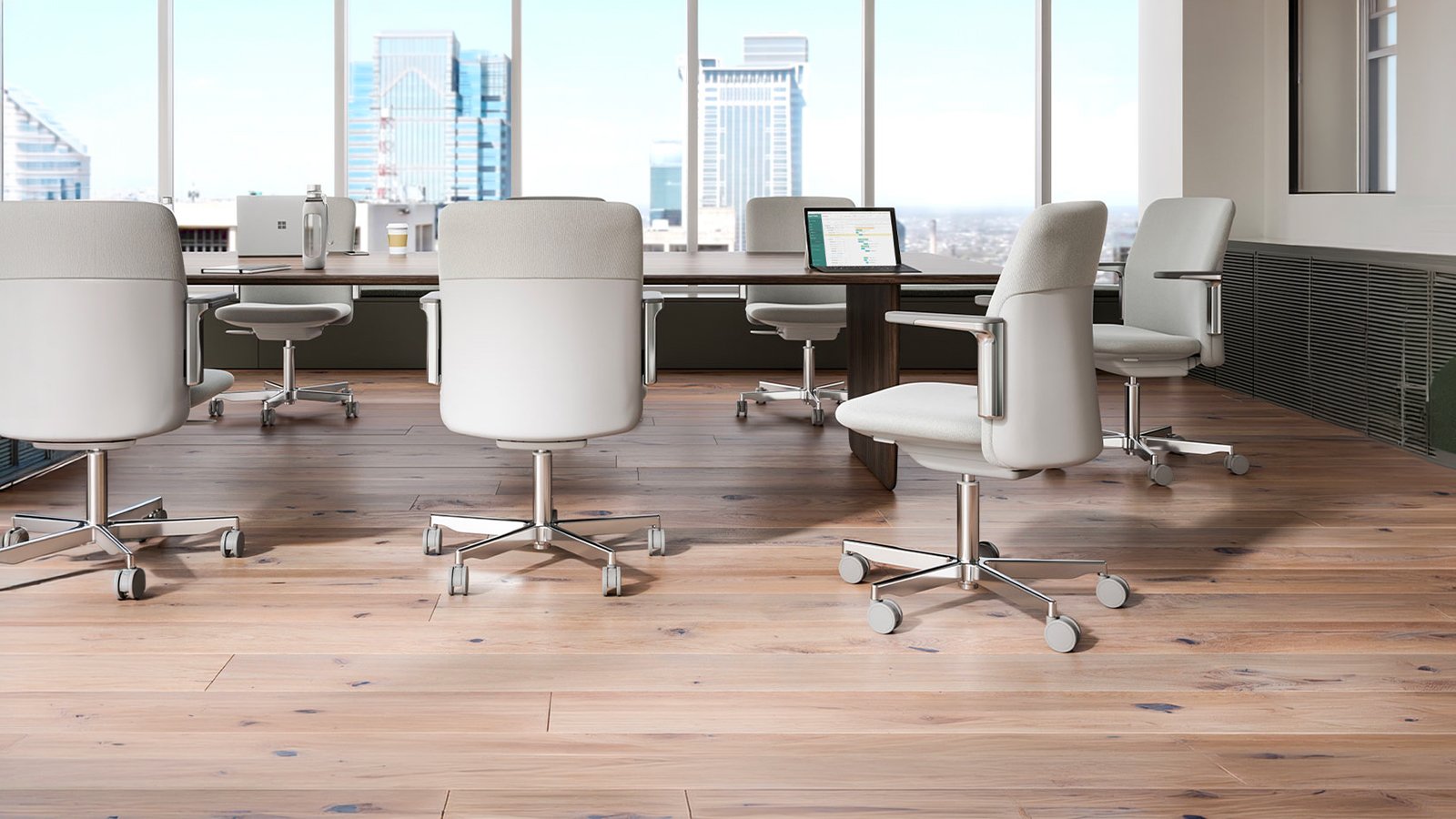
Desks call for the Path Task Chair; meetings, for the Path Meeting Chair, armless or with fixed arms; counter-high surfaces, for the Path Task Stool and its foot ring. All three come in the standard knit, in one of nine Kvadrat fabrics or in chrome-free leather. La Mercanti asks how many years the chairs are expected to stay in service before suggesting a covering.

Tell us which finishes you'd like to assess
They read differently at arm's length. Remix is a tight, minimal weave made from two mélange yarns, each blending up to three shades, so a single colour turns out to be several when you look closely; the card runs to 72 colours. Reflect is a twill designed by Patricia Urquiola, made from recycled polyester with a soft, gentle hand, in 35 colours. As a rule of thumb, Remix is the one to judge with the eyes and Reflect the one to judge with the fingertips.
The patented Gravity Mechanism does the work usually given to knobs. It engages the moment someone sits; as they recline it lifts them gently, so their own body acts as the counterweight and holds them firmly wherever they pause. Humanscale says this gives every user a fit of their own, whatever their size or weight. At a shared desk, the practical result is that a newcomer has nothing to learn before the first call of the morning.
Both are chrome-free, and each is finished to a different end. Ticino is a corrected-grain leather, finished for durability and an even appearance, in seven colours. Corvara is a full-grain semi-aniline, smooth and silky to the hand and lightly embossed so the grain stays uniform, in six. Each colour comes with its own stitching, chosen by Humanscale: Obsidian is sewn in Noir, for instance, and Saddle in Tan. Ticino suits a surface meant to stay uniform; Corvara, a hand meant to be felt.
According to Humanscale there are none to speak of: knitting the cover in 3D gives high performance without waste, which is why the company describes the process as zero waste. Humanscale also states that Path is made in TRUE Zero Waste facilities. For anyone filling in the environmental section of a supplier questionnaire, these are two separate statements, one about the material and one about the plant, and both are Humanscale's.
Humanscale counts Path among its climate-positive products and puts the net energy benefit of each chair at 23 kWh. The benefit is earned by funding projects, such as solar panels for non-profit organisations and efficient light bulbs for social housing, a balance the company calls its handprint. Humanscale adds that the figures vary with the configuration, so a chair specified differently may carry a different number.
Five decisions on the arms of a Path, starting from the build without them: the width each option adds, the heights Humanscale lists, the Duron pad and what can be fitted afterwards.
Without arms, the Path is at its slimmest, the narrowest of its three widths. Every version can be ordered this way: Task Chair, Meeting Chair and Task Stool. It is a sound place to start when the desks are not yet settled, because the decision on arms does not have to be taken on the first order.
Fixed arms sit 234 mm (9.21 in) above the seat and bring the width to 605 mm (23.82 in). They rise from the backrest rather than from the seat, so they move with the back as it reclines; Humanscale's own phrase is an arm support that moves with you. On the Meeting Chair this is the only armed option.
The adjustable arm is listed at 251 mm (9.87 in) above the seat, and with a pair fitted the chair is 620 mm (24.41 in) wide, the broadest of the three. This option belongs to the Task Chair and the Task Stool; the Meeting Chair keeps to armless or fixed.
Fixed or adjustable, both pairs carry a Duron armpad. Humanscale builds it in several layers and describes it as softer and far tougher than a standard armpad. It is the part of the arm the skin touches all day, which makes it the detail to feel with the hand when the arms are chosen.
Humanscale's spare-parts programme includes a retrofit: a pair of fixed or height-adjustable arms added to a chair that was ordered without them. Replacement arms are also supplied in pairs, fixed or adjustable, so a worn set can be renewed without touching the rest of the chair.