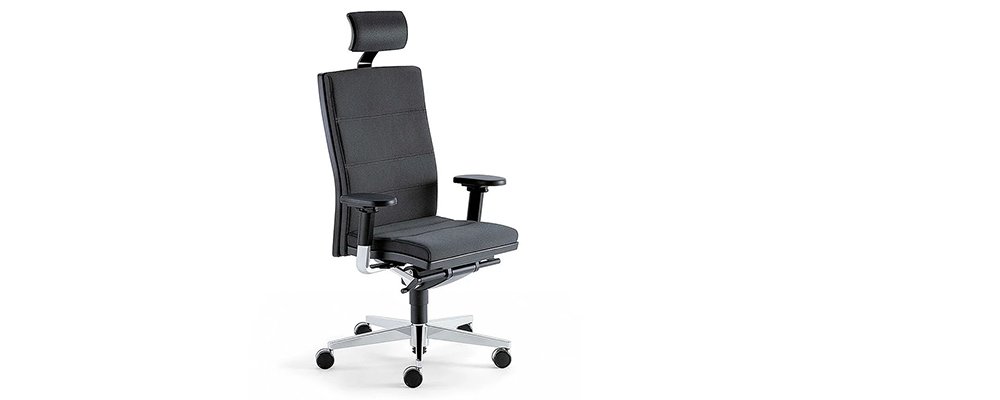
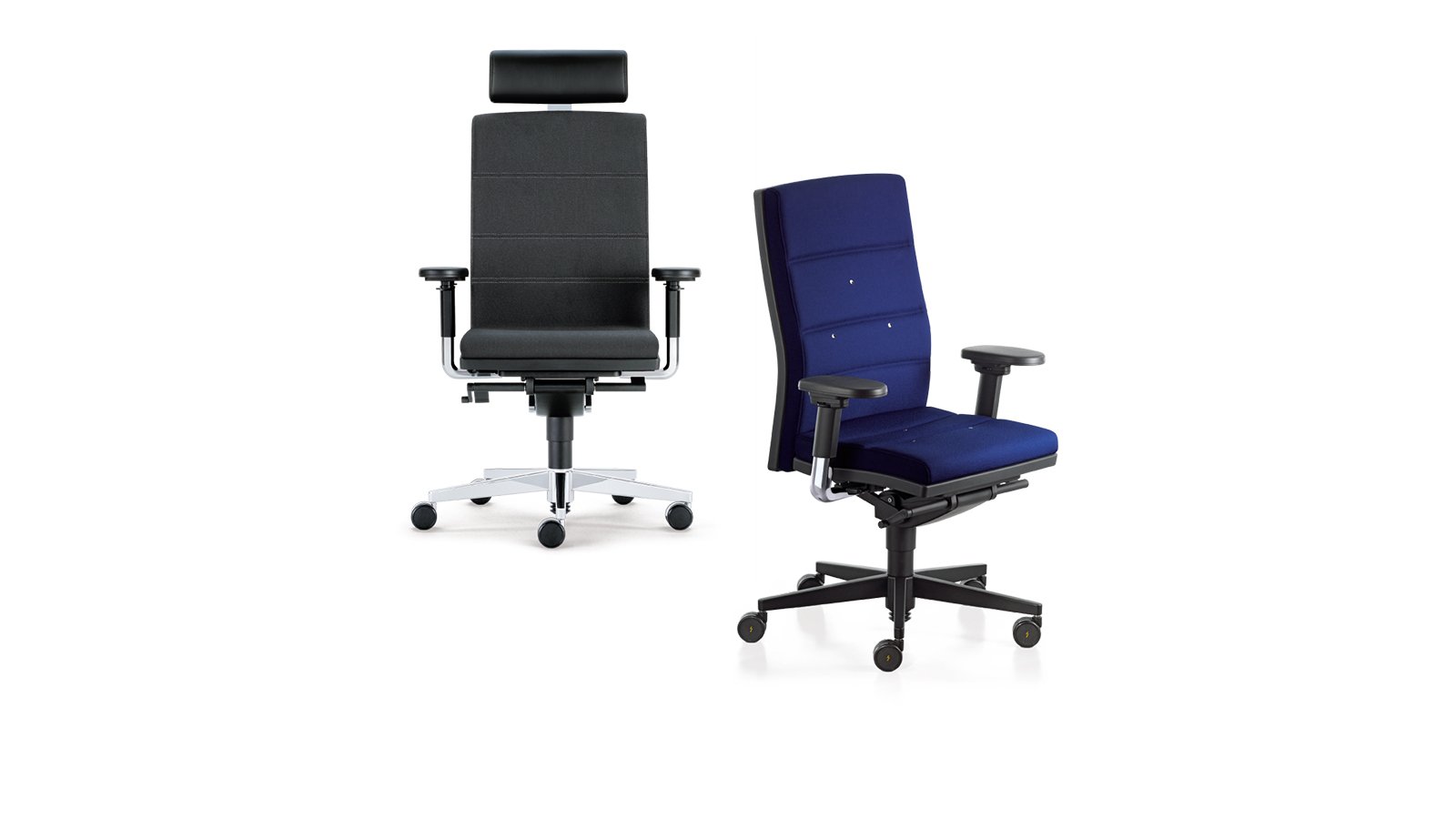
mr.24 task chair by Sedus in blue fabric with high back and 3D armrests

Thirty years on the lift: mr.24, the Sedus 24-hour chair with a rack where others fit a gas cartridge

Sedus
Task chair
mr.24 Most Requested Task chair
£ 4,037

From our design team in Italy — within 24 hours

Trade terms for professionals and design studios

Every office chair has a gas cartridge under the seat, and every cartridge is the part that eventually fails. mr.24 does not have one. Its height adjustment is the Sedo-Lift, a hydraulic rack-and-pinion unit that Sedus describes as almost immune to wear: no cartridge to replace, and a cushioning effect that still works at the lowest seat position, 420 mm (16½″) from the floor. The producer backs it with a thirty-year guarantee, where everything else on the chair carries five.

That is the logic of a chair for round-the-clock work. Among task office chairs mr.24 is certified for control-room use, for users up to 200 kg (441 lb), and the mechanical parts are the ones that would suffer first from three shifts a day. The Similar mechanism moves seat and back together to an opening of about 32°, the backrest tension is set with a hand crank between 550 and 1500 N, and the Schukra lumbar support moves in height and depth on two knobs.

Four versions, sorted by what sits above the backrest: nothing; a vinyl functional support that tilts; a leather comfort cushion on chrome; or that functional support on a chair ordered without armrests. Then come the options that change the order line rather than the chair: a deeper sliding seat, a polished aluminium base, soft castors for hard floors, and the cover, from Phoenix, Pure and Umber fabrics or Scala leather. For a control room in a workspace that never closes, the gas cartridge stays on the list only for sites that ask for Type A. La Mercanti names the rack on the order.

Technical information based on data declared by the manufacturer.
  • Collection: mr. 24, swivel chair for 24-hour use
  • Manufacturer: Sedus Stoll AG, Dogern, Germany
  • Design: Michael Kläsener, Sedus Design Team
  • Declared use: control rooms, continuous use over three shifts, shift work
  • Versions: without neck support · with functional neck support · with comfort neck support · with neck support, without armrests
  • User weight: recommended up to 200 kg (441 lb), stated on the product label
  • Standard: DIN EN 1335-1:2023 Type A in the configuration with gas cartridge and standard sliding seat
  • Mechanism: Similar with synchronised springs; seat-to-back ratio 1:2.7; backrest tension adjustable from 550 to 1500 N (124-337 lbf); tilt to about 32°, lockable in 11 positions
  • Height adjustment: Sedo-Lift hydraulic rack system, 420-520 mm (16½-20½″); alternatively gas cartridge DIN EN 16955 class 4, 390-520 mm (15⅝-20½″)
  • Seat: anatomical, slightly concave with pelvis support and rounded front edge; 50 mm (2″) quilted padding, polyurethane edge profile, replaceable pad; sliding 425-495 mm (16¾-19½″), width 480 mm (18⅞″); larger seat 460-530 mm (18⅛-20⅞″) on request
  • Backrest: high, fully fabric-covered; 40 mm (1⅝″) foam plus 10 mm (⅜″) non-woven; replaceable pad; Schukra lumbar support adjustable in height (70 mm, 2¾″) and depth (40 mm, 1⅝″)
  • Neck supports: functional in black vinyl, 50 mm (2″) height and 22.5° tilt, black powder-coated stem; comfort in black leather (cushion colour on leather versions), chrome stem, 50 mm height
  • Armrests: 3D with soft-touch or Gel-Pad tops, leather on request; height 110 mm (4⅜″), depth 80 mm (3⅛″), width 2 × 50 mm (2″) tool-free plus 2 × 15 mm (⅝″) with a TX40 key; lockable in any position
  • Base and castors: die-cast aluminium, black or polished; twin castors Ø 65 mm (2½″) with load-dependent braking, hard for soft floors or soft for hard floors
  • Covers: Scala leather in 14 colours; Phoenix fabric (3 colours listed, 21 in the wider range), Pure (4), Umber; backrest available in a different cover
  • Dimensions: overall height 740-940 mm (29⅛-37″), 740-1000 mm (29⅛-39⅜″) with neck support; width across armrests 650-780 mm (25⅝-30¾″); backrest 650 mm (25⅝″)
  • Materials (EPI): 28.22 kg (62.2 lb) without packaging; aluminium 27.1 %, solid wood 17.9 %, steel 15.2 %, plastics 28.4 %; recycled content 23.1 %, recyclability 99 %; covers not glued, CFC-free foams, chrome III
  • Certificates: GS TÜV Rheinland LGA (DIN EN 1335-1/-2, DIN 4573, up to 200 kg / 441 lb, valid to 27.09.2028); TÜV Rheinland Ergonomics approved; TÜV tested for harmful substances (valid to 15.10.2030); AGR seal; ANSI/BIFMA X5.1; BS 5459-2:2000; OEKO-TEX Standard 100 fabrics
  • Warranty: 5 years; 30 years on the Sedo-Lift, declared by Sedus
  • Planning files: CAD dxf/dwg, Revit, SketchUp, EPI, user instructions
La Mercanti Srl — trusted supplier for design and contract projects since 1997.
San Benedetto del Tronto (AP), Italy · +39 0735 753833 · info@lamercanti.com
Supply, quotations, specifications and project support across the UK and worldwide.

Tell us which finishes you'd like to assess

£ 170

Fully redeemable against your first order

FAQ

Which fabric on mr.24 meets a British fire specification?

Phoenix. Sedus lists it as 100 % polyester, at least 100,000 Martindale cycles, and declares it to EN 1021 parts 1 and 2 and BS 7176 Low Hazard. Umber, the wool option, is declared to BS 5852 Crib 5 as well. These are fabric declarations from the Sedus cover collection, not a fire class for the chair as a whole.

Where is mr.24 made?

In Dogern, in the far south of Germany, at the plant the GS certificate names as the manufacturing site. The environmental product information adds where the material comes from: two thirds of the steel, aluminium and wood are bought in Germany, almost all the rest in Europe, and under 3 % from outside the EU. The chair is built where it was tested, which is what a British specification usually wants to see in writing.

What does the Type A marking mean on the mr.24 price list?

DIN EN 1335-1:2023 Type A is the class covering the widest range of users. On the Sedus list the Type A configuration is a package: it includes the standard sliding seat and the gas spring with a 390-520 mm (15⅜-20½″) stroke. A chair ordered with the standard height column instead is listed as untyped.

Can the seat of mr.24 be ordered deeper for larger users?

Yes. The standard sliding seat runs from 425 to 495 mm (16¾ to 19½″) with a 480 mm (18⅞″) width. On request Sedus fits a larger sliding seat with a 460-530 mm (18⅛-20⅞″) depth range, 35 mm more at each end, for the builds a 200 kg chair is meant to carry.

Functional or comfort: which neck support suits mr.24?

The functional support is covered in black structured vinyl, tilts 22.5° forward and back and rises 50 mm (2″) on a black powder-coated stem. The comfort support is a padded cushion in black leather on a chrome stem, adjusted in height by 50 mm with both hands over five positions; on leather versions it comes in the cushion colour.

How to clean the fabric on mr.24 between shifts

A chair used twenty-four hours a day is cleaned more often than it is rested. Five steps from the Sedus instructions for the fabric covers of mr.24.

Start with compressed air

Light dust on the fabric of mr.24 is blown off with compressed air, the first method Sedus lists. In a control room it is also the quickest, because the chair does not have to leave the desk.

Vacuum the seams

The quilting on the seat and back of mr.24 collects dirt along the stitches. A vacuum with a brush head follows the lines of the seams before any liquid touches the cover.

Wipe with lukewarm water

Where air and vacuum are not enough, a cloth wrung out in lukewarm water is the next step the manual allows. No solvents, no aggressive cleaners: mr.24 covers are treated with mild agents only.

Use the Sedus cleaning foam for marks

For stains Sedus names its own cleaning foam. It goes on a cloth, not straight onto the mr.24 fabric, and is worked from the outside of the mark inwards.

Leave the pads to a specialist

If a cover is beyond cleaning, the seat and back pads of mr.24 are replaceable, but Sedus reserves the swap for specialist staff. La Mercanti opens the request with the chair code and a photo of the damaged pad.