What did you have in mind?
Trade terms for professionals and design studios
What did you have in mind?
Trade terms for professionals and design studios
Humanscale makes a claim for Liberty that few task chairs carry: its design, the company writes, was advanced enough to earn a place in the Smithsonian Design Triennial. Every reason behind it can be tested by sitting down. Anyone weighing up task chairs for open desks will find them behind the shoulders and under the seat.
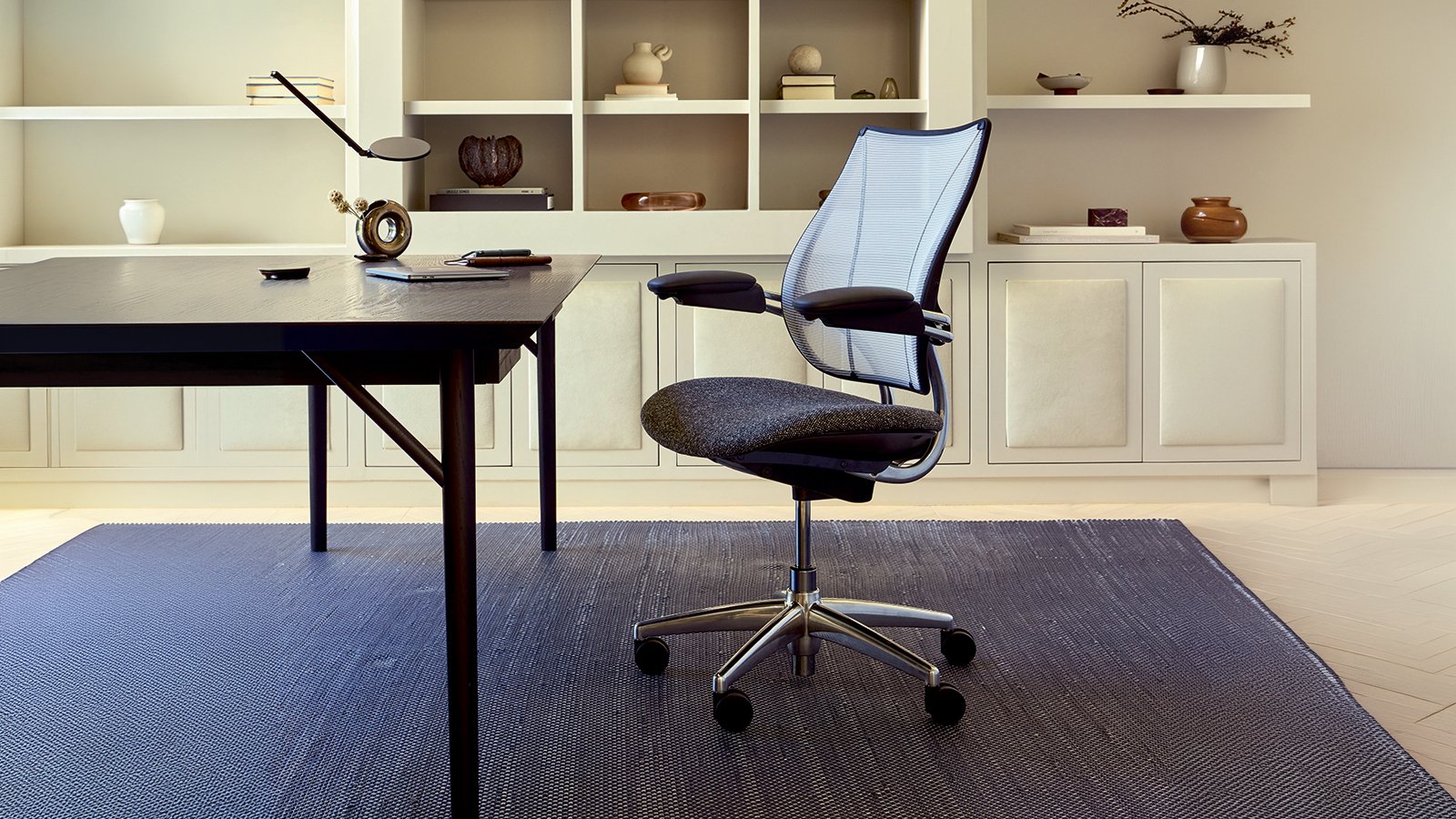
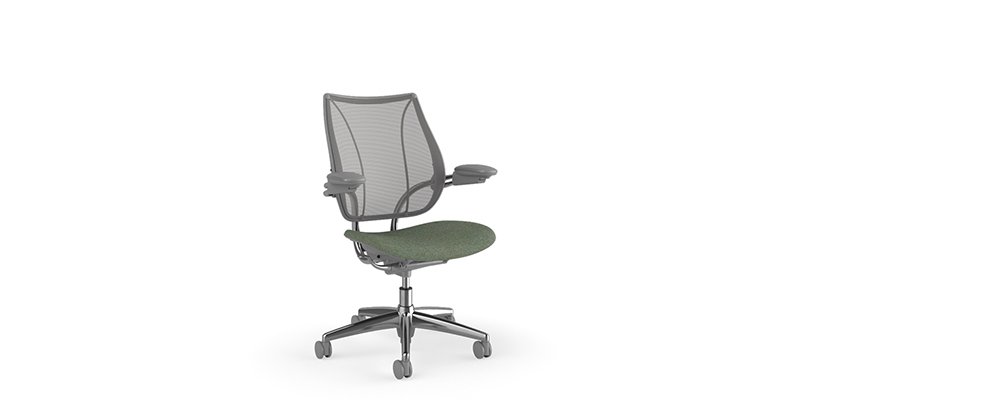
Start with the back. It is pieced from three panels of low-stretch mesh, the way a tailor pieces a shirt, so the surface follows the spine and gives lumbar support to whoever leans in, with no device to set. For buyers comparing mesh-back office chairs, the pairing is the point: mesh behind, padding below, the seat upholstered in fabric or leather. Design Niels Diffrient, who traded knobs, locks and tension springs for body weight and physics. The outer frame is die-cast aluminium, coated or polished.
Who sits decides the version. The person at the desk all day takes the Task Chair; the colleague at the conference table, the Meeting Chair; whoever works at counter height, the Task Stool and its foot ring; the visitor across the desk, the Side Chair; whoever works in the lab, the Lab Chair. Liberty Ocean builds the first three with fishing nets pulled from the sea. La Mercanti brings the chair to the desk it is meant to serve and asks a single question: who will spend the longest hours in it.

Tell us which finishes you'd like to assess
Close to 1 kg (2 lb) of fishing nets recovered from the sea, according to Humanscale. The company describes abandoned nets as the kind of ocean plastic thought to do the most harm, because they go on catching fish for years. Nothing changes for the person sitting: the Ocean takes the same armrests, the same back meshes and the same seat fabrics and leathers as any other Liberty. It is offered as a Task Chair, a Meeting Chair and a Task Stool.
From food, and from a place. Humanscale says the dense, rich shades of Catena were inspired by the lively spice markets of India. Catena is one of four designs offered for the backrest, woven in a proprietary mesh that does not stretch. Names such as Crimson, Cornflower and Bayberry share the card with plain Black, which means the back can carry the strongest colour in a room while the upholstered seat stays neutral, or the reverse.
The outer frame is die-cast aluminium, supplied either with a fused plastic coating or polished bare. The backrest frame and the cushion shell are structural plastics, injection-moulded and coloured through. Humanscale puts the whole chair at 37 % aluminium, 33 % plastic and 30 % steel. In practice the choice is visual: a polished frame shows the metal, a coated one comes in Black or Silver, and the base follows the trim colour.
Both are 100 % recycled polyester. Autumn is spun from used plastic bottles and comes in 14 colours; it is also the one fabric Humanscale offers in place of mesh on the backrest, as Autumn TexMesh. Guest is a soft chenille in 13 colours, on a palette by Sigvardt. A seat in Autumn with an Autumn back gives a chair covered in a single material, front and back, for anyone who would rather not see mesh at all.
Yes. Humanscale lists a Liberty Chair Coat Hanger among the additions for this chair, so a jacket stays with its owner instead of going in search of a stand by the door. It belongs to the same programme of add-ons and spares that covers armrests retrofitted in pairs, for anyone who first ordered without them, and replacement armpads in Duron, which can also be covered in the seat fabric.
Liberty runs on castors or glides and rides on one of five gas lifts. This guide works upwards, from the floor covering to the height of the seat, so the chair suits both the room and the person.
Liberty starts at floor level. Humanscale fits standard 75 mm castors for carpeted floors and offers softer, self-braking castors for hard ones. Walk every room the chairs are going into before deciding, because a single building often mixes carpet in the offices with a hard floor in the corridors and meeting rooms.
Not every seat needs to roll. For people who work without moving about, Humanscale lists glides as the third option, where castors would otherwise go. They keep the chair where it was set, which is useful at a bench or a counter where a rolling chair would drift away from the work surface every time someone leans back.
The standard cylinder takes the seat from 420 to 530 mm (16.6-20.9 in) above the floor, and Humanscale says it suits 95 % of the population. The Return-to-Height cylinder covers the same travel and, as its name says, resets the seat to the level it began at once the chair is empty; Task Chair and Meeting Chair can both have it.
Outside that range there are two answers. The low cylinder sets the seat between 390 and 465 mm (15.4-18.4 in), for shorter people; the Tall cylinder lifts it to between 440 and 575 mm (17.25-22.6 in), for very tall ones. Ask the people concerned rather than guessing, since one floor can easily need all three.
The highest cylinder comes with a polished foot ring, adjustable in height, and puts the seat between 535 and 725 mm (21.1-28.6 in). It is the cylinder of the Task Stool and is also offered on the Task Chair, for high benches, reception counters and standing-height desks where the feet need somewhere to rest.