Prefer a tailored configuration?
Trade terms for professionals and design studios
Prefer a tailored configuration?
Trade terms for professionals and design studios
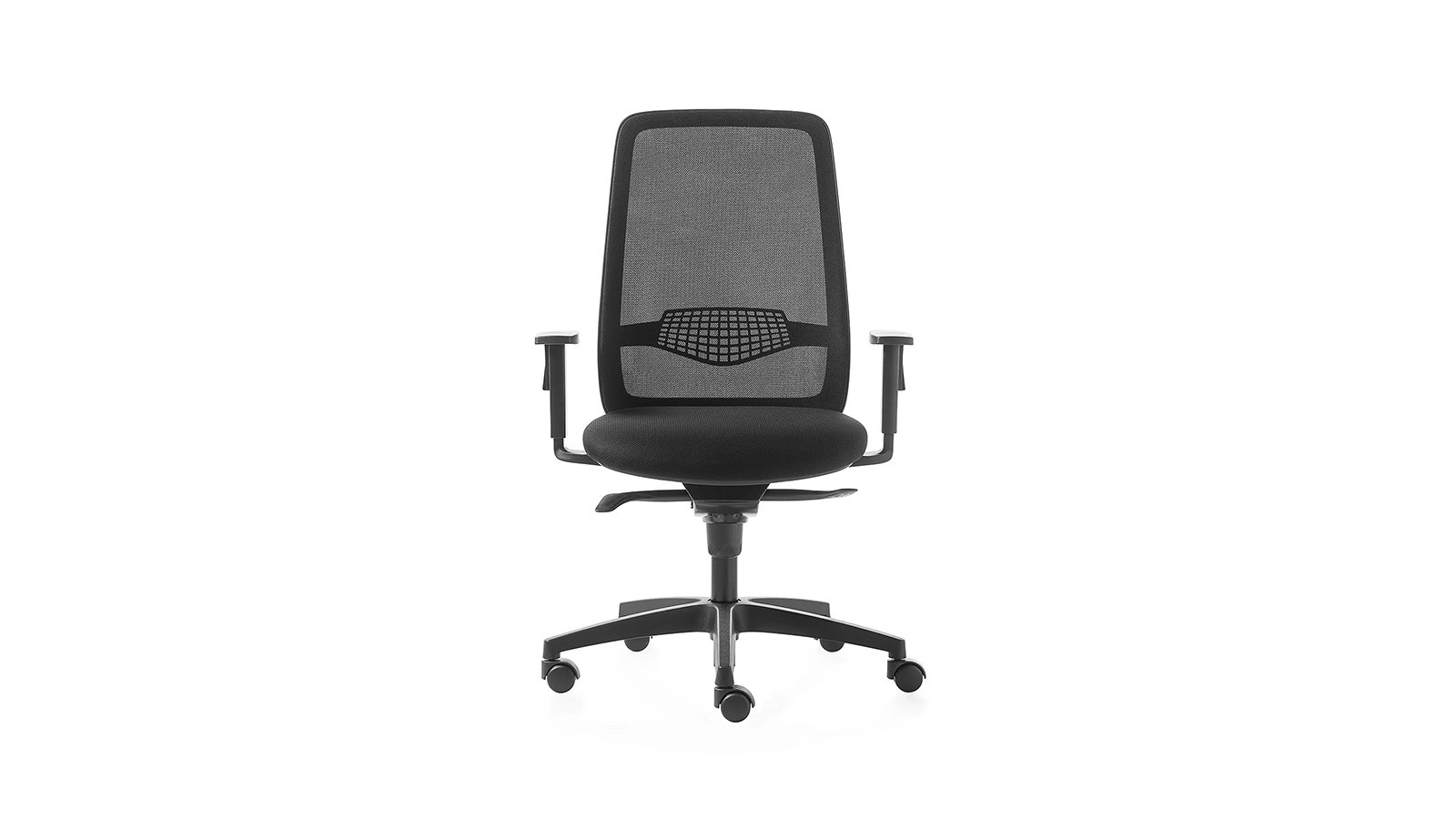
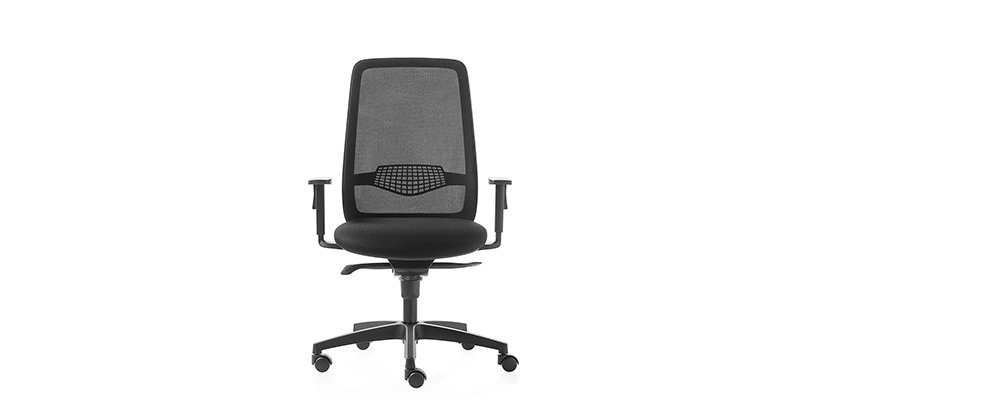
Walk behind a Key Go and what faces you is the back: a 3D polyester mesh, black or light grey, covering a frame of reinforced nylon. Kastel declares that fabric fire-retardant, and the treatment carries on below. The padded seat is upholstered in the same 3D polyester, also fire-retardant, so seat and back share one material and one colour on every code.
Filed under task office chairs, its seat is a rigid polypropylene shell, padded with polyurethane foam that Kastel calls non-deforming. Seat height comes from a gas lift, anywhere in a 42–51 cm band, or 16.5–20.1 in; seat and back tilt in synchro under a regulator for tension, and the lumbar pad rides up or down the back. This mesh office chair has an overall height of 100–109 cm (39.4–42.9 in) and asks for a footprint of 68 × 57 cm (26.8 × 22.4 in), which is the number to hold when rows of desks are drawn for an open-plan workspace.
Three codes, sorted by what your hands meet. KYG125 is black throughout, with 1D nylon arms and self-braking castors that are not rubberised. KYG225 is that same build in light grey. KYG128 goes back to black and swaps in 2D extendable arms with a soft-touch finish, a sliding seat for depth and rubberised castors without a brake. Jet fabric also makes a removable cover for the seat, bought as an extra. We also set it at meeting tables, and keep one by a desk for the colleague who pulls up for ten minutes of talk. La Mercanti puts a mesh sample on the client’s desk before the order.

Tell us which finishes you'd like to assess
A footprint of 68 × 57 cm (26.8 × 22.4 in), width by depth. The figure is the same for all three codes, so a layout drawn around one version stays valid if another is chosen later in the project.
Black nylon 1D arms, adjustable, as fitted to both the black KYG125 and the light grey KYG225. They are the standard arm on these two codes, and the frame, base and controls around them are the same as on the rest of the range.
One chair per box, and each box takes up 0.25 m³ (8.8 cu ft). That volume is the same whichever of the three codes is ordered, which makes it simple to work out how many boxes fit in a van or a storeroom.
Yes. Kastel lists it as an accessory under code 040080: one rubberised castor that also brakes. It is sold singly, so a set can be made up to the number a chair or a whole office actually needs.
Kastel lists Italian Legislative Decree 81/08 among the references for Key Go, written as D.L.81 on its own data sheet. For buyers working to Italian requirements, that is the citation to look for in the documents.
Key Go has up to four numbered controls under the seat plus the lumbar support, which moves in height. Here they are in the order Kastel numbers them, one lever at a time.
Lever 1 works the gas lift and moves the seat between 42 and 51 cm (16.5–20.1 in) from the floor. Settle this first, sitting down, since every other setting is made from the seat.
Control 2 locks and releases the synchro tilt. Released, seat and back move together with the person sitting; locked, the chair holds the position it was in when the control was set.
Number 3 is the tension regulator of the synchro mechanism. Turning it changes how much the back resists as you lean against it, which is why it comes after the height and the tilt lock.
Only the KYG128 has lever 4, the seat-depth control of its sliding seat. It moves the seat forward or back; on the KYG125 and KYG225 there is no fourth lever and this step is skipped.
Last comes the lumbar support, which adjusts in height. With the seat and tilt already set, slide it up or down the back until it meets the person sitting where they want it.