Already have something in mind?
Trade terms for professionals and design studios
Already have something in mind?
Trade terms for professionals and design studios
The Good Design Award of the Chicago Athenaeum Museum of Architecture, the Mixology People's Choice, a Red Dot, the GIO Design Awards and Interior Design's Best of Year: five awards, one task chair. At three of them Diffrient World was named outright winner. What those trophies went to is quickly described, and that is rather the point. On any shortlist of swivel task chairs it asks one thing of the sitter, to lean back; a pair of frame components and the sitter's own weight handle the rest.
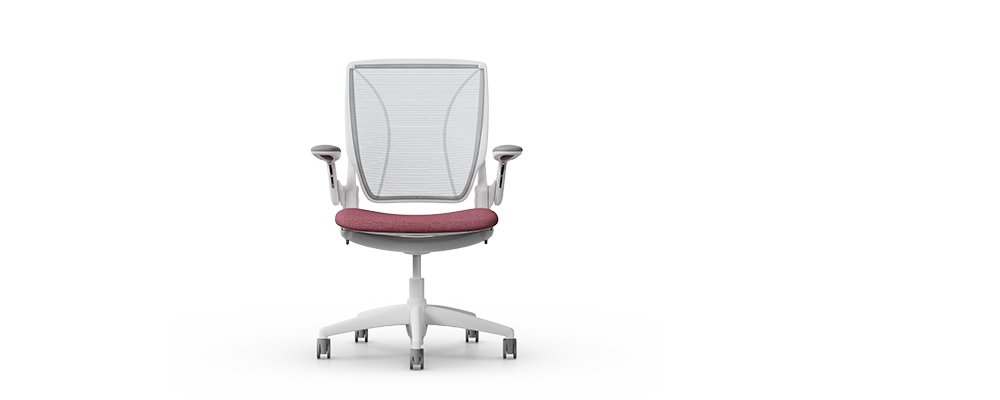
Humanscale calls it its first task chair in mesh from top to bottom. The back is three panels of Form Sensing Mesh that take the shape of whoever rests against them, and the seat follows suit. Anyone weighing up all-mesh office chairs should know the weave is non-stretch and low-abrasion, which Humanscale says spares clothing. Design Niels Diffrient, who held that you learn what people need by understanding them, not by asking.
Then come the seat and the room. Mesh, or upholstered in sculpted foam; the Task Chair at the desk, the Meeting Chair at the meeting table, the Task Stool at a counter with its foot ring (the brochure calls it World High Task), and in the laboratory the Lab Chair, which sits on Lotus. La Mercanti sets the five awards to one side and asks whoever will use the chair to lean back once, because awards are voted elsewhere and the verdict that counts comes from a back.

Tell us which finishes you'd like to assess
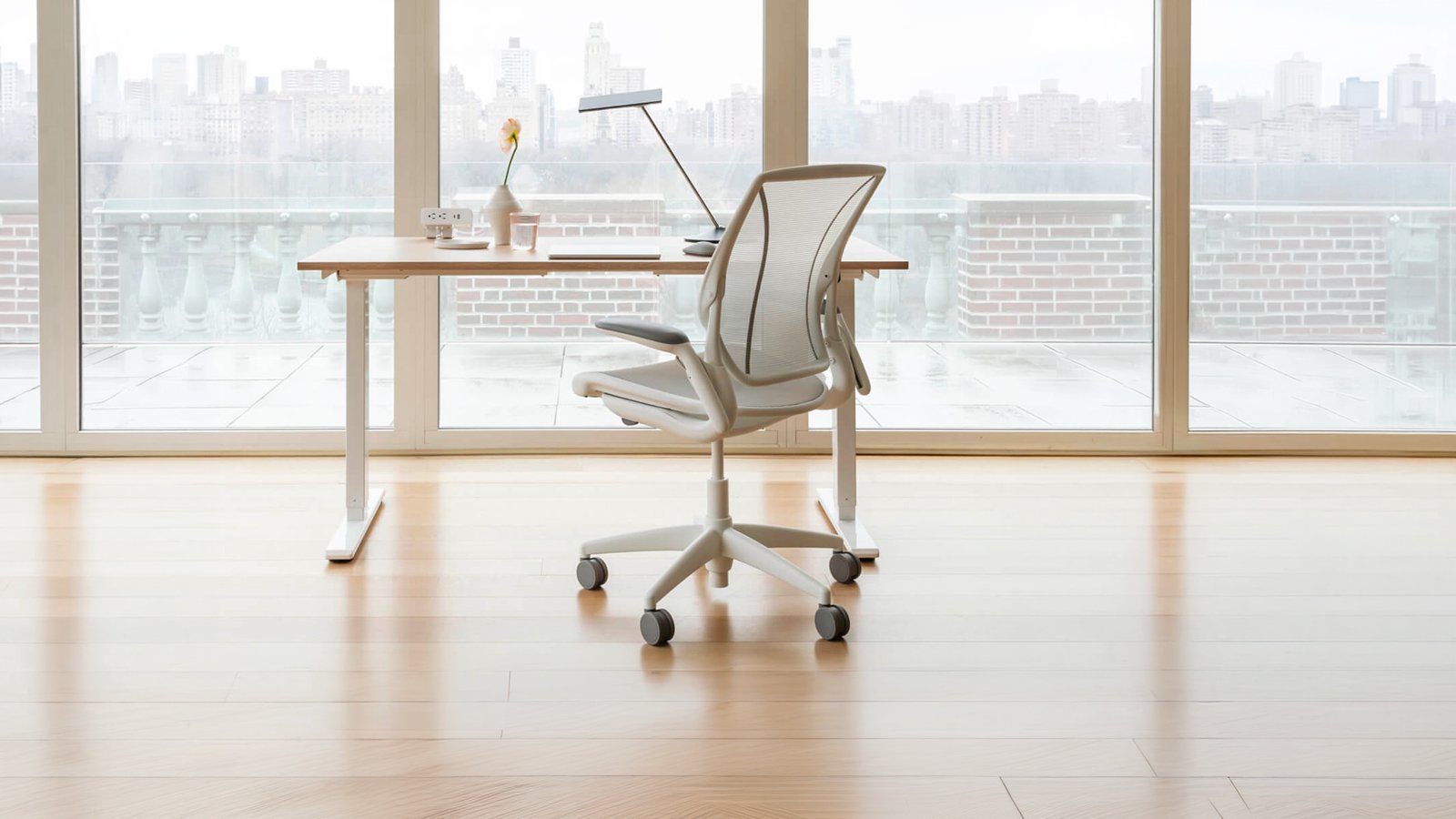
It does. Humanscale makes the Diffrient World frame in Black, White or Grey, and the five-star base comes in the same colour, so the whole underside reads as one piece. In Humanscale's own photographs the white frame wears a white Pinstripe back, the black one Catena or Monofilament Stripe. A practical tip: decide the frame with the desk legs and the floor in view, because from the doorway those are the things the eye pairs it with.
Hard castors are the standard fitting. For hard floors Humanscale offers soft self-braking castors, and for anyone who does not need to roll about there are fixed glides in place of wheels. The choice is made per room rather than per building: a chair that moves between desk and drawer on a hard floor wants the soft castors, while seats that stay put round a table can stand on glides.
Humanscale built the mesh seat with no frame along its front edge, and says this removes the pressure under the thighs. The mesh is non-stretch and moulds itself to the body; depth runs from 400 to 464 mm (15.7 to 18.25 in). Anyone who prefers a fuller feel can have the upholstered seat, in polyurethane foam sculpted, in Humanscale's words, to reduce pressure points and spread weight, 410 to 470 mm (16.1 to 18.5 in) deep.
The person sitting in it. Humanscale calls it weight-compensating recline: no tension spring to adjust, no lock to engage or release. Two parts of the chair's frame, the sitter's weight and the laws of physics give support that stays balanced through the whole movement. The travel is 17° of recline plus 8° from the pivoting back, which adds lumbar support when it is needed. On a desk shared across the week, nobody inherits someone else's tension setting.
The standard cylinder gives a seat height of 397-527 mm (15.6-20.75 in), a range Humanscale sets for 95% of users. The low one, meant for shorter people and offered on the Task Chair only, gives 324-400 mm (12.75-15.75 in). Return-to-Height, on Task and Meeting Chairs, takes the seat back to its starting height when the sitter stands: 381-502 mm (15-19.75 in). The high cylinder brings a foot ring and lifts the seat to 460-651 mm (18.1-25.6 in), on the Task Chair or the Task Stool.
Humanscale supplies the parts of Diffrient World that see the most use as separate spares, so a chair can be renewed piece by piece. Start at the back and work down to the arms.
On Diffrient World the three-panel back is modular and, as Humanscale puts it, easy to replace. The spare-parts programme lists a replacement mesh backrest, so a back that has done its years is swapped while frame, base and arms stay in service. The same programme covers a replacement mesh seat for chairs ordered all in mesh.
The upholstered seat is one moulded unit: fabric, foam and a plastic support shell are formed together in a single pass and fixed to the chair with four screws. Humanscale offers a replacement foam cushion in all thirteen seat coverings, so a tired seat can come back in its original fabric or in a different one.
For a chair bought with the mesh seat, the replacement programme includes a seat conversion kit that moves it to an upholstered one. It is made for Black, White and Grey frames and in the same thirteen coverings as a new chair. The choice between mesh and padding can therefore wait until people have actually sat on it.
The armpads are Duron, a multi-layer material that Humanscale describes as a softer cushion with a tougher surface. Replacement pads are sold on their own, and for fixed and height-adjustable arms they also come covered in fabric. A pad that has worn through is a small order, and the arm beneath it carries on.
A chair delivered armless can gain arms later. Humanscale sells retrofit armrests in pairs, in three types: fixed, height-adjustable and 4D. That makes it reasonable to start a floor without arms and add them where people ask for them, keeping the same chairs and the same frames.