What did you have in mind?
Trade terms for professionals and design studios
What did you have in mind?
Trade terms for professionals and design studios
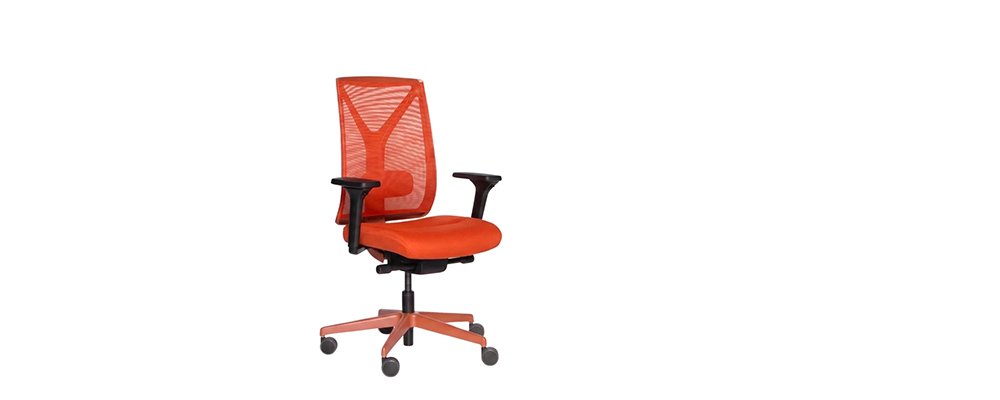
The armrest colour on Core is settled before anyone opens a fabric card. Luxy has fixed it: black arms on the black, blue and copper frames, white arms on the white frame, and on every one of them a soft polypropylene pad that is always black. On a floor of office task chairs ordered in two or three frame colours, that rule is what keeps the room from looking like a parts bin.
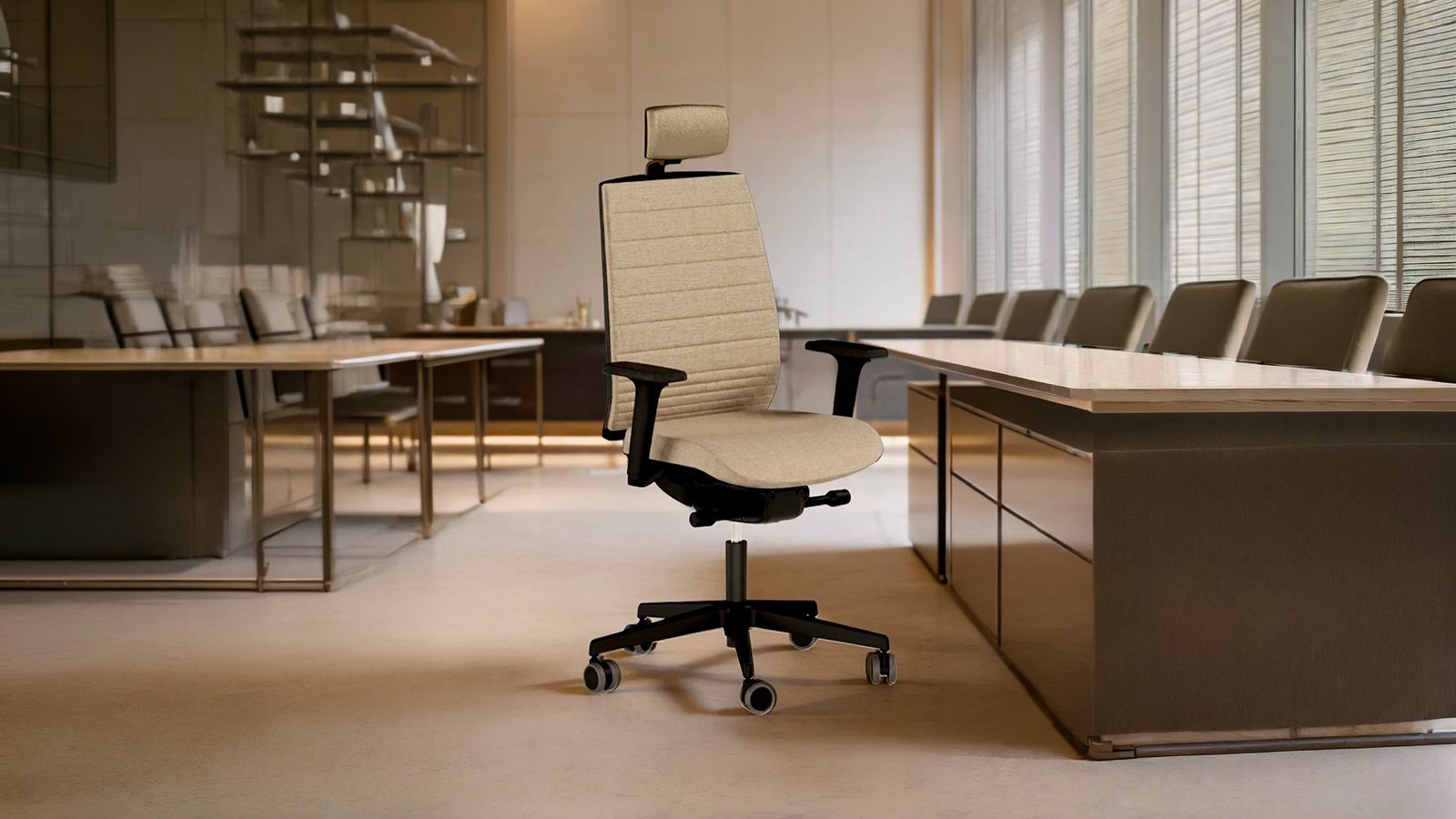
Core is new for 2026 and was drawn in-house by Luxy R&D. Its back rides on a glass-fibre-reinforced polyamide frame and adjusts in height; the lumbar support moves in depth; seat and back recline on a synchronised mechanism, and the seat slides. Luxy talks of formal simplicity and advanced ergonomics, and anyone comparing office chairs in mesh will find the self-supporting mesh on the back alone or on the seat as well. The arms come as 1D or 4D, or the chair is ordered without.
Read the range by frame colour. Black or white sits on a nylon base of that colour; copper or blue takes an aluminium base painted to match. Each can have a mesh back over an upholstered seat, mesh throughout, or upholstery throughout. The managerial version keeps to a black structure, upholstered, on a chromed aluminium base with 5D or fixed arms, and Luxy places it in executive offices. La Mercanti lays the frame colour and the arm colour side by side before the fabric comes out, because on Core one decides the other.

Tell us which finishes you'd like to assess
It is the same design dressed for a different room. The managerial version is upholstered on seat and back, keeps a black nylon structure and stands on a chromed aluminium base with hollow chromed castors. Its arms are either 5D, which add a 360° rotation to height, width, depth and angle, or fixed. Luxy builds it with a headrest or without one, and describes it as the version for executive offices. A director and the team outside the door can therefore sit on one family of chairs.
Yes. Among the accessories Luxy lists a kit of 5 glides for the base, in chrome, white or black, so the finish can follow the base it is fitted to. The standard chair runs on self-braking castors; glides make sense wherever a chair is meant to stay where it is put, on a polished hard floor for instance. La Mercanti asks which positions are fixed before the chairs are counted, since swapping five feet per chair afterwards is nobody's idea of a good afternoon.
Luxy states it: 55 kg/m³, in hot-moulded, fire-retardant foam. Density is the figure worth asking any chair maker for, because it tells you how much material is in the cushion and not how the cushion is described. The same hot-moulded foam pads the headrest and the lumbar support. If you are weighing Core against another task chair, put the two densities next to each other first and the adjectives second.
The seat does. When the seat is upholstered, the headrest is covered in the same fabric as the seat; when the seat is mesh, it takes the fabric of the lumbar support, which is itself matched to the back. The headrest is padded, adjusts in height and tilt, and remains optional on every configuration. In practice there is one decision fewer on the order form, and nobody has to explain later why the top of the chair looks different from the rest of it.
Allow 70 × 70 cm (27 1/2 × 27 1/2 in) per chair. Luxy gives that footprint for every model in the collection, headrest or not, managerial included. What changes is the height: 122-135 cm (48-53 1/8 in) with a headrest and 103-116 cm (40 1/2-45 5/8 in) without, which matters under shelving and for sightlines across an open floor. Because the plan dimension is constant, the configuration can still change after the layout has been agreed.
Core adjusts to its user in five moves. Take them in this order, seat first and recline last, and each setting builds on the one before, so nothing has to be done twice.
Begin with the height. The seat of Core travels from 46 to 59 cm (18 1/8 to 23 1/4 in) off the floor, a range of 13 cm (5 1/8 in). Set it so that your feet rest flat and your thighs sit roughly level, then leave it alone until the other four settings are done.
The mechanism includes a seat slide with 7 cm (2 3/4 in) of travel. Longer legs want the seat further forward, shorter legs further back. A sensible check: two or three fingers should fit behind the knee once you are sitting right back.
The backrest moves up and down on what Luxy calls the up-down system, which the brochure describes as simple and intuitive. Bring the curve of the back to meet the curve of your spine. Between one colleague and the next, this is the setting that differs most.
The lumbar support adjusts in depth by a knob. Turn it while seated and leaning back, until the support is felt but does not push. Too far out is as tiring as too far in; stop at the point where you forget it is there.
The mechanism is synchronised, so seat and back move together. Tension is preset in three positions and the back locks in four; the release has an anti-shock function. Try each tension for a few minutes before settling, and lock the back only for tasks that call for it.