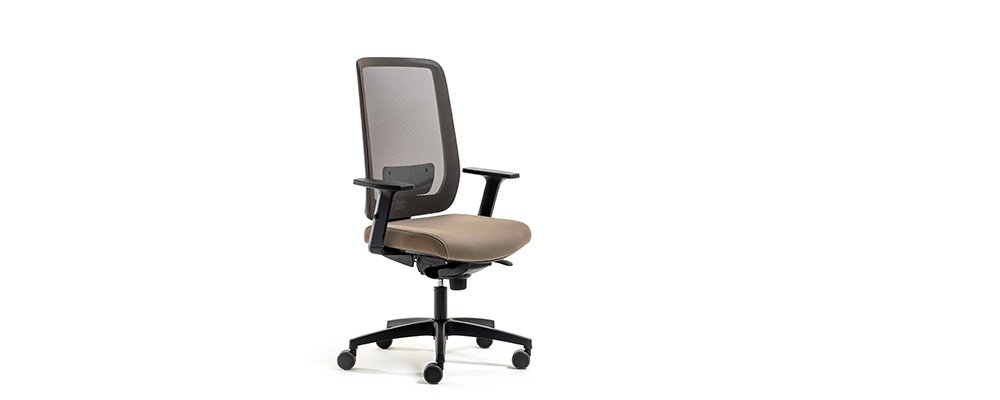
White Assia EV task chair with blue seat and white mesh on a plain background

Grey bar, optional cushion: the lumbar support of Assia EV by Vaghi takes a pad in flame-retardant fabric

Vaghi
Task chair
Assia Available now Task chair
£ 983

Let's discuss your project

Trade terms for professionals and design studios

Grey polypropylene, a bar behind the mesh: the lumbar support of Assia EV leaves the factory like that. Vaghi lets it be padded on request, with a cushion in grey flame-retardant fabric, height-adjustable like the bar beneath it and ordered as a line of its own, for anyone who wants the support softer. Among the height-adjustable task chairs of the programme it is a quiet option, one line after the chair code, felt rather than seen.

The chair under the cushion was drawn by Vaghi R&D and reads like a short list: a medium backrest in mesh that rises and reclines, an upholstered seat that swivels and lifts, the grey bar with its position indicator. The synchronised mechanism is listed twice, as a weight-activated version and as one with tension adjustment, and an anti-return safety device is on each. Three weaves dress the back, one in polyester and two flame-retardant, which is what places Assia EV among mesh-backed office seating.

By what sits on the frame there are three ways to have it: with headrest and armrests, with armrests alone, or as a plain chair with neither; the white series and the black series run through all three, plastics, arms and castors included, and the cushion goes on any of them. La Mercanti puts the chair with the pad and the chair without it next to each other, because the choice is felt with the back, not read in a code.

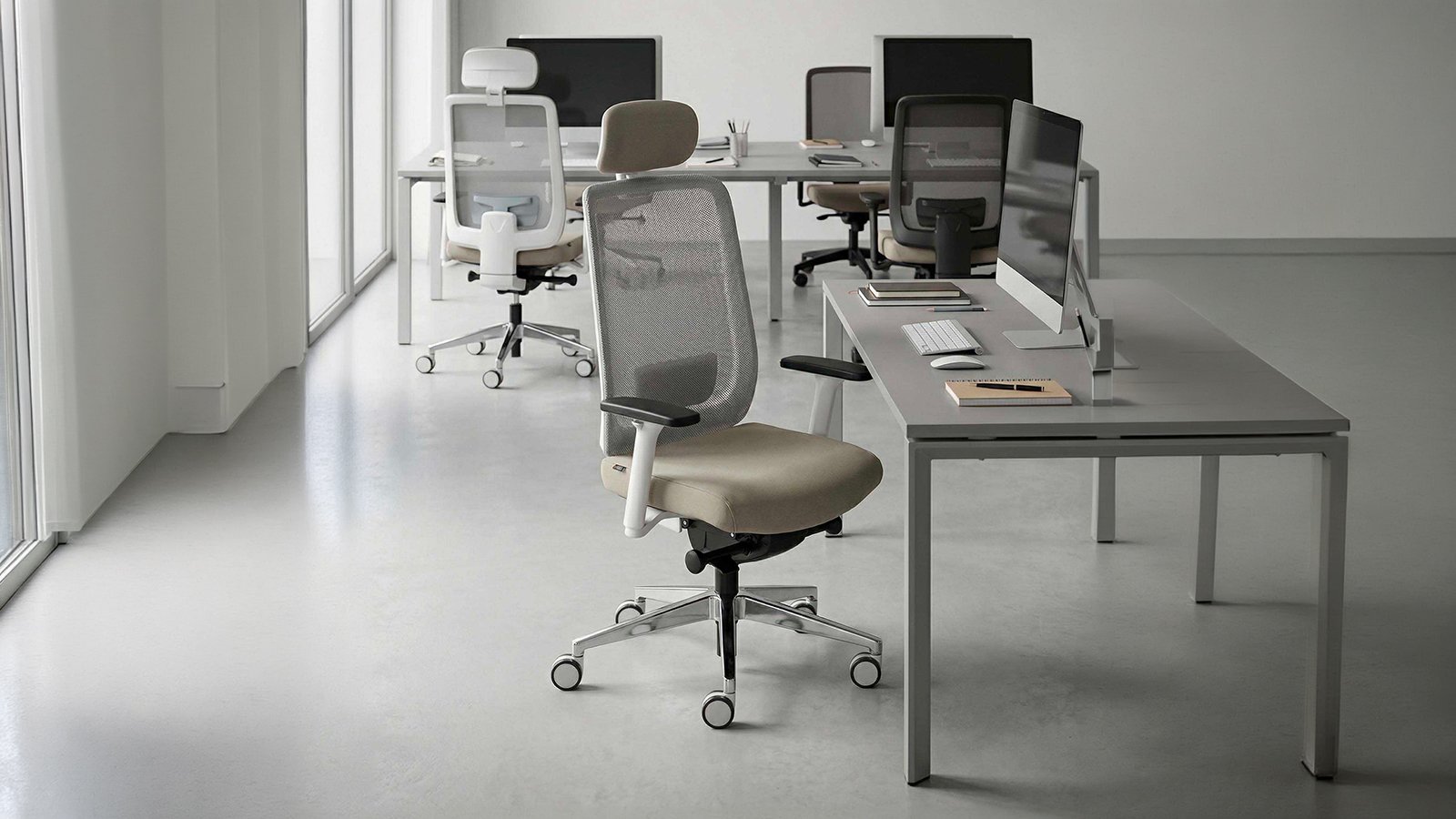
Technical information based on data declared by the manufacturer.
  • Collection: Assia EV
  • Manufacturer: Vaghi S.r.l., Bovisio Masciago (MB), Italy
  • Design: Vaghi R&D
  • Type: swivel task chair with mesh backrest
  • Builds: armchair with headrest and armrests · armchair with armrests · chair without armrests; each in the white series or the black series
  • Mechanism: weight-activated synchro, or synchro with tension adjustment; anti-return safety system; optional synchro with seat-depth adjustment
  • Seat: upholstered, swivelling, height-adjustable from 420 to 540 mm (16.5-21.3 in); depth adjustable with the T mechanism
  • Backrest: medium, in mesh, adjustable in height and reclining
  • Lumbar support: grey polypropylene RAL 7047, moves up and down with a position indicator; optionally in depth too; optional pad in grey flame-retardant fabric
  • Headrest: upholstered, height-adjustable and tilting; white or black structure
  • Armrests: polyamide with polypropylene pad, height-adjustable; optionally height and depth, or height, width and depth, with pivoting pad
  • Base: 5-star, white or black polyamide; optionally white or black painted aluminium, or polished aluminium
  • Castors: rubber, Ø 65 mm (2.6 in), for hard floors; hard castors optional for carpet
  • Plastics: white RAL 9003 or black RAL 9017; recyclable polypropylene and polyamide with scratch-resistant embossing
  • Backrest mesh: RE in 7 colours · R1 flame-retardant in Trevira CS, 5 colours · RS three-dimensional flame-retardant, 4 colours
  • Seat covering: categories A-F: Leiria, Radio, Guatemala · Belem, Lagos, Oporto, Rio · Norfolk, Zenith · 24/7+, Bogotà Melange, Wilson · natural leather · full-grain leather; customer's own material
  • Dimensions: footprint 680 × 680 mm (26.8 × 26.8 in); width with armrests 490 mm (19.3 in), backrest 435 mm (17.1 in); seat height 420-540 mm (16.5-21.3 in); overall height 1060-1260 mm (41.7-49.6 in), with headrest 1260-1460 mm (49.6-57.5 in); armrest height 600-820 mm (23.6-32.3 in)
  • Weight and volume: gross: with headrest 21 kg (46.3 lb), 0.55 m³ (19.4 cu ft) · with armrests 18.5 kg (40.8 lb), 0.5 m³ (17.7 cu ft) · without armrests 17.5 kg (38.6 lb), 0.5 m³ (17.7 cu ft)
  • Customer's own material: 0.7 linear metres (0.77 yd), 1.40 m (55 in) wide; leather 0.9 m² (9.7 sq ft)
  • Declared certifications: Italian D.Lgs. 81/08 · EN 1335, tested by CATAS · CAM · class 1 IM with R1 mesh
  • Warranty: 5 years
  • Origin: Made in Italy
La Mercanti Srl — trusted supplier for design and contract projects since 1997.
San Benedetto del Tronto (AP), Italy · +39 0735 753833 · info@lamercanti.com
Supply, quotations, specifications and project support across the UK and worldwide.

Tell us which finishes you'd like to assess

£ 170

Fully redeemable against your first order

FAQ

Box included, how heavy is each Assia EV and how much room does it take?

Vaghi prints a gross weight and a packed volume for every build. The armchair with headrest and armrests ships at 21 kg (46.3 lb) in 0.55 m³; the armchair with armrests at 18.5 kg in 0.5 m³; the chair without armrests at 17.5 kg, again 0.5 m³. They are the figures a delivery is planned on, build by build, and the ones to put on the transport note before a floor of chairs is ordered. Three figures for three builds: what separates the heaviest from the lightest is the headrest and the pair of armrests.

Which mesh gives Assia EV its Italian class 1 IM approval?

The R1. Vaghi declares Assia EV approved in class 1 IM with the R1 mesh, the flame-retardant weave in Trevira CS offered in five colours; the approval is declared for that mesh, so the line is quoted with the mesh code beside the chair. The seat is a separate matter: there the class is the one of the fabric chosen, and several in the programme carry class 1 IM as fabrics in their own right. A specification that needs the approval therefore names the R1 for the back and a class 1 IM covering for the seat, and quotes nothing about the chair alone.

Anti-return on the Assia EV mechanism: what does the safety system actually stop?

Vaghi lists a safety anti-return system on the mechanism, next to the synchronised movement and the tension adjustment. What it governs is the release: when the lock is let go while someone is still leaning back, the backrest does not spring forward. It is on both mechanisms of the programme, the weight-activated one and the one with tension adjustment, and it is not an option to be ordered; it comes with the chair, whichever letter is written for the mechanism.

Is there a seat fabric on Assia EV rated for round-the-clock use?

Yes, in category D: the fabric Vaghi calls 24/7+, a crêpe for use around the clock, blended from 50 % polyamide, 33 % wool, 10 % FR viscose and 7 % viscose, 609 g, rated at 400,000 Martindale cycles, the highest figure among the fabrics listed for Assia EV. The chair under it does not change: the fabric is a seat choice, ordered by its category, and the mesh on the back is chosen separately, so a 24/7+ seat can sit under any of the three weaves.

Does the whole Assia EV backrest move, or only the lumbar part?

The whole backrest. Vaghi describes it as a medium mesh back that is height-adjustable and reclining: the frame itself rises and lowers on the chair and tilts with the synchronised movement, while the grey lumbar bar makes its own travel inside it, read off its position indicator. Two separate adjustments, listed as two separate points on the Vaghi drawing, number 2 for the backrest and number 6 for the lumbar, and both come on every one of the three builds.

Writing an Assia EV order line: from the series letters to the seat covering

Vaghi codes an Assia EV as a short grammar: a pair of letters for the series, one for the mechanism, one for the build, one for the base and castors, then the mesh and the seat. Five steps to write it.

Two letters for the series

An Assia EV line opens with the series, two letters. EB puts the chair in the white series, with plastics, armrests and castors in white; EN puts it in the black one, the same parts in black. Where the lumbar support should adjust in depth as well as height, the pair is written 2B or 2N in their place, and the rest of the code is unaffected by that swap.

One letter for the mechanism

Next comes the mechanism, as a single letter. E marks the weight-activated synchro, the one with nothing to set; S the synchro whose tension is adjusted by hand to the person sitting; T the synchro that adds a seat-depth adjustment, written in place of S when the seat should move forward and back. The anti-return safety goes with all three.

One letter for what the chair carries

The fourth letter is the build. K stands for the armchair with headrest and armrests, I for the armchair with armrests, 5 for the chair without any. Armrests on K and I adjust in height; for arms that also move in depth, with a swivelling top, Z or V replaces the letter; for height, width and depth together, with the same top, Y or T.

Base and castors in one letter

Fifth is the base. D is polyamide, white on the white series and black on the black; B is painted aluminium in white, L painted aluminium in black, X polished aluminium on either series. Castors in rubber, for hard flooring, come as standard; where the floor is textile the hard castor is ordered by changing that same letter, D to C, B to W, L to I, X to J.

Mesh code, then seat category

After the chair come the coverings. The mesh takes a 13 in front of the weave and its colour: RE for the standard polyester weave, R1 for the flame-retardant weave in Trevira CS, RS for the three-dimensional one. The seat is named by its category letter, A to F, or declared as the customer's own fabric, for which Vaghi wants its characteristics stated before assessing feasibility and quantity.