Trade terms for professionals and design studios
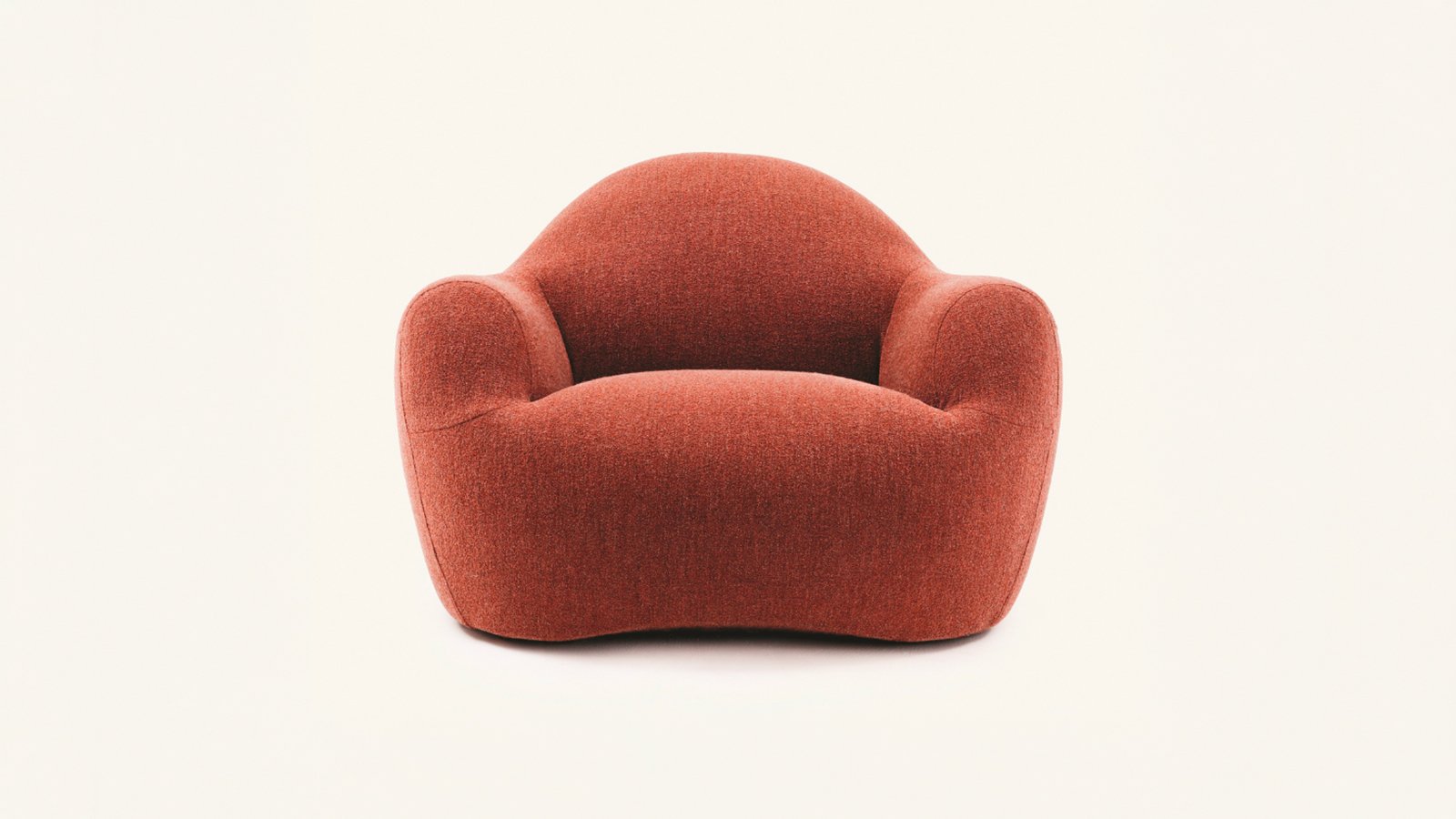
Most armchairs can be read part by part: two arms, a seat, a back, and a line where each one stops. On Venus Verzelloni has taken that line away. Its own text says the armrests, seat and backrest “merge into a single enveloping gesture”, and what results is a body with no edges at all, only “fluid lines” and what the maker calls “a monolithic and balanced silhouette”. If you are comparing lounge armchairs and sofas for a formal room, this is the one that explains itself from across it.
The continuity runs all the way round. The armchair is padded and covered everywhere, with what Verzelloni describes as “a rich and tactile surface” following the curves, while the base sits hidden inside the body, leaving the line unbroken down to the floor. Design CRD Verzelloni, the company’s in-house research and design centre, for the 2026 collection. We picture it in an executive office, a little away from the desk, where a guest sits down opposite the person they came to see.
On the order form the size is already settled, because there is one. What remains is the cover. A fabric one can be stripped off whole for cleaning; leather is fitted for good. A client with a cloth of their own can have Venus made up in that instead. La Mercanti runs a hand with the client from arm to back and asks where one ends and the other begins.

Tell us which finishes you'd like to assess
Yes, for the fabric version. Verzelloni lists a spare cover in fabric for Venus, and since the fabric cover comes off completely, a second one means the armchair is never left bare: one goes on as the other comes off. Order it together with the chair rather than later. In its general terms Verzelloni does not assure the same dye lot on repeat orders, so a cover bought a year on may not match the one already in the room.
On a base Verzelloni describes as integrated and not visible, contributing, in its words, to “the purity of the volume”. Seen from the room, the upholstered body comes down to the floor on its own, so there are no legs to clean round and no metal finish to match to the rest of the furniture. How that base is built is not described in the documentation, and we would not guess at it in a specification.
Verzelloni answers that one itself: its general terms state that perfect uniformity of tone between the sample book and the fabric actually used is not assured. A small square of cloth also reads differently from a whole chair in real light. Our advice is to judge colour on the largest piece of fabric available, in the room where Venus will stand, and to keep the scheme loose enough to absorb a slight shift.
Verzelloni describes the upholstery of Venus as “a rich and tactile surface” that hugs the curves and emphasises the relationship between light and form. On a body without flat planes, light falls unevenly: the crown of an arm brightens while the underside drops into shade, so one fabric reads in several tones. Look at a sample folded over a curve rather than laid flat on a table, and if you can, by the window it will face.
Venus measures 76 cm (29.9 in) from the floor to its highest point. Set that figure against what the room already has at the same height: a desk top, a sideboard, a run of low cabinets. A chair that stays below those lines keeps the view across the room open; one that rises above them becomes the first thing a visitor notices. Decide which of the two you want before choosing its wall.
Verzelloni writes the care of Venus down in two places, and it changes with the covering chosen. Five steps for the years after delivery, from the label on the swatch book to adding a chair later.
Before Venus is even ordered, turn over the swatch book of the chosen fabric: Verzelloni prints the washing and care instructions on its label. Note down the symbols for that one cloth, since they vary from fabric to fabric, and hand them to whoever will run the office once the chair is in.
The same instructions reach the client a second time, on the product sheet Verzelloni encloses at delivery. File it with the building's maintenance records rather than leaving it in the packaging: it is the paper a cleaning contractor asks for the first time the cover needs attention.
A leather Venus keeps its covering for good, so every bit of care happens on the chair itself. For that, Verzelloni supplies a kit: nourishing cream plus a cleaning product. Settle early who applies it, and at what intervals; on a rounded body every part of the hide is in plain view.
Verzelloni's terms note that the tone of a sample and of the fabric actually used may not be perfectly uniform. So when a cover is renewed after some years, hold the new cloth against the chair in its own light, not against the original swatch, which has had a different life in a drawer.
If another Venus arrives a year or two after the first, allow for a possible difference in shade: on pieces ordered to complete an earlier delivery, Verzelloni does not undertake to match the dye bath. Where a pair is already likely, buying both at the outset is the simpler route.