Prefer a tailored configuration?
Trade terms for professionals and design studios
Prefer a tailored configuration?
Trade terms for professionals and design studios
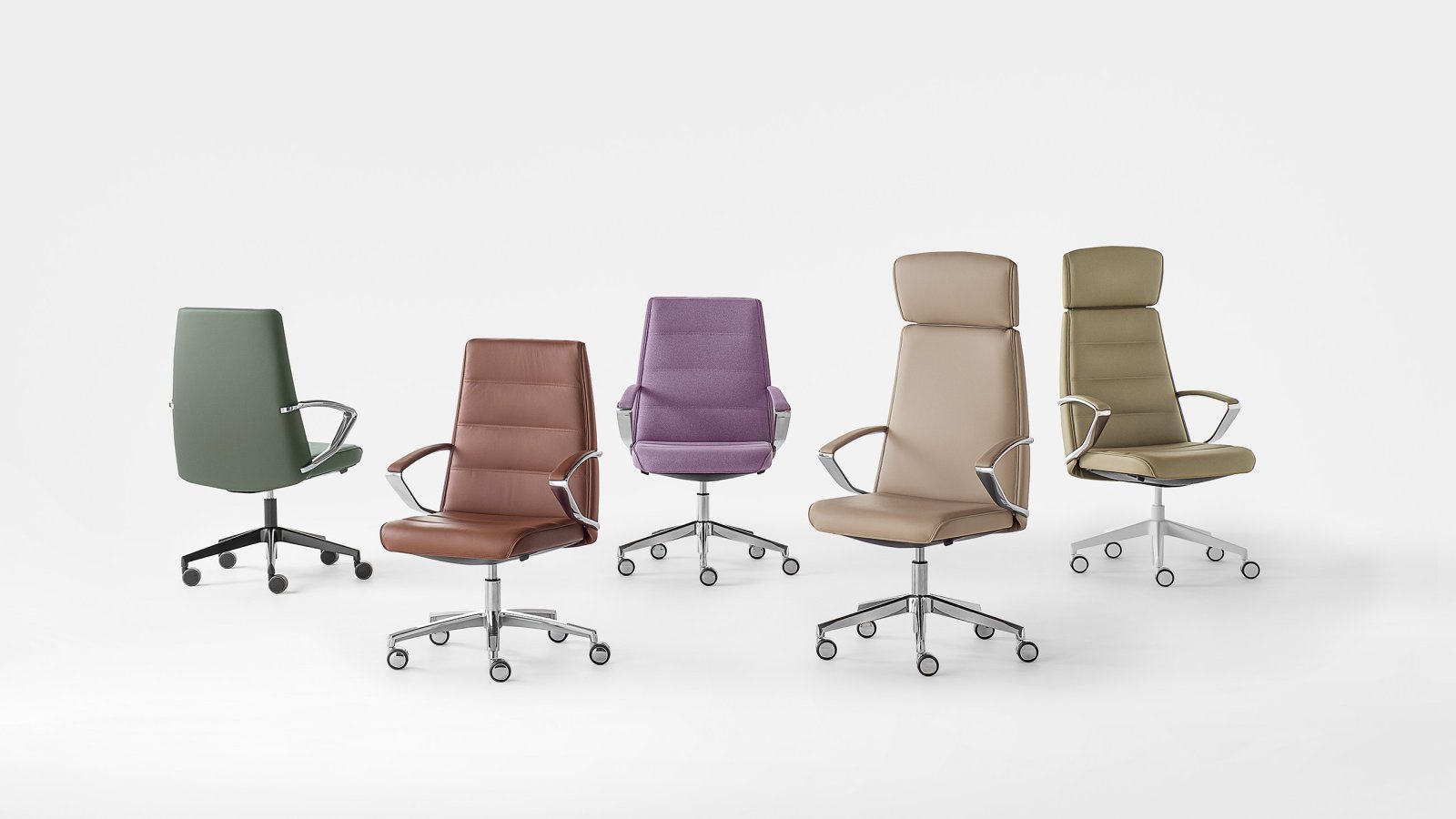
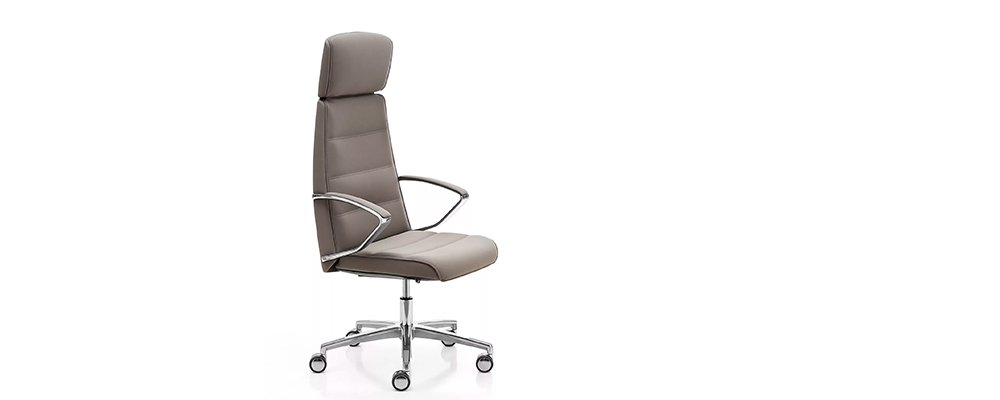
Rest a hand on Klivia and it meets two materials at once. Below is aluminium, die-cast and polished; above sits a multilayer pad upholstered in non-deforming polyurethane foam, so the forearm lands on something soft while the bright metal stays in view along the side. Kastel, which makes the chair at San Vendemiano near Treviso, fits that same arm to the high back and to the medium one, whatever padding or base is chosen. Seen from across a desk, it is the line of metal that catches the light.
As executive office chairs go, Klivia is sized for the principal’s desk: the high back stands 119–131 cm (46.9–51.6 in) tall, the seat travels from 40 to 52 cm (15.7–20.5 in) on a gas lift, and the chair takes 65 × 60 cm (25.6 × 23.6 in) of floor. The seat is a technopolymer shell under non-deforming foam. The back is built on curved multilayer with a birch counter-panel, and a self-adjusting syncron mechanism, steel-bodied, is housed in the seat itself.
Away from the desk the chair changes height rather than character. The medium back stops at 90–102 cm (35.4–40.2 in) and is the version we place in front of a partner’s desk or along a meeting table, usually on the four-star AL4 base with chrome glides in place of castors. Each back is offered with plain padding or with linear stitching. On five spokes, the base can be black, white or grey nylon, or aluminium that is polished, painted black, painted white, or polished with a chrome cylinder and chrome castors. In an executive office suite one cover can run across both heights. La Mercanti puts the arm finish next to the desk it will sit beside.
Tell us which finishes you'd like to assess
90–102 cm (35.4–40.2 in) from the floor to the top of the backrest, read from the drawings in Kastel’s 2026 price list. It is the lower of the two Klivia versions and shares its seat, arms and base options with the high back.
Yes. The syncron mechanism offers 3 locking positions: seat and back can be held at any one of them, or released to move together again. Locking and unlocking sit on one of the chair’s two controls; the other raises the seat.
Four. Polished (AL6 and AL7), painted black (ANN), painted white with a white cylinder and white castors (AWW), and polished with a chrome cylinder and chrome castors (AL5 and AL3).
Yes, on request: Class 1IM, an Italian approval, available only with the Planet cover from category A. Outside Italy, the rules that apply are checked against the individual project.
For one medium-back chair, 1.60 m (1.75 yd) of fabric is needed, which is 3.11 m² (33.5 sq ft). The high back takes 1.70 m (1.86 yd), or 3.29 m² (35.4 sq ft). Kastel gives these figures per chair, in the customer’s own material, COM or COL.
Every Klivia order line is built from the same parts: the chair code, the base, the covering and its category. Five steps put them down in the right order.
There are four: KLV18LS, KLV28LS, KLV58LN and KLV68LN. Read the digit after KLV first. A 1 or a 5 means the high back, a 2 or a 6 means the medium one.
The suffix carries the padding. LS is the plain version, LN the one with linear stitching. All four codes come with the self-adjusting syncron and the gas lift already included.
Next comes the base code. In nylon: APS, APW or APG. In aluminium on five spokes: AL6, AL7, ANN, AWW, AL5 or AL3. On four spokes with chrome glides: AL4. One base goes on each line.
Write the collection by name, chosen from the fifteen Kastel offers for this model, from Planet and Cura to Valencia and Poseidon. Pick the colour from the physical swatch folder.
Each collection belongs to category A, C or D. Planet and 3D Fabric are A; Skill/Secret, Cura, Trevi, Xtreme, Mirage and Jet are C; the other seven sit in D.