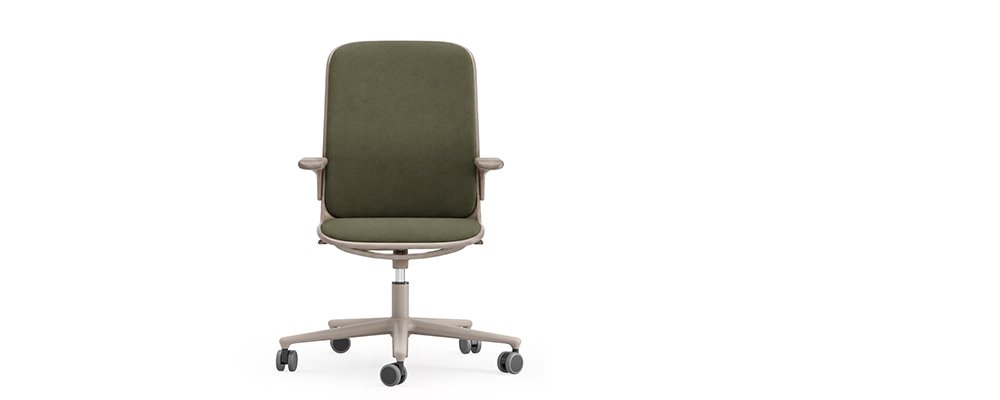
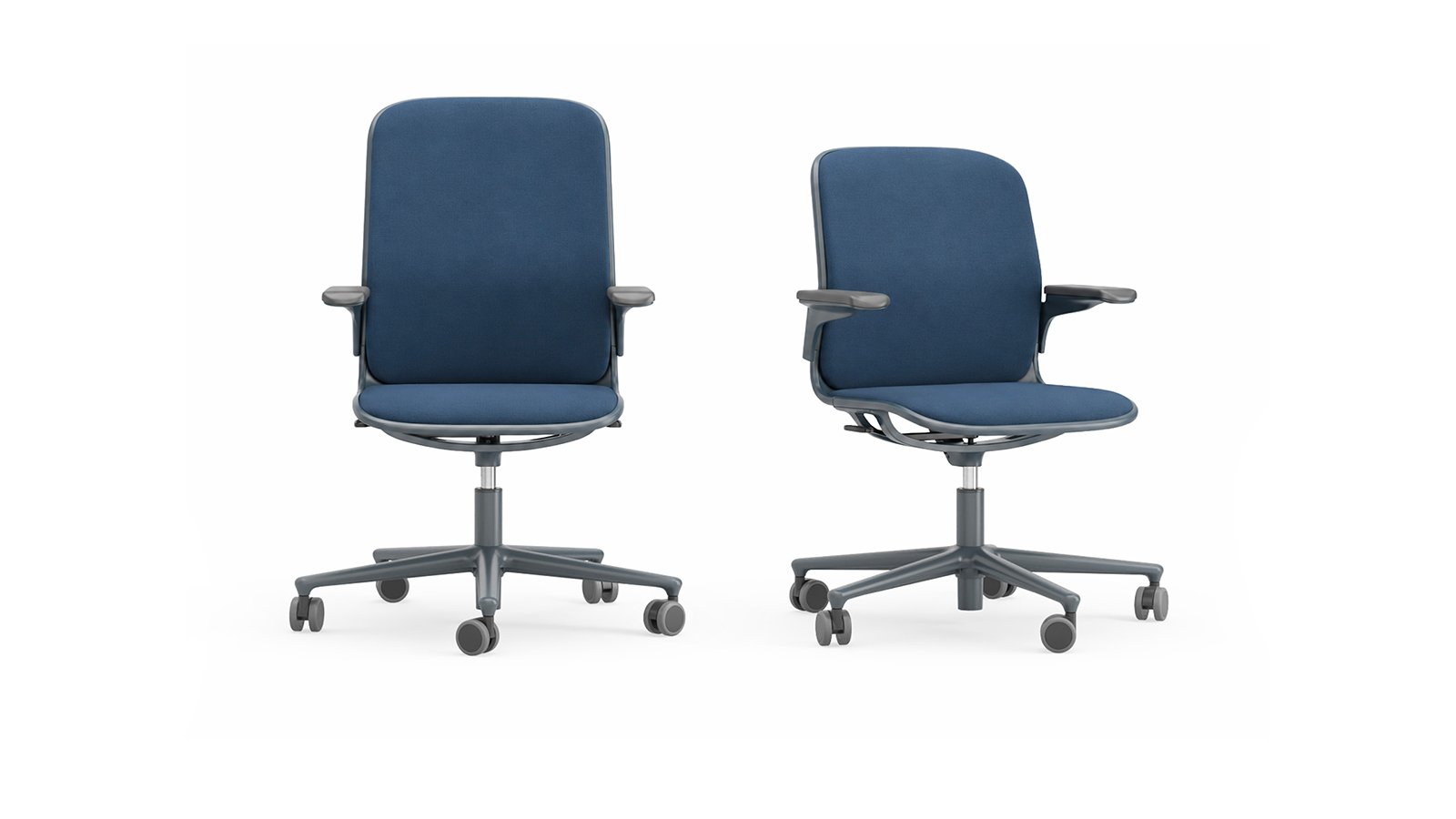
Executive office chair Cloud by ICF with a low back, seen in profile

Cloud Chair by ICF comes as a pair: four-star glides that swing free, five-star castors that lock

ICF Office

Sottsass Associati

Executive chair
Cloud An icon of Italian design Executive chair

What did you have in mind?

Trade terms for professionals and design studios

Pick the base and you have picked the recline. ICF builds the Cloud Chair in two matched pairs: the four-star base on glides carries a synchronised tilt that swings free and cannot be locked, the five-star base on castors carries the tilt you can lock upright or in four intermediate positions. The code fixes the pairing, 08 or 17. In the executive chair collection that is one digit for two decisions.

Underneath, the two are the same chair: a perimeter of extruded aluminium holding two suspended membranes, seat and back, in nylon mesh, elastic mesh, fabric or leather, a membrane that moves with the mechanism instead of fighting it. Sottsass Associati drew it for ICF in 1998 to favour a relaxed working atmosphere; the base is the one decision that changes how the chair behaves.

Both bases take both arms. On glides the chair stays put and keeps swinging, at the meeting table or across the desk; on castors it rolls and it locks, at the executive workstation. Task arms, open with a polyurethane pad, are declared for operative and executive use; Meeting arms, closed and in aluminium, for meeting rooms and visitors, next to the chairs for the meeting room. Three back heights on each; either will also seat someone waiting. La Mercanti puts 08 and 17 on the same line of the quotation, side by side, so that whoever signs sees that base and recline were chosen together.

Technical information based on data declared by the manufacturer.
  • Collection: Cloud Chair
  • Manufacturer: ICF S.p.A., Vignate (Milan), Italy
  • Design: Sottsass Associati, 1998
  • Versions: Task (SAT), open armrests with an integral polyurethane pad, for operative and executive workstations · Meeting (SAM), closed aluminium armrests, for meeting rooms and visitor seating
  • Backrest: three heights, overall height minimum/maximum: low 83/96 cm (32 5/8–37 3/4 in), medium 90/103 cm (35 3/8–40 1/2 in), high 100/113 cm (39 3/8–44 1/2 in)
  • Width and depth: 62 cm (24 3/8 in) Task or 60 cm (23 5/8 in) Meeting × 47 cm (18 1/2 in)
  • Codes: SAT/SAM .408 .417 .108 .117 .608 .617; ending 08 = four-star base on glides with non-locking tilt; ending 17 = five-star base on castors with lockable tilt
  • Frame: extruded aluminium perimeter, load-bearing components in die-cast aluminium
  • Frame finishes: 47 polished · 55 chromed · powder-coated 111 Warm black, 100 white, 070 Soft grey, R11 copper brown, R12 dark blue, R15 grey green, R22 silk grey
  • Seat and back: membrane in nylon mesh (75% vinyl resin, 25% polyester) or elastic mesh (70% polyester elastomer, 30% polyester), or a sandwich laminate in fabric or leather with a technical core between two layers of flexible polyurethane
  • Coverings: fabric cat. B Atlantic (17 colours), Mini (7), Tonal (15) · cat. C Cura (15), Mini Melange (9), Sealife (10), Step (8), Step Melange (8), Sotega (5) · cat. F Breeze Fusion (5), Grain (10) · leather cat. E (15) · mesh cat. X Rete Elastica (7), Tale (15); seat and back may be in different categories; the all-mesh version comes only with the Rete Elastica
  • Lumbar support: accessory SLXN in black polyurethane, 6 cm (2 3/8 in) of travel, can be fitted and removed
  • Height adjustment: gas lift to EN 16955:2017, 14 cm (5 1/2 in) of travel, lever on the right
  • Tilt: synchronised mechanism with a knob to set the counter-pressure to body weight; lock upright and in four intermediate positions on the 17 codes
  • Base: four-star with glides or five-star with castors, die-cast aluminium, polished or chromed to match the frame
  • Castors: Ø 65 mm (2 1/2 in), soft tread for hard floors, automatic brake to EN 12529:2001; hard tread for carpet on request
  • Glides: black nylon, Ø 37 mm (1 1/2 in), with a soft rubber insert
  • Weight and volume: 15-16 kg (33-35 lb) and 0.45 m³ (15.9 cu ft) for low and medium back; 16-17 kg (35-37 lb) and 0.49 m³ (17.3 cu ft) for high back
  • Materials: aluminium 75%, plastic 13%, metal 4%, other 8%; 92% recyclable with components fully separated (ICF data on code SAM.117)
  • Tests and certifications: EN 1335-1-2-3:2014 · UNI 9084:2002 · ANSI/BIFMA X5.1:2002 · UNI 8591:1984 + FA 1:1995 and UNI 9083:1987 declared by ICF · reaction to fire class 1 IM with Rete N · user manual: UNI EN 15373 level 2 and EN 13761 for visitor and community seating, UNI EN 1335 type B for screen-based workstations
  • Accessories: SLXN lumbar support · SAR5 set of five castors · SAF5 set of five glides
  • Origin: Made in Italy
La Mercanti Srl — trusted supplier for design and contract projects since 1997.
San Benedetto del Tronto (AP), Italy · +39 0735 753833 · info@lamercanti.com
Supply, quotations, specifications and project support across the UK and worldwide.

Tell us which finishes you'd like to assess

£ 170

Fully redeemable against your first order

FAQ

Polished, chromed or painted: what are the frame options on the Cloud Chair?

Three. The aluminium of frame and arms comes polished (code 47), chromed (code 55) or powder-coated in one of seven colours, from 111 Warm black to R22 silk grey, and the finish is written into the order as V, L or CR. Base and arms take the same finish as the frame, while the base stays polished or chromed to match, even under a painted frame. For a boardroom where the chairs have to match the door handles and the table edge, the seven colours are the part of the order to settle first.

Do the arms on the Cloud Chair move, and what are they made of?

They stay where they are. Both arm versions are fixed and cast in aluminium, finished like the frame. The Task arm is open in shape and carries an integral polyurethane pad, which ICF describes as soft cushioning that is pleasant to the touch; the Meeting arm is closed and left in bare aluminium. The pad is the detail to check in person: it is the part of the chair a sitter touches most, and on the Task version it is what separates a working day from a meeting.

Is the Cloud declared for visitors and communal areas, not just the desk?

Yes, and the manual says so in its introduction. ICF files its visitor and community seating under UNI EN 15373 level 2 and EN 13761, and its chairs for screen-based workstations under a type B class of their own; the family-wide tests are listed in the passport below. In practice one reference can appear on the reception clause and on the boardroom clause of the same specification, which is rare for a chair with an executive back height.

Coffee on the mesh of a Cloud Chair: what does ICF say to do?

Nothing dramatic. Dust comes off with a vacuum cleaner or a soft non-metallic brush; a stain is worked with the same brush or a sponge, water and a detergent, then rinsed abundantly and left to dry in the open air. The instruction is the same for the nylon mesh and for the elastic mesh, and the membrane stays suspended in its perimeter while you clean it. No special product, no machine, and no reason to take the chair out of the room.

Which fabrics on the Cloud are woven in Trevira CS?

Four of the fourteen collections: Mini and Mini Melange in category B and C, Step and Step Melange in category C, all 100% Trevira CS, the fibre that is flame-retardant by construction rather than by treatment. Mini carries UNI 9175 class 1, DIN 4102 B1, NF M1, EN 1021 parts 1 and 2 and BS 7176 Medium Hazard; Step adds the MED certificate for use on board ships and BS 5852 Crib 5. For a British specification that asks for Crib 5 on the covering, Step is the collection to name.

Adding the lumbar support to a Cloud Chair and finding the height where it works

On the Cloud Chair the lumbar support is an accessory, not a built-in part. Five steps cover ordering it, fitting it at any point in the chair's life and setting its height from the seat, as the ICF manual describes.

Order it as a line of its own

On the Cloud Chair the lumbar support is the accessory SLXN: a block of black polyurethane listed on its own, not inside the chair code. Add it to the order next to the SAT or SAM reference, or leave it out. ICF treats it as an addition, and the suspended membrane behind the back carries the sitter with or without it.

Fit it whenever you like

ICF states that the support can be installed or removed at any moment. That turns it into a decision for the first weeks of use rather than for the purchase order: a chair delivered without it can receive it later, and a sitter who finds it in the way can have it taken off again. Nothing else on the chair changes.

Set it from the seat, with both hands

Stay seated. The manual asks you to grip the support with both hands and slide it up or down along the back membrane; the travel is 6 cm (2 3/8 in). Doing it seated matters, because the membrane is already loaded with your weight and the support is being placed against the back you actually sit with, not an empty one.

Aim for the kidneys

The guidance on height is a single line: the support generally sits at the height of the kidneys. Start there. The travel leaves room to correct up or down for a shorter or taller sitter without removing anything, and a chair shared by two people can be reset between them in a few seconds.

Feel what it does to the membrane

The support does not add padding. ICF describes it as automatically tightening the back's membrane at that point, so that the suspension pushes back a little harder in the lumbar zone while the rest of the back distributes the weight as before. If that extra tension is not wanted, the support comes off, as ICF allows at any time, and the back returns to its original suspension.