Tell us your requirements
Trade terms for professionals and design studios
Tell us your requirements
Trade terms for professionals and design studios
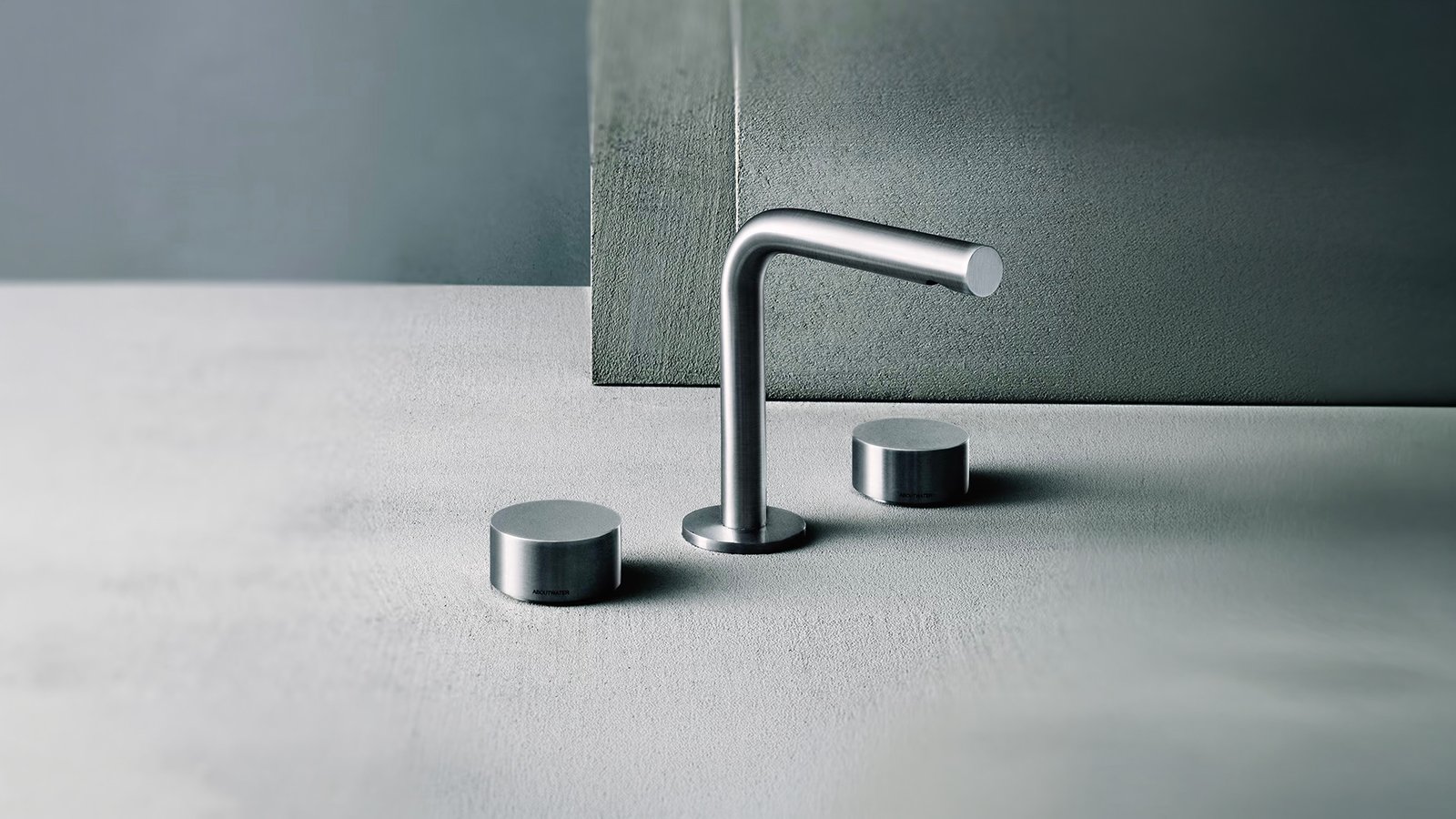
Anyone who has turned up the volume on a proper amplifier knows the object: a low metal disc that moves under two fingers and stays where it is left. Fantini goes to that memory to explain AF/21. In the maker’s account the taps have become discs, reminiscent of the forms found on the controls of a stereo. It is a plain way to describe taps drawn by a designer: by what the hand does with them.
The comparison holds at the basin. In the catalogue photographs the disc sits low, at the foot of a slim cylinder on the single-hole mixer and either side of the spout on the three-hole set. Fantini calls the series a work of simplification, its line reduced “almost to a pure icon” so that the material does the talking. In an executive washroom that visitors use alone, a control everybody already understands is worth more than a caption.
Naoto Fukasawa drew it for Aboutwater Boffi-Fantini, and Fantini makes the series in Pella, on Lake Orta. It follows the water round the building. At the basin it stands on the counter, comes out of the wall or rises from the floor; the bidet has its own single-hole mixer; the shower runs from concealed valves, with a rain head and a slim hand shower; the bath fills from the wall, from its rim or from a column on the floor; and in the kitchen the spout swivels over the sink. La Mercanti lets the client turn a disc before anyone talks about finish.

Tell us which finishes you'd like to assess
Matt Copper, Matt Gun Metal and Matt British Gold. All three are applied over brass by Physical Vapour Deposition: thin metal films are laid on the piece under vacuum, a process Fantini notes is also used in the aerospace and biomedical fields and which, it says, keeps the surface unaltered. Together with chrome and brushed stainless steel they bring the choice to five. Our advice is to judge them against the stone or tile they will stand beside, since a matt metal borrows a good deal from its neighbours.
Yes, and in more than one form. With the progressive cartridge the tall single-hole mixer has a spout projecting 15.5 cm (6.1 in); with the traditional cartridge the same model can also be had at 18.5 cm (7.3 in). A tall two-hole version, where spout and control stand apart, reaches 19 cm (7.5 in) thanks to an extended spout, and the three-hole set has a tall edition as well. On paper the versions differ by the projection of the spout, so that is the figure to check against the drawing of the basin.
Fantini’s guidance fits in a sentence: after each use, rinse the tap with water and finish by drying it with a soft cloth. The aim is to remove what soaps and body-care products leave behind and to stop limescale settling. The only other instruction is to fit original Fantini spare parts. For a washroom cleaned by contract staff this is welcome, because Fantini gives one routine for the whole series, short enough to be written on a single row of the cleaning schedule.
The phrase appears against every concealed AF/21 shower mixer, whether it feeds one outlet, two through a rotary diverter, or three, and again against the 3/4″ stop valve. Fantini states acoustic insulation and attaches no figure to it, so none is quoted here. The mixers concerned have 1/2″ inlets and are made with the progressive or the traditional cartridge; the stop valve works on a ceramic headwork that opens in 90° and can carry a marble handle.
Two handles working ceramic headworks that open in a quarter turn, a rotary diverter with two outlets, plus the FIT hand shower with its wall outlet, holder and a 150 cm (59 in) PVC hose. The set is made with a spout projecting 21.5 cm (8.5 in), or as controls and hand shower alone, and the handles can be ordered in marble. Separately, among the complements of the series, Fantini lists a bath waste column, also in a version that delivers water through the overflow.
An AF/21 shower is ordered piece by piece: a mixer in the wall, a head on its arm, a hand shower. Five steps, each resting on a figure from Fantini, to get the list right before the tiler arrives.
Start with how many things the AF/21 mixer has to feed. The concealed mixer is made for one outlet, with a rotary diverter for two, or for three, each with the progressive or the traditional cartridge and 1/2″ inlets. A rain head plus a hand shower makes two; add a side head and it is three.
The alternative is the 3/4″ thermostatic mixer. One version has a rotary diverter with shut-off for two or three outlets and is made for horizontal mounting only. The other has no diverter and, Fantini specifies, must always be ordered together with the 3/4″ stop valve.
Its limiter holds the rain head to 12 litres per minute, measured at 3 bar (3.2 gpm at 43.5 psi), and Fantini asks for a supply of no less than 10 litres a minute (2.6 gpm) for it to work properly. Ask the plumber to confirm that figure at the shower wall before the head goes on the order. An anti-limescale system and a non-return valve are built in.
Wall arms are made in three lengths, 30, 35 and 45 cm (11.8, 13.8 and 17.7 in), and there is a 25 cm (9.8 in) arm for the ceiling, each with a round rose. Where the arm meets a plasterboard wall, Fantini lists an optional concealed part made for that construction.
The shower set brings the FIT hand shower, a wall outlet with holder and a 150 cm (59 in) PVC hose. If the plan calls for water from the side as well, the series has an adjustable side shower head in brass with an anti-limescale system of its own.