What did you have in mind?
Trade terms for professionals and design studios
What did you have in mind?
Trade terms for professionals and design studios
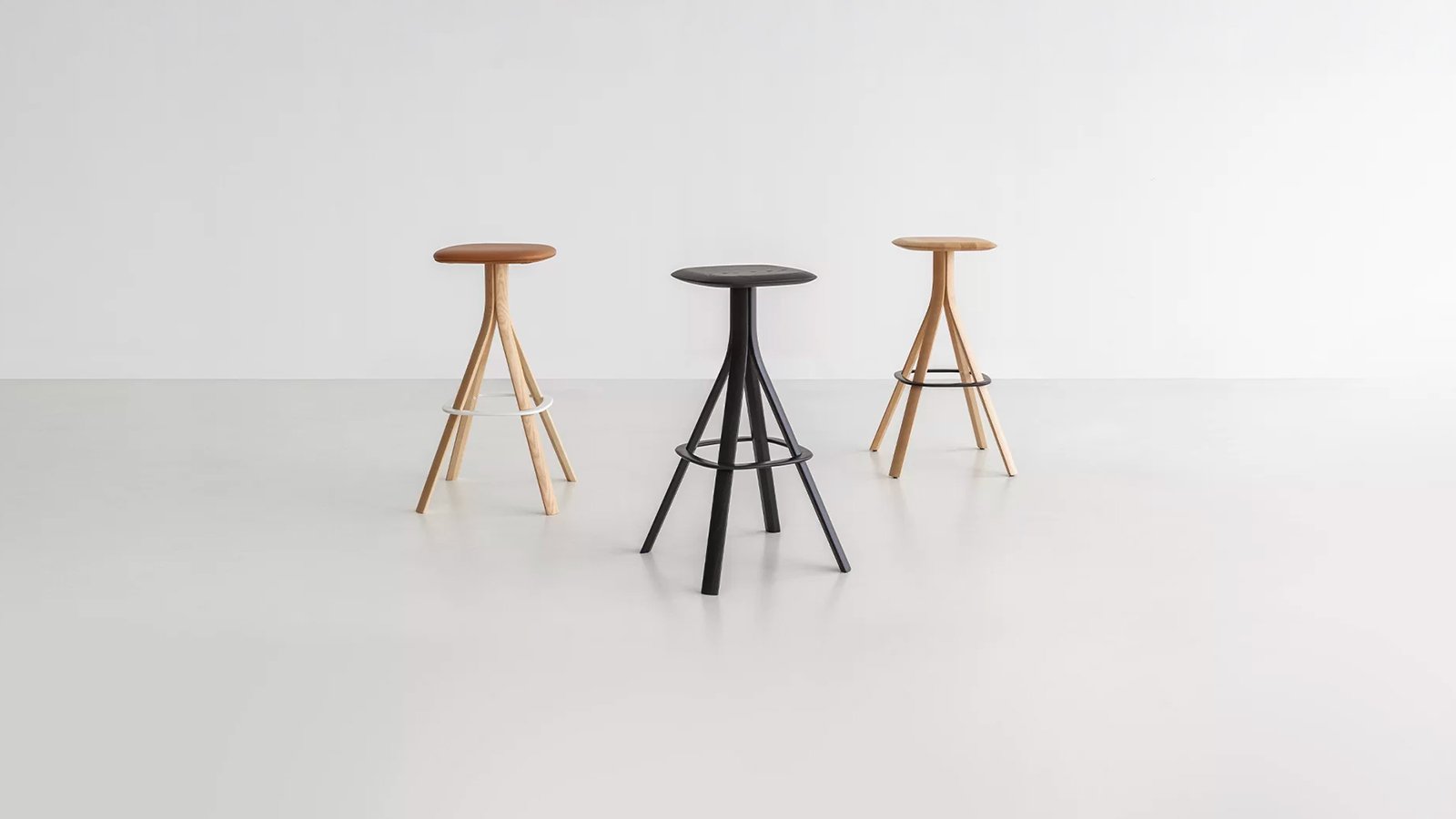
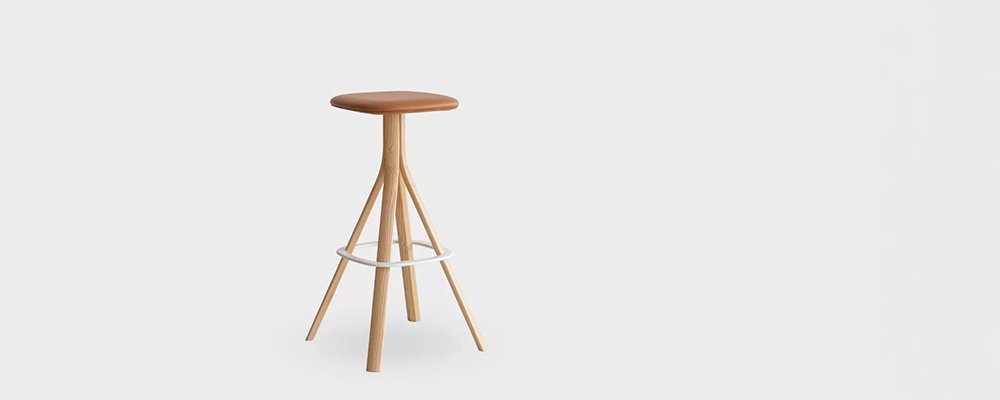
Look at LUSTO from the side and the eye travels upwards: four legs set wide on the floor draw together as they rise, pass through the footrest ring and open out at the top into the seat. Lapalma calls that seat the crown and describes it as one of ‘extreme comfort’; Karri Monni, the Finnish designer who drew it in 2023, gave the whole piece the logic of something growing, and the crown is where the growth arrives. Among our high stools for bar counters it is the one whose seat reads as a destination rather than a lid.
The crown comes two ways. It can be solid ash, varnished like the frame, natural and grained or open-pore black; or it can be fully upholstered in fabric, leather or faux leather. In Lapalma's photographs both live side by side: grey-beige and timber seats on black frames, a cognac-coloured seat on natural ash.
LUSTO has one height, its seat at 78 cm, or 30 3/4 in, so the choices are in the details: frame in natural ash or open-pore black, seat in matching timber or upholstered, including in a material the client supplies, powder-coated steel footrest in black or white, nylon feet with a felt or plastic insert. We see it where people stop for a coffee and stay to talk, in the coffee corner of an office and at high bar counters at home. La Mercanti lays a fabric swatch on a timber seat sample so the client can judge the crown both ways before anything is chosen.

Tell us which finishes you'd like to assess
Lapalma offers two: a soft-leather and the Valencia faux leather, both as a fully upholstered seat over the ash frame. The care sheet treats small marks in leather and wood as part of a natural material, within accepted standards. Our view: where the seat is wiped many times a day, at a busy café counter, faux leather is the practical choice; in a private home or a client lounge, leather gives the warmer hand.
Yes. Alongside the fabrics graded A to D, leather and faux leather, Lapalma accepts the customer's own material for the seat. It is the route we suggest when a restaurant or a reception already has a cloth on its banquettes or chairs and the stools should pick it up. Our advice is to have a generous sample to hand early, so the fabric can be judged next to the timber before the order is confirmed.
Both are solid ash. Natural ash keeps the pale tone and the grain of the timber; open-pore black colours it while leaving the texture of the wood readable. The frame decides a timber seat: black goes with a black seat, natural ash with an ash seat, and Lapalma does not mix the two in wood. An upholstered seat goes on either, which is where most of the freedom lies.
Each leg ends in a nylon foot with an insert in felt or in plastic. The sheet notes that the maker takes no responsibility for marks on delicate or soft floors, so the choice deserves a moment. Our reading of the two options: felt on parquet and other delicate surfaces, plastic where the floor is mopped every day, as in most restaurants and office kitchens.
The ring is steel, powder-coated in black or white, and it holds the four legs together between floor and seat. In Lapalma's photographs the white ring sits on natural ash and the black one on the dark frame. Our own reading: white stands out against black wood and makes the ring a detail; black on black keeps one continuous line from the floor up.
A seat at 78 cm (30 3/4 in) belongs with bar counters, high counters and tall tables. Five checks to run on site before LUSTO is ordered, from the worktop down to the floor beneath it.
LUSTO has its seat at 78 cm (30 3/4 in) from the floor. Before any finish is discussed, measure the height of the bar counter or tall table it will stand at, then sit there on a stool of similar height: there must be comfortable room for the thighs between seat and worktop.
The four legs spread to 58 cm (22 3/4 in) at floor level, wider than the 43 cm (16 3/4 in) seat. Plan the run of stools from the floor figure rather than the seat, and add a margin between one stool and the next so that people can turn their knees.
Behind a row of stools someone always passes, carrying a tray, a laptop or a coat. On the plan, keep a clear strip at the back of the seated people, more generous in a café than in a private home, where fewer people arrive at the same moment.
Sit on a sample and rest both feet on the ring: that is where the knees will be in relation to the counter edge. In our view it is the quickest way to see whether the overhang of the top leaves enough room, and it settles doubts faster than any drawing.
The sheet warns that sunlight can change the colour of the timber, and that the stool should not stand beside radiators or anything hotter than 40 °C, which is 104 °F. Before fixing the position of the run, see where the sun falls at midday and where the radiators are.