Let's discuss your project
Trade terms for professionals and design studios
Let's discuss your project
Trade terms for professionals and design studios
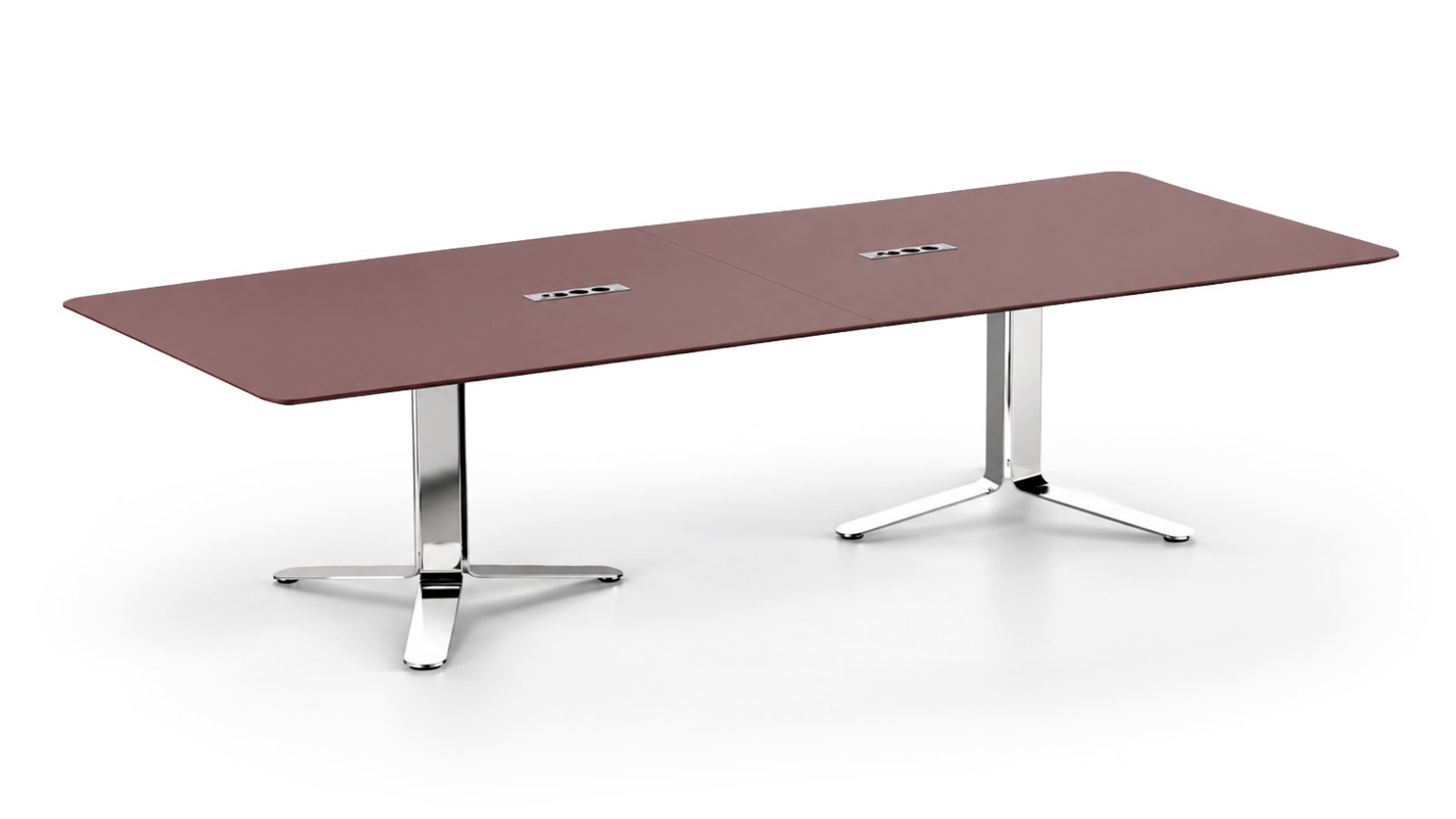
A long top usually announces what it takes to hold it up. ICF goes the other way with the Levita Table: «large tabletops with minimal components» is how the maker puts it, and that phrase is the whole argument for this conference table. Everything else follows from how little has been left underneath.
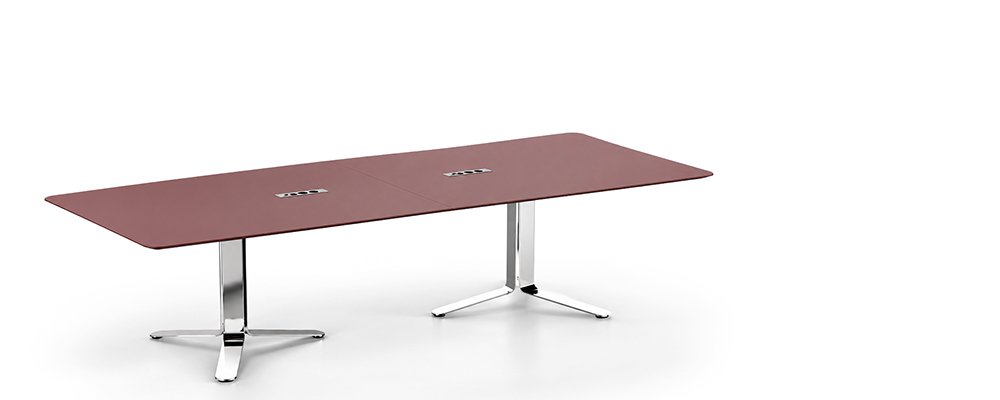
Two things do the carrying, an I-beam structure and legs of curved steel, and Khodi Feiz has drawn them to look slight while staying exact as engineering. ICF's published images show a long top in two sections resting on just two bases, which leaves a good deal of open floor. That counts for more than it sounds in boardrooms and meeting rooms, where the table sets the terms and everything else in the room has to work around it.
Beneath the same idea sits a family that starts small. ICF lists side tables and low versions, then working and dining tables, and finally the meeting table itself, across the operational, executive and meeting spaces it declares. The Levita Desk takes the language into operational areas; the Levita Sofa takes it into lounges, with benches, high-backed panels and poufs. La Mercanti starts from the room in question and comes back with the top sizes that can actually be ordered for it.

Tell us which finishes you'd like to assess
ICF's own answer is no. Presenting its four new collections at Orgatec, the company spoke of a vision that transcends trends, aimed at furniture able to adapt to new ways of working, connecting and experiencing spaces. For a buyer that is a practical test rather than a slogan: a meeting table lives through several changes in how a team gathers, and one that rests on no passing look has less to apologise for when those changes come.
Yes. ICF lists low versions and side tables alongside the tables for working, dining or meeting, all with the same essential forms and softly shaped tops. So the waiting area outside a boardroom can speak the same language as the room itself, without a second collection being brought in to fill the gap. Which of these can be ordered today is something La Mercanti confirms with ICF for each request, since the range has only just been presented.
Not at all. ICF describes the table as complementing the Levita Sofa System while standing on its own, so a meeting room can take the table alone and the sofa may arrive later, or never. On the stand in Cologne the two were shown together, with the orange sofa behind the table, and that is the case for pairing them: an open area and the room beside it end up looking like one decision instead of two separate purchases.
ICF speaks of light, recognisable bases, and the images it has published show what that means: a column of I-section rising from three arms, which touch the ground on small feet, in a mirror-bright or a dark graphite finish. Nothing about this is hidden. A base of this kind stays in view from across the room, and from the far end of a long table, so it deserves the same attention as the surface when the finishes are being settled.
ICF describes the tops as softly shaped, and in its published images a long rectangle ends in rounded corners. The same softness runs through the family: the backrests of the Levita Sofa are given what the company calls a precise softness. In a room used all day there is a plain benefit too, since a rounded corner is kinder to anyone edging past with a laptop, and it keeps a very long table from looking severe when it stands empty.
Five entries for the architect or designer drafting a specification before any figures exist: what the table is, what is declared about it, where it belongs and what stays open until we confirm it.
Open the entry with the plain identification: Levita Table, ICF, design Khodi Feiz, 2026. Then say what the table has to do in this particular room, choosing from what ICF declares: meeting, working or dining, or a low or side version. One line is enough, and it prevents a contractor from reading the entry as a generic meeting table.
Write the construction in the words the maker uses: an I-beam structure with curved steel legs. Stop there. Anything added from memory, such as a thickness or a weight, becomes an invented figure on a tender document. Leave those fields visible and marked as pending until we have them from ICF, which is far safer than a neat number nobody can stand behind.
Note whether the same project also takes a Levita Desk for operational areas or a Levita Sofa for the lounge, and list those pieces beside the table. The designer reading the drawing later will then see the rooms as one family. It also tells us at once that finishes have to be looked at together, and not settled one item at a time.
Add the destinations as ICF gives them: operational, meeting and executive spaces, then reception, hospitality, commercial and public spaces from the stand panel. Quote them as declared. Any claim about suitability beyond that wording belongs to whoever signs the specification, and a client's facilities team will ask where it came from, so keep the source of each phrase beside it.
Finish the entry with what is still to be fixed: the size of the top, the finish of top and base, and any cable access. Mark each of them as to be confirmed by us, and send the entry over with the room it applies to. We go through it with ICF and return it with the versions that can be ordered, ready for the final issue.