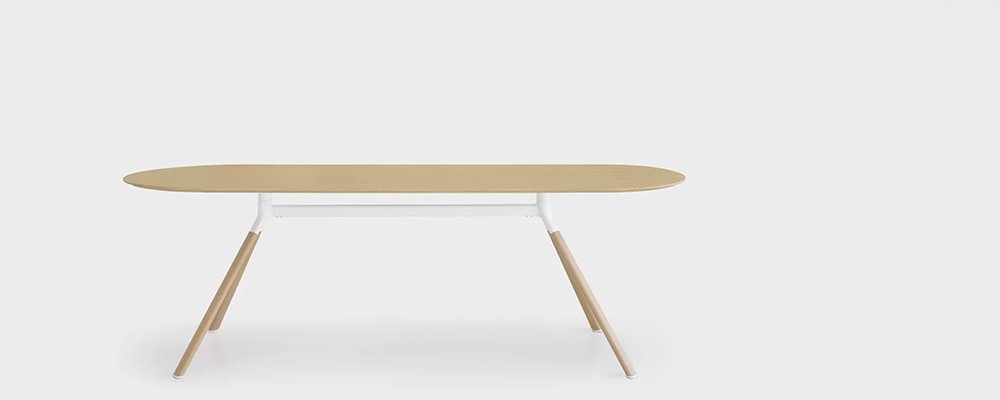
Fork

Oval or rectangular over the same base: the FORK meeting tables by Lapalma

Lapalma

Tomoya Tabuchi

Conference table only
Fork The piece that makes the room Conference table only
£ 2,867

Let's discuss your project

Trade terms for professionals and design studios

The two meeting tables of FORK, P127 and P128, take either outline over the same base: an oval with semicircular ends, or a rectangle with square corners. Lapalma offers both in every size, from 160 to 240 cm long (63 to 94 1/4 in), so the decision has little to do with the table and a great deal to do with the room. It is the first question we put to anyone weighing up conference and meeting tables for a board or a project team.

Our reading of the two: the oval eases the walk round the ends and leaves no corner at hip height, while the rectangle gives a clear head of the table and sits flush against a wall or against a second table. Underneath, nothing changes: the same base carries either top. Tomoya Tabuchi designed the family in 2016, and Lapalma traces it to an image from Japanese culture: the tree, rooted in the ground and open to what the sky brings.

Around these two sit the round P120 and P124, 60 to 110 cm across (23 1/2 to 43 1/4 in), the high P121 and P125, and the EP series for terraces, round or square. We see FORK in meeting rooms of every size, and in studios where clients are received at the very table the team works on. La Mercanti draws both outlines over the client's floor plan and walks each one with them, chair by chair, before a top is chosen.

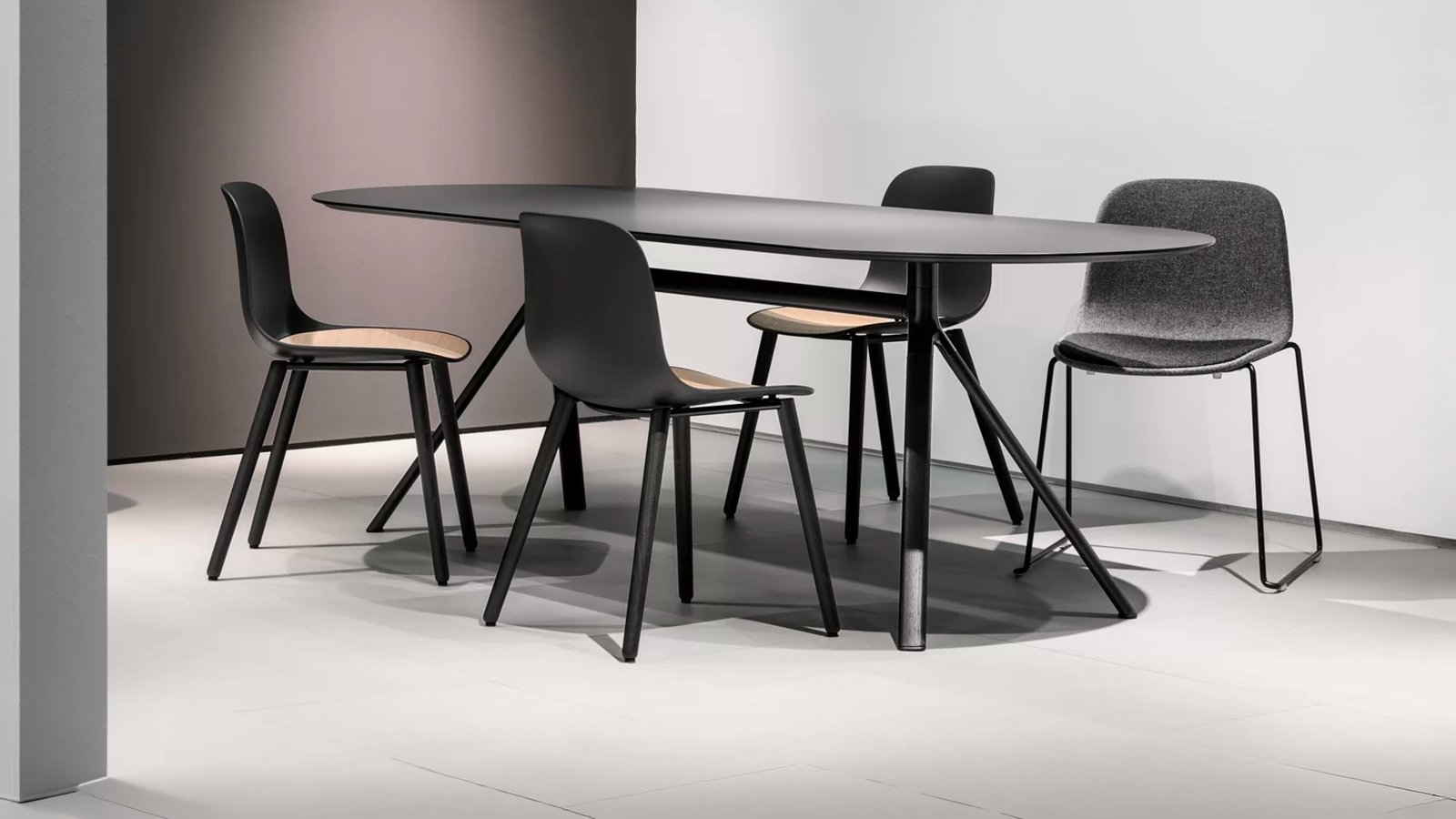
Technical information based on data declared by the manufacturer.
  • Name: FORK
  • Manufacturer: Lapalma
  • Design: Tomoya Tabuchi, 2016
  • Type: family of meeting tables, round tables and high tables, for indoor and outdoor use
  • Round tables: P120 with a top of Ø 60, 70 or 80 cm (23 1/2, 27 1/2 or 31 1/2 in) and P124 with Ø 90 or 110 cm (35 1/2 or 43 1/4 in), both 74 cm (29 in) high
  • High tables: P121 on the P120 tops and P125 on the P124 tops, raised to 110 cm (43 1/4 in)
  • Meeting tables: P127, 160 × 80 or 180 × 90 cm (63 × 31 1/2 or 71 × 35 1/2 in) · P128, 200 × 90 or 240 × 90 cm (78 1/2 × 35 1/2 or 94 1/4 × 35 1/2 in); height 74 cm (29 in); oval or rectangular top
  • Base: drawn aluminium tube with an elliptical section; four-way joint on the round tables, two three-way joints with a connecting bar on P127 and P128, in die-cast recycled aluminium, powder-coated; adjustable nylon glides
  • Legs: aluminium, powder-coated black or white, or wood-veneered in two finishes, bleached oak and black open-pore
  • Tops: bleached oak, dark walnut oak, black open-pore, white lacquered wood, Fenix black, Fenix white; bevelled edge lacquered to match; 16 mm (5/8 in) thick on P120 and P121, 20 mm (3/4 in) on all the others
  • Outdoor version: EP120 and EP121, Ø 60 or 70 cm (23 1/2 or 27 1/2 in) or square 60 × 60 and 70 × 70 cm (23 1/2 × 23 1/2 and 27 1/2 × 27 1/2 in); EP124 and EP125, Ø 80, 90 and 110 cm (31 1/2, 35 1/2 and 43 1/4 in) or 80 × 80 cm square (31 1/2 in a side); 74 or 110 cm (29 or 43 1/4 in) high; HPL top, 10 mm thick (3/8 in), in white, Fenix black, white, Jaipur red or London grey; black or white base; waterproof cover
  • Care: damp cloth or a mild neutral detergent; lift it by the frame; indoor models away from heat above 40 °C (104 °F)
La Mercanti Srl — trusted supplier for design and contract projects since 1997.
San Benedetto del Tronto (AP), Italy · +39 0735 753833 · info@lamercanti.com
Supply, quotations, specifications and project support across the UK and worldwide.

Tell us which finishes you'd like to assess

£ 170

Fully redeemable against your first order

FAQ

What holds the two pairs of legs together under the longer tops?

On P127 and P128 each pair of legs meets in a three-way joint of die-cast recycled aluminium, fixed to the top by its own plate. An extruded aluminium bar links the two joints. In Lapalma's drawing they stand 140 cm (55 in) apart on the P127 and 180 cm (70 3/4 in) on the P128, so the long sides stay clear between them: worth setting against the chair spacing before the plan is fixed.

Which woods are on offer, for tops and for legs?

Tops come in bleached oak, dark walnut oak and black open-pore wood, the two oaks on a core of birch plywood. The legs can be veneered in bleached oak or black open-pore too. That means timber can run from the floor to the top, or stop at the top over black or white painted legs. We would decide it with the chairs that will stand round the table in view, not on their own.

How long and how deep do the two biggest models go?

The P127 measures 160 × 80 cm (63 × 31 1/2 in) or 180 × 90 cm (71 × 35 1/2 in); the P128 is 200 × 90 cm (78 1/2 × 35 1/2 in) or 240 × 90 cm (94 1/4 × 35 1/2 in). All four stand 74 cm (29 in) high with a 20 mm (3/4 in) top. Before picking a length, our advice is to measure the ring a pulled-out chair needs on every side, then see which size leaves the room a comfortable walkway.

Can the family go out onto a terrace or a roof garden?

Yes, with the EP series: EP120, EP121, EP124 and EP125, round or square, at 74 or 110 cm (29 or 43 1/4 in). Tops are HPL in white, Fenix black or white, Jaipur red or London grey, on a base powder-coated black or white. Lapalma adds a waterproof cover for every size. Outdoors the family keeps to rounds and squares, so a terrace pairs naturally with a café or a breakout area.

Which cleaning products are safe on the tops?

Water and a soft damp cloth do the job, with a drop of neutral detergent for stubborn marks; the Lapalma sheet excludes spirit-based cleaners, bleach, any solvent and anything abrasive. Spills want drying at once. Wood and natural materials may show small irregularities within the norm, and strong direct sun can shift their colour and tone over time: a point to raise when the table will catch full sun for part of the day.

Pairing the top and the legs of a FORK table, one finish at a time

Six tops, two kinds of leg and an edge lacquered to match: five steps for putting together a FORK finish that suits the room and the chairs already in it.

Start from the six tops

FORK tops come in six finishes: bleached oak, dark walnut oak, black open-pore wood, white lacquered wood, black Fenix and white Fenix. We would settle the top first, because it is the largest surface in the room and the one everybody's hands rest on during a meeting.

Painted legs or veneered ones

The legs are extruded aluminium, either powder-coated in black or white or veneered in wood, in a bleached oak finish or in black with the pores left open. Veneered legs carry the timber down to the floor; painted ones set the top apart from the frame. Both read well, and the question is which effect the room is asking for.

Let the edge follow the top

Every top has a bevelled edge lacquered in the colour of the top itself, so from the side it reads as one piece. Thickness is 16 mm (5/8 in) on the small rounds and 20 mm (3/4 in) everywhere else, which changes how much of that edge you actually see from a chair.

What sits beneath the finish

Oak tops are built on birch plywood, while lacquered and Fenix tops are built on MDF. It is worth knowing when a specification or a tender schedule has to state the core material next to the finish, and it is one more line that architects tend to ask for.

Compare samples in the room's light

Our advice: hold the top sample and the leg sample together in the room where the table will stand, at the hour it is used most, next to the chairs going round it. Daylight and artificial light can bring bleached oak and white lacquer closer together, or push them further apart, than they look on a desk.