What did you have in mind?
Trade terms for professionals and design studios
What did you have in mind?
Trade terms for professionals and design studios
Eight chairs stack on the floor; build the pile on the trolley instead and it takes ten. Those are Kastel’s figures for Kicca with the bare polypropylene shell, on four legs or on the sled base, and padding changes them. Give the chair an upholstered seat and the count falls to four, floor or trolley alike. Pad the back too and it is three on the floor, four on the trolley. Padded chairs also need the KC18, an ivory cover fitted under the seat so that upholstered versions can be stacked at all; the trolley is the KC17, painted black.
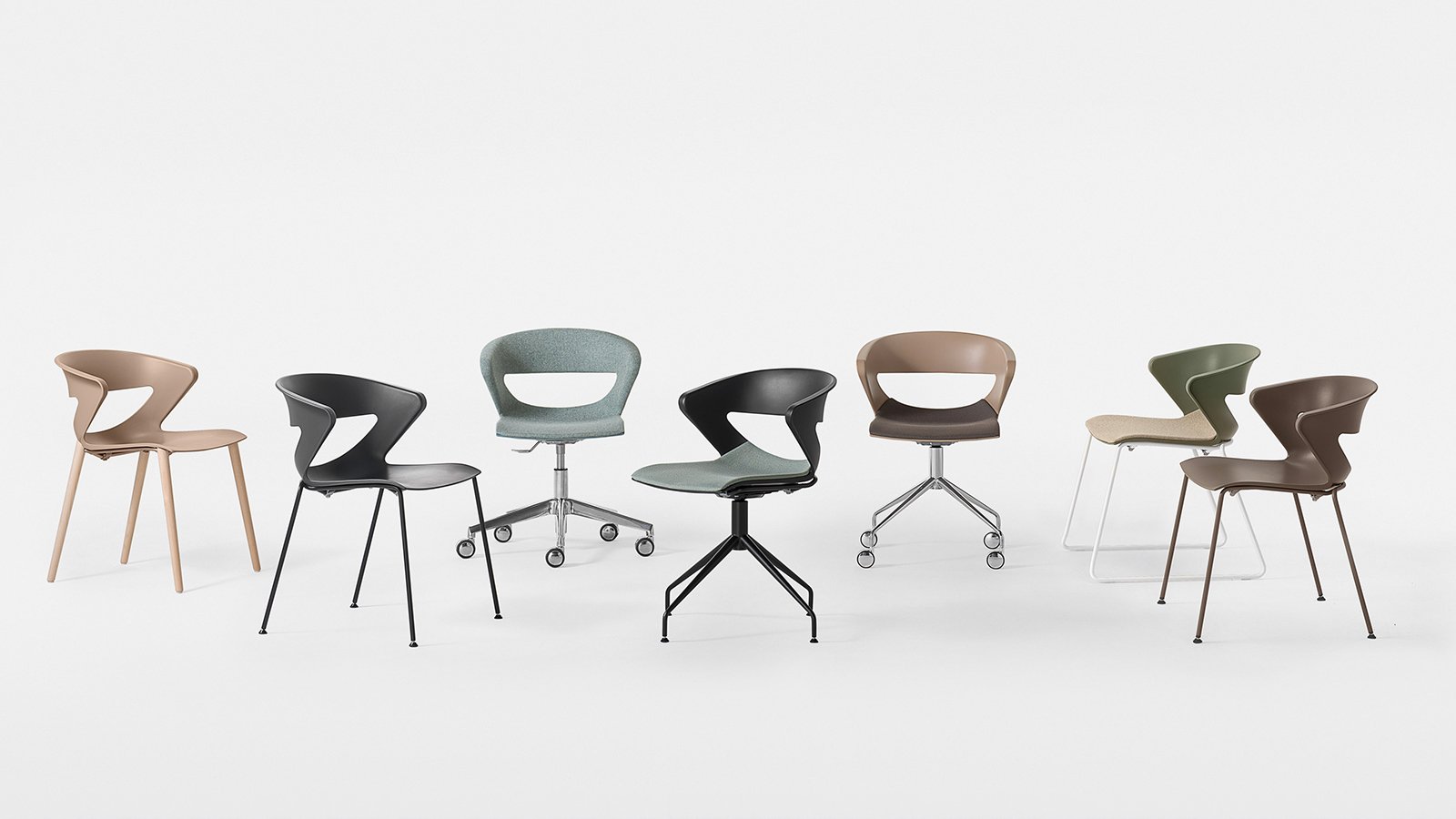
At the table, the model to look at is the four-leg one: 55 × 55 cm (21.7 × 21.7 in), 76 cm (29.9 in) from floor to top, and you sit at 46 cm (18.1 in). We file it under meeting room chairs, the job it does most, though it serves just as readily as one of the visitor and reception chairs. The shell is a single injection-moulded piece, held to the steel frame by polypropylene clips, and each leg ends in a jointed glide of nylon or steel. Eleven shell colours; ten frame finishes on four legs.
Away from the trolley, the range has other arguments. Maple legs hide a steel structure and stand on felt glides. The cross sled can be had painted bronze. Then the swivels: on four feet without castors, on castors, on castors plus a gas lift, on a convex round base, on a five-star base. Two sisters complete the line: Kicca One, a monobloc in glass-fibre-reinforced polypropylene, and Kicca Plus, an upholstered armchair. We put Kicca round meeting tables, opposite an executive desk for guests, in waiting areas and receptions, in conference halls, behind a manager’s desk, in restaurants and canteens. La Mercanti works out how many stacks and how many trolleys your storeroom will have to hold.

Tell us which finishes you'd like to assess
Eleven. White, Taupe, Orange, Red, Brick Red, Olive Green, Turquoise, Ocean Blue, Grey, Lava and Black. Kastel itself calls its colour references indicative, and a screen is less reliable still, so look at the plastic in daylight before you commit a whole room to one shade.
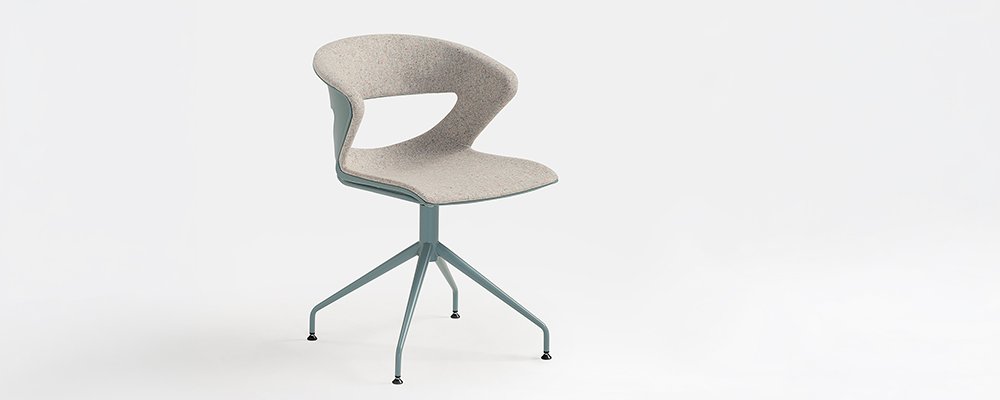
Yes: the swivel frame on four feet, supplied without castors. The seat turns while the feet stay where you left them, which suits interview rooms and small meeting tables where people swing round to talk but the furniture should hold its place. Its footprint is the same as the four-leg chair.
Non-deforming expanded polyurethane foam, carried on a counter-shell of polypropylene. The counter-shell is the part that receives the foam and the covering, and it sits on the main shell of the chair. La Mercanti can show you how the padded seat looks against the bare one before you decide.
Yes. Kastel lists EN 16139 as the technical standard for Kicca, and the same reference appears on its sheets for Kicca One and Kicca Plus. If your specification names that standard, quote it against the exact version being ordered, base and padding included.
Jointed ones. The steel frames end in articulated glides that swivel, so each foot can turn to sit square on the floor instead of resting on an edge. Kastel supplies them in nylon or in steel; La Mercanti will ask what the floor is made of before suggesting one or the other.
The KC19 underseat link joins Kicca chairs side by side at 56 cm (22 in) per seat. Five steps for laying out a hall, starting with the length of one row.
Multiply the seats in one row by 56 cm (22 in): that is the space Kastel gives for each linked chair. Do the sum for the longest row before anything is carried into the hall, and you will know whether the layout fits.
The KC19 is listed for four fixed versions: four legs, maple legs, sled and cross sled. Swivel bases are not part of that list, so a hall laid out in joined rows is planned on one of those four frames.
The link is an ivory cover that sits under the seat and carries the coupling. Ask for it together with the chairs, and say how many rows you are planning, so every seat that needs a coupling arrives with one.
Start at one end of the row and work along it, coupling each seat to the next. Each place in the joined row occupies 56 cm (22 in), whichever of the four frames you have chosen, so the sum from step one still holds.
Set the finished row length beside the width of the hall. If the row is too long, take seats off it and run the sum from step one again: the figure per seat is fixed, the number of seats is the only thing you can change.