
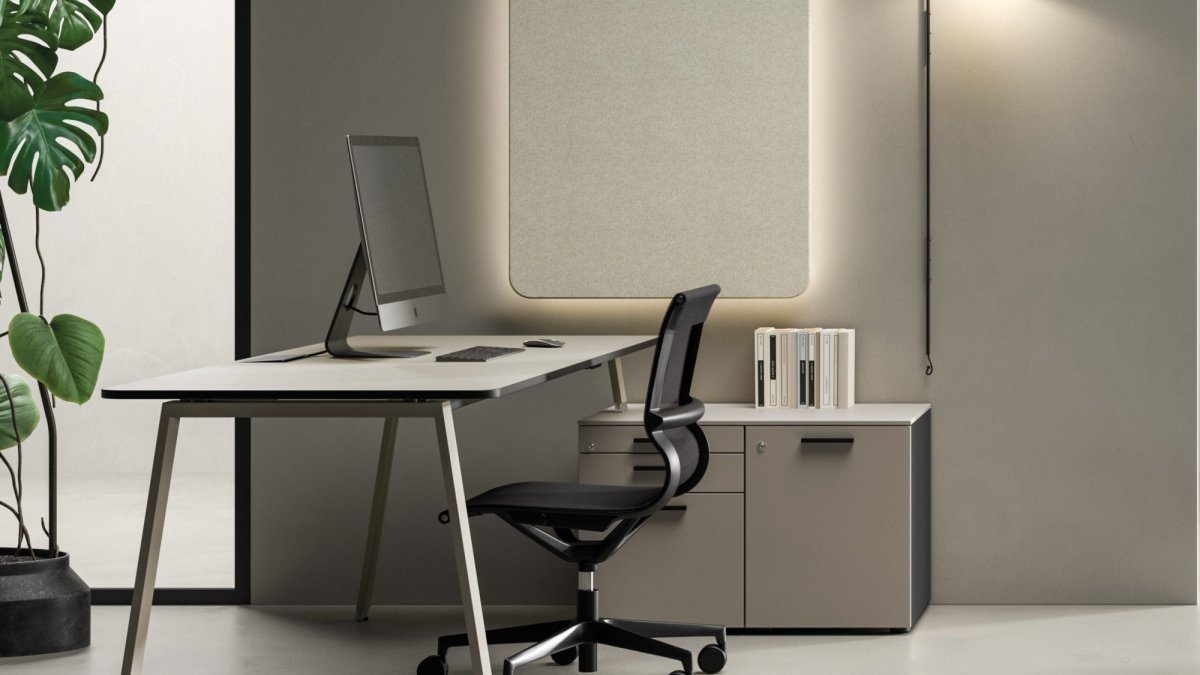
Read the Health and Safety (Display Screen Equipment) Regulations 1992 from the first line to the Schedule and you will not find a single measurement for a desk. The law asks for a work surface that is “sufficiently large” and low in reflectance, and for “adequate space for operators or users to find a comfortable position”. The figure a fixed office desk is expected to meet, 740 mm (29 in), is set elsewhere: in BS EN 527-1:2011, the British adoption of the European standard, with a tolerance of 20 mm (0.8 in) above or below. Italian law, by contrast, writes a range of 70 to 80 cm into its own display screen rules. British law leaves the number out and puts the weight on the person sitting there.
What the Regulations ask of an employer
If the desk has no number, the chair carries several requirements. The Schedule says the seat “shall be adjustable in height”, the backrest adjustable in both height and tilt, and that “a footrest shall be made available to any operator or user who wishes one”. Around the furniture sits a set of duties that HR teams and employment lawyers know well. Regulation 2 requires every employer to carry out “a suitable and sufficient analysis” of the workstations used by its DSE users, and to review it when there is reason to think it no longer holds or something significant has changed. Regulation 5 entitles a user to an eye and eyesight test on request.
Who counts as a user matters. HSE's guidance, INDG36, describes users as workers who use display screens “daily, for continuous periods of an hour or more”. Anyone who fits that description is covered, and a desk that does not suit the person at it belongs in their workstation assessment.
A standard drawn on a range of bodies
BS EN 527-1 is candid about whom it was drawn for. Its dimensions rest on European office users between the 5th percentile woman and the 95th percentile man, which in stature means 1,493 to 1,913 mm (about 4 ft 11 in and 6 ft 3 in at either end). The typical Briton falls well inside that range. The NCD-RisC collaboration, whose estimates appeared in eLife in 2016, puts men born in the United Kingdom in 1996 at 177.5 cm (5 ft 10 in) on average and women at 164.4 cm (5 ft 5 in). Britons born a century earlier, in 1896, stood about 10.6 cm shorter for men and 11 cm for women.
Trouble starts at the edges. For shorter people, HSE's own advice is that a footrest “may be helpful, particularly for smaller users”. For taller ones there is a limit to what a standard product can do. A client of ours, a very tall man, was replacing his desk, and in his case we had to have one made to his measurements by the manufacturer. Above the 1,913 mm the standard is designed for, a 740 mm top sits low, and what matters becomes the room underneath: at least 800 mm (31.5 in) of legroom in depth, 850 mm (33.5 in) in width under a fixed desk, and a front edge no more than 70 mm (2.8 in) thick. Past that point, the answer is a desk that adjusts.
What HSE's figures count
HSE's figures for Great Britain put the scale of the problem plainly. In 2024/25, 511,000 workers were suffering from a work-related musculoskeletal disorder, new or long-standing, and 7.1 million working days were lost to them: 27% of all work-related ill health and 20% of the days it cost. Most cases affect the back (43%) or the upper limbs and neck (41%). These are figures for every industry, construction and transport included, so they cannot be laid at the door of the office desk. Among the causes workers themselves reported in the surveys HSE uses for this (2009/10 to 2011/12), it lists working in awkward or tiring positions and keyboard or repetitive work alongside manual handling.
The practical test in INDG36 is a simple one and it has nothing to do with the tape measure: forearms roughly horizontal, eyes level with the top of the screen. The chair brings the body to that position. The desk only has to leave room for it.
A fitter's view of the tolerance
Catalogues quote a height. The site decides the one you get. When we fit a desk, the top usually settles three to five centimetres (1.2 to 2 in) away from the catalogue figure, and five centimetres already exceeds the entire tolerance BS EN 527-1 gives a fixed desk. The typical fault on site is easy to avoid: a desktop nobody levelled, standing on feet nobody adjusted after unpacking. Anyone writing a specification can deal with that in one line, by asking for the height to be measured once the desk is installed and level.
Executive desks are another matter. There is no single height to quote for them, since each model has its own, so read it on the data sheet for that model and choose the chair afterwards.
Sit-stand desks, and the programme that makes them work
For desks that adjust, BS EN 527-1 sets minimum ranges: 650 to 850 mm (25.6 in to 33.5 in) for seated work, 650 to 1,250 mm (25.6 in to 49.2 in) for sitting and standing, and 950 to 1,250 mm (37.4 in to 49.2 in) for a desk used only standing.
Whether people actually use them is another question. The Cochrane review of workplace interventions published in 2018 found that, on average, sit-stand desks took 100 minutes a working day off the time spent seated in the opening three months, with 57 minutes still saved in the period from three to twelve months. It rated the evidence low quality and found nothing beyond a year. The result most useful to a British buyer comes from England. SMArT Work, a trial run in an NHS trust with 146 desk-based staff and reported by the BMJ in 2018, recorded 83 minutes less sitting per working day at twelve months. Its participants got more than a desk: a seminar, targets for sitting and standing, feedback on their own data and a coaching session every three months. A facilities budget for sit-stand desks should cover that part as well.
Where we start
Our first question on any floor of office workstations is about the people: who will sit there, how tall they are, how many hours a day, and whether each desk has one owner or several. Only then do we look at desktops, and at the task office chairs that lift or lower each person to where a fixed desk needs them. On installation day the last word goes to a spirit level. The right height is settled with someone sitting at the desk.
Quick answers
How high should an office desk be in the UK? BS EN 527-1:2011 sets a fixed-height desk at 740 mm (29 in), with a tolerance of 20 mm above or below. The Display Screen Equipment Regulations 1992 give no figure.
What do the DSE Regulations require at a user's workstation? Among other duties: an analysis of workstations used by DSE users, a seat adjustable in height, a backrest adjustable in height and tilt, a footrest for anyone who wants one, and an eye and eyesight test when a user asks for it.
Who counts as a DSE user? HSE's guidance describes users as workers who use display screens daily, for continuous periods of an hour or more.
How much legroom should an office desk have? BS EN 527-1 wants legroom at least 800 mm (31.5 in) deep and, under a fixed desk, at least 850 mm (33.5 in) wide.
Do sit-stand desks reduce sitting time? On average, yes: by about 100 minutes a working day during the first three months, according to the 2018 Cochrane review, on low-quality evidence. The English SMArT Work trial found 83 minutes less sitting per working day after a year when the desks came with a support programme.