
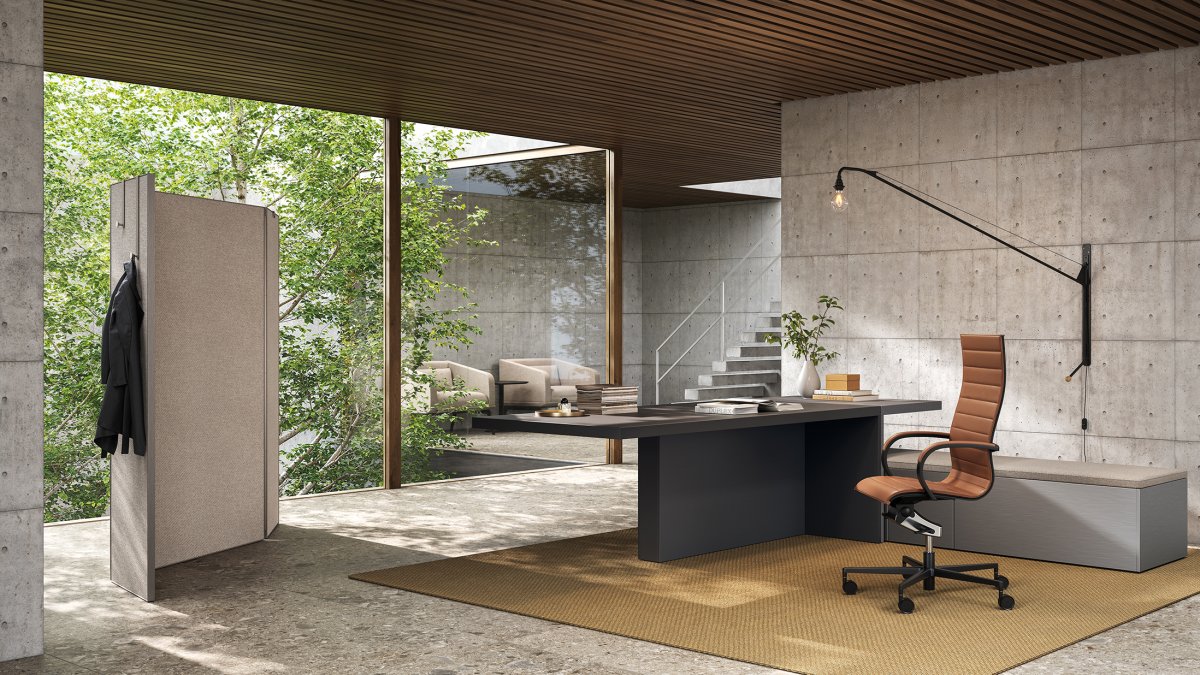
An executive desk is the most eloquent piece of furniture a company owns. Before a single word is spoken in that office, the desk has already introduced its owner — as a modernist, a traditionalist, a collector of beautiful things or a person of quiet efficiency. Italian manufacturers understood this a century ago, which is why their executive collections divide into four great families: modern, design, contemporary and classic. Choosing between them is the real decision — and this is a field guide to making it well.
Four families, four different sentences
Each family says something distinct. The modern executive desk speaks in clean lines and engineered calm: leadership as clarity. The design desk is a signed statement — an architect's or designer's idea you sit behind, for owners who want the room remembered. The contemporary desk balances warmth and rigour, the diplomatic choice that offends no one and ages gracefully. And the classic desk — noble woods, inlays, tradition — speaks of continuity, patrimony, decisions made slowly and kept long. None is superior. But they are not interchangeable: each writes a different opening line for every meeting held in that room.
Start with the room's job, not the catalogue
The decisive question is rarely asked: what does this office actually do? An office that receives clients weekly is a stage, and the desk is its lead actor — the statement families earn their keep there. An office used mostly for deep work and video calls needs ergonomics, cable discipline and a background that behaves on camera more than it needs marble. An office that hosts small meetings needs the desk to cooperate with a table or a lounge corner rather than dominate. Write down the room's real week, and the right family usually names itself.
The desk is a system, not a slab
What separates an executive workplace from a beautiful table is the system around it: the return that carries the screens at working height, the credenza that hides what should be hidden and displays what should not, the storage that keeps the desktop worthy of its finish. Italian collections are built as systems — desk, return, credenza and cabinets drawn by the same hand, in the same finishes. Buying the desk alone and improvising the rest is how handsome offices grow ugly by instalments. Plan the composition once, on one drawing.
Materials, honestly
Every family has its materials — glass and lacquer for the modern, sculptural woods and metals for design pieces, warm veneers for the contemporary, walnut and leather for the classic. Two rules travel across all of them. First, judge finishes on physical samples under your own office lighting, never on a screen. Second, ask for the manufacturer's declared material documentation — real factories describe their veneers, leathers and finishes precisely, and that paperwork is the difference between buying provenance and buying adjectives.
Ordering one, without regrets
Executive desks are made to order: your finish, your dimensions, your composition. So the ordering discipline matters. Measure the room and the route in — some desks arrive in sections by design, but the lift still has opinions. Approve dimensioned drawings before production. Confirm what the delivery includes: to the kerb, to the floor, or assembled in place. And have the manufacturer's declared dimensions and documents attached to the quotation — at La Mercanti this is standard practice, because what the producer has not declared, we do not promise. The four families are all within reach; the discipline is what gets them into the room intact.
Quick answers
What is the difference between a design desk and a modern desk? A modern desk pursues clean, engineered restraint; a design desk is a signed statement piece by a named designer, meant to be remembered. Both are current — they simply say different things about the person behind them.
Which executive desk family suits a client-facing office? The statement families — design and classic — earn their keep where the office is a stage. For deep-work offices, modern and contemporary families usually serve better, with ergonomics and cable discipline first.
Should the desk match the rest of the office? It should converse with it, not match it slavishly. Italian collections solve this with coordinated systems — desk, return, credenza in one hand and one finish palette — so the room reads as composed, not assembled.
Can I see finishes before ordering from Italy? Yes, and you must: physical samples of veneers, leathers and lacquers travel before production and should be judged in your own light. It is a normal part of the process, not a favour.