
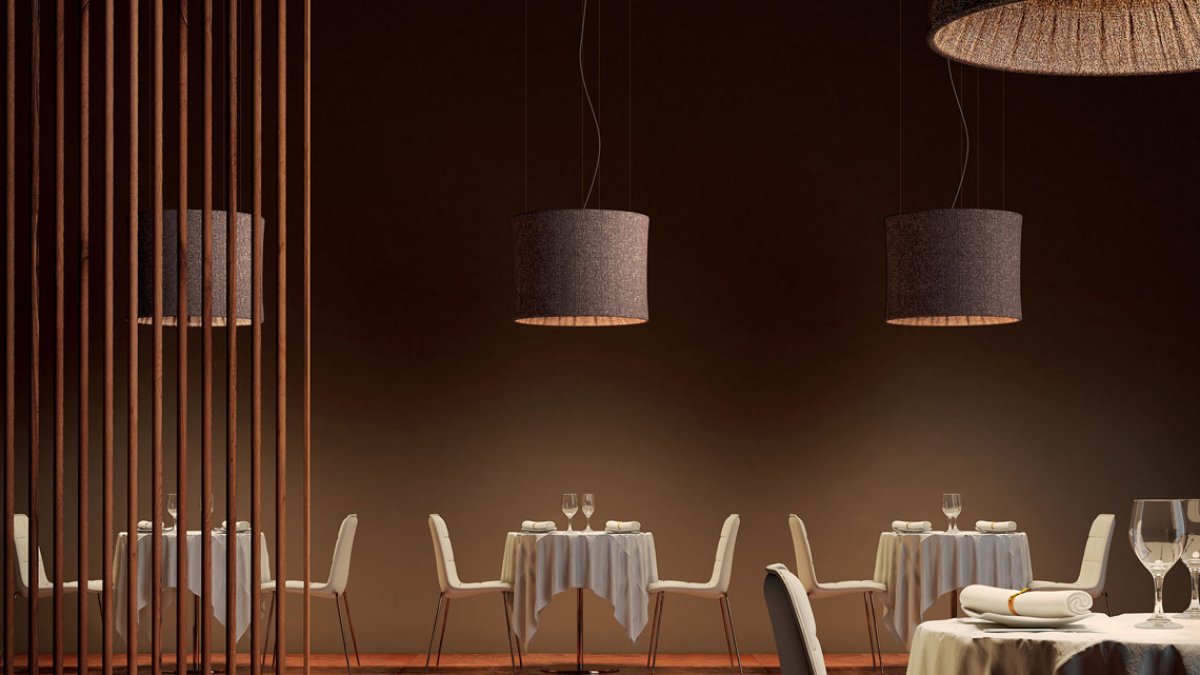
The Health and Safety Executive gives employers two quick tests for a noise problem. The first asks whether the noise is intrusive, "like a busy street, a vacuum cleaner or a crowded restaurant", for most of the working day. The second asks whether staff have to raise their voices to hold a normal conversation when about 2 metres apart. To describe a workplace that needs looking at, the regulator reaches for a dining room.
The Control of Noise at Work Regulations 2005 exist to protect hearing, and their numbers show it: a lower exposure action value of 80 dB(A) as a daily or weekly average, an upper action value of 85 dB(A), and an exposure limit of 87 dB(A). Conversation gives up well before any of those. In the model built by the acoustician Jens Holger Rindel, two people a metre apart can still understand each other sufficiently while the room sits at 71 dB or below. Hong Kong restaurants measured by To and Chung (Noise & Health, 2014) ran at hourly averages from about 67 to 83 dBA, a range that straddles both figures. So my starting point is this: the number of people who can hold a conversation in a room is fixed by its reverberation before it is fixed by the chairs, and reverberation can be measured and specified before anything is bought, in a restaurant and on an open-plan floor alike.
Each voice in a busy room lifts all the others
In 1911 Lombard described, in the Annales des maladies de l'oreille, something every diner has heard without naming it: put a speaker in noise and the voice rises. The Lombard effect still carries his name, and Rindel's review of the measurements gives it a slope. From a background of roughly 45 dB upwards, every 2 dB of extra noise pushes the voice up by about 1 dB.
Now add tables. Each group speaks up to clear the others, the general level climbs, and everyone speaks up again. Rindel calls it a feedback situation. MacLean had already shown in 1959, in the Journal of the Acoustical Society of America, that a party has a maximum number of guests compatible with quiet, and beyond it the party turns loud.
Rindel's own example is the round table for ten. Talking across it, about 2 metres, would need the room at 59 dB at most, so it is often impossible; at 77 dB you can only talk to the person beside you.
Volume divided by twenty times the reverberation
The quantity that ties all this together is the reverberation time, T: how many seconds a sound takes to die away in the room. The longer the tail, the more each voice piles onto the next and the sooner the feedback starts.
Rindel turned it into a back-of-envelope rule he calls acoustic capacity, the largest number of people who can converse at one metre with sufficient quality. It comes to roughly the room volume in cubic metres divided by twenty times T, with T measured in the furnished but unoccupied room at mid frequencies, 500 to 1000 Hz. On his six-step scale, sufficient sits one step above insufficient: the other person's voice may arrive up to 3 dB below the background. For satisfactory conditions he advises staying under half the capacity. Listeners whose hearing is slightly impaired, or who work in a second language, need roughly 3 dB more in hand, and in a Norwegian survey he cites, 52% of people with impaired hearing were severely or much disturbed by noise in canteens, restaurants and cafés.
I ran the rule over three rooms of the kind a fit-out brief lists: a café or meeting suite of 250 m³, a restaurant or staff canteen of 500 m³, and an open-plan floor of 1,000 m³.
250 m³: 10 people at 1.2 seconds, 15 at 0.8 seconds, 25 at 0.5 seconds.
500 m³: 20 people at 1.2 seconds, 31 at 0.8 seconds, 50 at 0.5 seconds.
1,000 m³: 41 people at 1.2 seconds, 62 at 0.8 seconds, 100 at 0.5 seconds.
Read down any column and the cubic metres do the work you would expect. Read across a row and the same room more than doubles its capacity without losing a square metre. Rindel's own pair of halls shows it at full scale: two spaces of almost the same volume, about 2,490 m³, one at 2.5 seconds with a capacity of 50 and the other at 0.8 seconds with 156.
He adds that a full restaurant typically exceeds its acoustic capacity by a factor of two or more, and proposes that seats should not exceed it by more than a quarter and that the figure be displayed at the entrance.
On the open-plan floor the cost is memory
The physics does not change when the tables become desks. In 2005 Banbury and Berry asked 88 employees at two sites what distracted them, and published the answers in Ergonomics: 99% said office noise impaired their concentration, above all telephones left ringing at empty desks and people talking in the background. They found no sign that staff got used to those sounds.
Jahncke and colleagues (2011) put 47 students to work in office noise for two two-hour sessions, one at 39 dB and one at 51 dB. At the higher level they remembered fewer words, left more answers blank, and reported feeling more tired and less motivated, while the other tests did not move. During the break, those who watched a film of a river with its sound reported more energy; staying in the office noise hit motivation harder.
What harms is speech you can follow. In the same researcher's later work, performance fell as the background talk grew more intelligible, and the Speech Transmission Index needed to stay below 0.50 for no harm to show. BS EN ISO 3382-3:2022, the current British edition of the standard for measuring unoccupied open-plan offices, uses that same 0.50 as the edge of its distraction distance, the metres beyond which a colleague's voice drops under that index. It also measures how many decibels speech loses with each doubling of distance. Together those numbers tell you how far a voice travels across a particular layout.
Where the layout cannot give you that distance, the call or the two-person review needs a room of its own, and that is the job of office pods.
Noise reaches the plate as well
For a restaurateur there is a second reason to care. Woods and colleagues, working with Unilever, fed blindfolded volunteers through headphones in silence and in quiet or loud white noise (Food Quality and Preference, 2011). In the loud condition sweetness and saltiness were rated weaker and crunchiness stronger, and how much people liked the noise went together with how much they liked the food. Yan and Dando (2015) gave 48 people solutions of the five basic tastes with and without sound imitating an aircraft cabin: sweet dropped, umami rose, salty, sour and bitter stayed put.
Diners also judge the room. In 2021 Steffens, Wilczek and Weinzierl surveyed 142 guests in twelve Berlin restaurants while measuring level and occupied reverberation; sound level and the pleasantness of the soundscape predicted how good the guests rated the restaurant, with reverberation acting through the level. The authors note a trade-off between comfort and liveliness, which is a fair brief for any designer. Across 112 restaurants in Singapore, Lindborg found the pricier the menu, the quieter the room. None of these studies looked at whether guests come back, and I will not pretend they did.
Absorbing and insulating are separate jobs
The two terms sound alike and describe different work. A sound-absorbing panel takes energy out of the sound inside the room, which shortens the reverberation tail that makes voices add up. Stopping sound passing from one room into the next is sound insulation, a matter of walls and floors with its own standards. For new buildings, and refurbishments that change a building's use, the British Standard giving guidance on noise control, including room acoustics for non-critical situations, is BS 8233:2014.
A panel's absorption is measured in a reverberation chamber under ISO 354 and reduced to one figure, the weighted sound absorption coefficient αw, under ISO 11654. The same figure places the product in a class from A, the most absorbent, down to E. The classes are wide and give only an approximate picture, so on the data sheet read the αw value itself and the area the panels will cover.
Five numbers to have before you order panels
1. Volume: length times width times height, in cubic metres.
2. Reverberation time in the furnished, empty room at 500 to 1000 Hz, taken by an acoustic consultant.
3. Peak headcount and what those people are doing: dining in groups, phoning, concentrating.
4. Target reverberation, worked back from the rule: if 50 people must talk in 500 m³, T has to come down to about 0.5 seconds.
5. αw and area of the panels needed to get there.
With those on paper, the design choice gets easier and more enjoyable, because acoustics is chosen with the eye as well. Among the acoustics and workplace privacy solutions from the brands we work with, αw narrows the field and taste picks between products doing the same job. If you are planning a room with us, send the volume and the measured reverberation first; everything else is built on those two lines.
The HSE's crowded restaurant is a fair yardstick for hearing. For conversation, the yardstick is the second figure on the consultant's report.
Quick answers
What is the acoustic capacity of a room?
It is the largest number of people who can hold a conversation at one metre with sufficient quality, meaning ambient noise of no more than 71 dB. On Jens Holger Rindel's rule, take the volume in m³ and divide it by 20 × T, where T is the reverberation time of the furnished, unoccupied room.
Do the UK noise at work rules cover restaurant and office chatter?
They apply to all industry sectors in Great Britain, but they are written to protect hearing, with action values of 80 and 85 dB(A) and a limit of 87 dB(A). Conversation becomes difficult at lower levels: in Rindel's model sufficient communication at one metre needs ambient noise of 71 dB or below.
How are open-plan offices measured acoustically?
BS EN ISO 3382-3:2022 measures unoccupied open-plan offices with single-number quantities for one person speaking, including the distraction distance, where the Speech Transmission Index of a voice falls below 0.50, and the decibels speech loses per doubling of distance.
How does sound absorption differ from sound insulation?
Absorption reduces reverberation inside a room and is rated by αw (ISO 354 and ISO 11654, classes A to E). Insulation limits sound travelling between rooms through walls and floors and is a separate set of requirements.